



 Chat with AI
Exam 36: Diffraction

Exam 1: Measurement37 Questions
Exam 2: Motion Along a Straight Line90 Questions
Exam 3: Vector37 Questions
Exam 4: Motion in Two and Three Dimensions56 Questions
Exam 5: Force and Motion I73 Questions
Exam 6: Force and Motion II74 Questions
Exam 7: Kinetic Energy and Work73 Questions
Exam 8: Potential Energy and Conservation of Energy63 Questions
Exam 9: Center of Mass and Linear Momentum99 Questions
Exam 10: Rotation102 Questions
Exam 11: Rolling, Torque, and Angular Momentum66 Questions
Exam 12: Equilibrium and Elasticity57 Questions
Exam 13: Gravitation55 Questions
Exam 14: Fluids88 Questions
Exam 15: Oscillations75 Questions
Exam 16: Waves I82 Questions
Exam 17: Waves II71 Questions
Exam 18: Temperature, Heat, and the First Law of Thermodynamics96 Questions
Exam 19: The Kinetic Theory of Gases113 Questions
Exam 20: Entropy and the Second Law of Thermodynamics61 Questions
Exam 21: Electric Charge52 Questions
Exam 22: Electric Fields55 Questions
Exam 23: Gauss Law38 Questions
Exam 24: Electric Potential52 Questions
Exam 25: Capacitance61 Questions
Exam 26: Current and Resistance55 Questions
Exam 27: Circuits73 Questions
Exam 28: Magnetic Fields55 Questions
Exam 29: Magnetic Fields Due to Currents49 Questions
Exam 30: Induction and Inductance90 Questions
Exam 31: Electromagnetic Oscillations and Alternating Current88 Questions
Exam 32: Maxwells Equations; Magnetism of Matter81 Questions
Exam 33: Electromagnetic Waves83 Questions
Exam 34: Images79 Questions
Exam 35: Interference46 Questions
Exam 36: Diffraction77 Questions
Exam 37: Relativity68 Questions
Exam 38: Photons and Matter Waves57 Questions
Exam 39: More About Matter Waves41 Questions
Exam 40: All About Atoms79 Questions
Exam 41: Conduction of Electricity in Solids51 Questions
Exam 42: Nuclear Physics68 Questions
Exam 43: Energy From the Nucleus50 Questions
Exam 44: Quarks, Leptons, and the Big Bang55 Questions
Select questions type


When 450-nm light is incident normally on a certain double-slit system the number of interference maxima within the central diffraction maximum is 5. When 900-nm light is incident on the same slit system the number is:
(Multiple Choice)
4.8/5  (78)
(78) A beam of x rays of wavelength 0.10 nm is found to diffract in second order from the face of a LiF crystal at a Bragg angle of 30 . The distance between adjacent crystal planes is about:
(Multiple Choice)
4.8/5 (82)
(82) In a double-slit diffraction experiment the number of interference fringes within the central diffraction maximum can be increased by:
(Multiple Choice)
4.9/5 (90)
(90) An N-slit system has slit separation d and slit width a. Plane waves with intensity I and wavelength are incident normally on it. The angular separation of the lines depends only on:
(Multiple Choice)
4.9/5 (76)
(76) As more slits with the same spacing are added to a multiple-slit system the lines:
(Multiple Choice)
4.8/5 (79)
(79) Light of wavelength 550 nm is incident on a diffraction grating that is 1 cm wide and has 1000 slits. What is the dispersion of the m = 2 line?
(Multiple Choice)
4.8/5 (98)
(98) At a bright diffraction line phasors associated with waves from the slits of a multiple-slit barrier:
(Multiple Choice)
4.9/5 (67)
(67) A diffraction pattern is produced on a viewing screen by illuminating a long narrow slit with light of wavelength . If the slit width is decreased and no other changes are made:
(Multiple Choice)
4.7/5 (90)
(90) Radio waves are readily diffracted around buildings whereas light waves are negligibly diffracted around buildings. This is because radio waves:
(Multiple Choice)
4.8/5 (82)
(82) When a highly coherent beam of light is directed against a very fine wire, the shadow formed behind it is not just that of a single wire but rather looks like the shadow of several parallel wires. The explanation of this involves:
(Multiple Choice)
4.9/5 (81)
(81) A person with her eye relaxed looks through a diffraction grating at a distant monochromatic point source of light. The slits of the grating are vertical. She sees:
(Multiple Choice)
4.9/5 (81)
(81) A diffraction pattern is produced on a viewing screen by illuminating a long narrow slit with light of wavelength . If is increased and no other changes are made:
(Multiple Choice)
4.7/5 (97)
(97) The diagram shows a single slit with the direction to a point P on a distant screen (not shown). At P, the pattern has its second minimum (from its central maximum). If X and Y are the edges of the slit, what is the path length difference (PX) - (PY)? 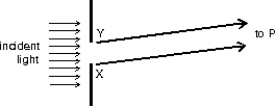
(Multiple Choice)
4.8/5 (88)
(88) A beam of white light (from 400 nm for violet to 700 nm for red) is normally incident on a diffraction grating. It produces two orders on a distant screen. Which diagram below (R = red, V = violet) correctly shows the pattern on the screen? 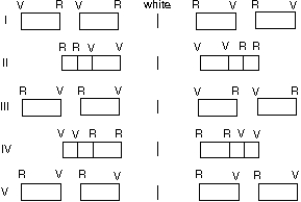
(Multiple Choice)
4.8/5 (84)
(84) Two slits of width a and separation d are illuminated by a beam of light of wavelength . The separation of the interference fringes on a screen a distance D away is:
(Multiple Choice)
4.9/5 (81)
(81) Which of the following is true for Bragg diffraction but not for diffraction from a grating?
(Multiple Choice)
4.9/5 (65)
(65) A diffraction grating of width W produces a deviation in second order for light of wavelength . The total number N of slits in the grating is given by:
(Multiple Choice)
4.9/5 (75)
(75) Light of wavelength 480 nm falls on a slit of width 3.5 µm. What is the relative intensity (that is, the value of I/Im) of the diffraction pattern at an angle of 18°?
(Multiple Choice)
4.8/5 (76)
(76) Light of wavelength is normally incident on some plane optical device. The intensity pattern shown is observed on a distant screen ( is the angle measured to the normal of the device). The device could be: 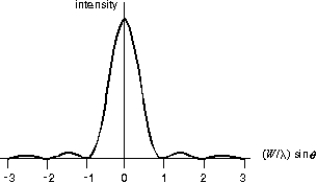
(Multiple Choice)
4.8/5 (76)
(76) 
Filters
- Essay(0)
- Multiple Choice(0)
- Short Answer(0)
- True False(0)
- Matching(0)