



 Chat with AI
Exam 36: Diffraction

Exam 1: Measurement37 Questions
Exam 2: Motion Along a Straight Line90 Questions
Exam 3: Vector37 Questions
Exam 4: Motion in Two and Three Dimensions56 Questions
Exam 5: Force and Motion I73 Questions
Exam 6: Force and Motion II74 Questions
Exam 7: Kinetic Energy and Work73 Questions
Exam 8: Potential Energy and Conservation of Energy63 Questions
Exam 9: Center of Mass and Linear Momentum99 Questions
Exam 10: Rotation102 Questions
Exam 11: Rolling, Torque, and Angular Momentum66 Questions
Exam 12: Equilibrium and Elasticity57 Questions
Exam 13: Gravitation55 Questions
Exam 14: Fluids88 Questions
Exam 15: Oscillations75 Questions
Exam 16: Waves I82 Questions
Exam 17: Waves II71 Questions
Exam 18: Temperature, Heat, and the First Law of Thermodynamics96 Questions
Exam 19: The Kinetic Theory of Gases113 Questions
Exam 20: Entropy and the Second Law of Thermodynamics61 Questions
Exam 21: Electric Charge52 Questions
Exam 22: Electric Fields55 Questions
Exam 23: Gauss Law38 Questions
Exam 24: Electric Potential52 Questions
Exam 25: Capacitance61 Questions
Exam 26: Current and Resistance55 Questions
Exam 27: Circuits73 Questions
Exam 28: Magnetic Fields55 Questions
Exam 29: Magnetic Fields Due to Currents49 Questions
Exam 30: Induction and Inductance90 Questions
Exam 31: Electromagnetic Oscillations and Alternating Current88 Questions
Exam 32: Maxwells Equations; Magnetism of Matter81 Questions
Exam 33: Electromagnetic Waves83 Questions
Exam 34: Images79 Questions
Exam 35: Interference46 Questions
Exam 36: Diffraction77 Questions
Exam 37: Relativity68 Questions
Exam 38: Photons and Matter Waves57 Questions
Exam 39: More About Matter Waves41 Questions
Exam 40: All About Atoms79 Questions
Exam 41: Conduction of Electricity in Solids51 Questions
Exam 42: Nuclear Physics68 Questions
Exam 43: Energy From the Nucleus50 Questions
Exam 44: Quarks, Leptons, and the Big Bang55 Questions
Select questions type


A student wishes to produce a single-slit diffraction pattern in a ripple tank experiment. He considers the following parameters: 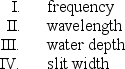 Which two of the above should be decreased to produce more bending?
 (Multiple Choice)
4.8/5  (85)
(85) A light beam incident on a diffraction grating consists of waves with two different wavelengths. The separation of the two first order lines is great if:
(Multiple Choice)
4.9/5 (97)
(97) A point source of monochromatic light is placed in front of a soccer ball and a screen is placed behind the ball. The light intensity pattern on the screen is best described as:
(Multiple Choice)
4.7/5 (83)
(83) Bragg's law for x-ray diffraction is 2d sin = m . The quantity d is:
(Multiple Choice)
4.9/5 (83)
(83) If 550-nm light is incident normally on a diffraction grating and exactly 6 lines are produced, the ruling separation must be:
(Multiple Choice)
5.0/5 (65)
(65) Bragg's law for x-ray diffraction is 2d sin = m , where is the angle between the incident beam and:
(Multiple Choice)
4.8/5 (87)
(87) 600-nm light is incident on a diffraction grating with a ruling separation of 1.7*10-6 m. The second order line occurs at a diffraction angle of:
(Multiple Choice)
4.8/5 (71)
(71) At the second minimum adjacent to the central maximum of a single-slit diffraction pattern the Huygens wavelet from the top of the slit is 180 out of phase with the wavelet from:
(Multiple Choice)
4.9/5 (78)
(78) Figure (i) shows a double-slit pattern obtained using monochromatic light. Consider the following five possible changes in conditions: 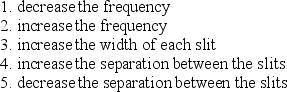 Which of the above would change Figure (i) into Figure (ii)?
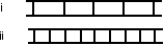
Which of the above would change Figure (i) into Figure (ii)? (Multiple Choice)
4.9/5 (66)
(66) The resolving power of a diffraction grating is defined by R = / . Here and + are:
(Multiple Choice)
4.9/5 (66)
(66) Diffraction plays an important role in which of the following phenomena?
(Multiple Choice)
4.8/5 (82)
(82) Monochromatic light is normally incident on a diffraction grating that is 1 cm wide and has 10,000 slits. The first order line is deviated at a 30 angle. What is the wavelength of the incident light?
(Multiple Choice)
4.9/5 (78)
(78) The largest x-ray wavelength that can be diffracted by crystal planes with a separation of 0.316 nm is:
(Multiple Choice)
4.9/5 (81)
(81) The diagram shows a single slit with the direction to a point P on a distant screen (not shown). At P, the pattern has its maximum nearest the central maximum. If X and Y are the edges of the slit, what is the path length difference (PX) - (PY)? 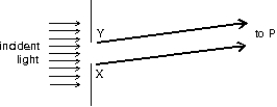
(Multiple Choice)
4.7/5 (69)
(69) The intensity at a secondary maximum of a single-slit diffraction pattern is less than the intensity at the central maximum chiefly because:
(Multiple Choice)
4.8/5 (84)
(84) Two nearly equal wavelengths of light are incident on an N slit grating. The two wavelengths are not resolvable. When N is increased they become resolvable. This is because:
(Multiple Choice)
4.8/5 (77)
(77) 
Filters
- Essay(0)
- Multiple Choice(0)
- Short Answer(0)
- True False(0)
- Matching(0)