



 Chat with AI
Exam 36: Diffraction

Exam 1: Measurement37 Questions
Exam 2: Motion Along a Straight Line90 Questions
Exam 3: Vector37 Questions
Exam 4: Motion in Two and Three Dimensions56 Questions
Exam 5: Force and Motion I73 Questions
Exam 6: Force and Motion II74 Questions
Exam 7: Kinetic Energy and Work73 Questions
Exam 8: Potential Energy and Conservation of Energy63 Questions
Exam 9: Center of Mass and Linear Momentum99 Questions
Exam 10: Rotation102 Questions
Exam 11: Rolling, Torque, and Angular Momentum66 Questions
Exam 12: Equilibrium and Elasticity57 Questions
Exam 13: Gravitation55 Questions
Exam 14: Fluids88 Questions
Exam 15: Oscillations75 Questions
Exam 16: Waves I82 Questions
Exam 17: Waves II71 Questions
Exam 18: Temperature, Heat, and the First Law of Thermodynamics96 Questions
Exam 19: The Kinetic Theory of Gases113 Questions
Exam 20: Entropy and the Second Law of Thermodynamics61 Questions
Exam 21: Electric Charge52 Questions
Exam 22: Electric Fields55 Questions
Exam 23: Gauss Law38 Questions
Exam 24: Electric Potential52 Questions
Exam 25: Capacitance61 Questions
Exam 26: Current and Resistance55 Questions
Exam 27: Circuits73 Questions
Exam 28: Magnetic Fields55 Questions
Exam 29: Magnetic Fields Due to Currents49 Questions
Exam 30: Induction and Inductance90 Questions
Exam 31: Electromagnetic Oscillations and Alternating Current88 Questions
Exam 32: Maxwells Equations; Magnetism of Matter81 Questions
Exam 33: Electromagnetic Waves83 Questions
Exam 34: Images79 Questions
Exam 35: Interference46 Questions
Exam 36: Diffraction77 Questions
Exam 37: Relativity68 Questions
Exam 38: Photons and Matter Waves57 Questions
Exam 39: More About Matter Waves41 Questions
Exam 40: All About Atoms79 Questions
Exam 41: Conduction of Electricity in Solids51 Questions
Exam 42: Nuclear Physics68 Questions
Exam 43: Energy From the Nucleus50 Questions
Exam 44: Quarks, Leptons, and the Big Bang55 Questions
Select questions type


The widths of the lines produced by monochromatic light falling on a diffraction grating can be reduced by:

Free
(Multiple Choice)
4.9/5  (81)
(81) Correct Answer: Verified
B
A diffraction grating just resolves the wavelengths 400.0 nm and 400.1 nm in first order. The number of slits in the grating is:
Free
(Multiple Choice)
4.8/5 (71)
(71) Correct Answer:Verified
VerifiedD
No fringes are seen in a single-slit diffraction pattern if:
Free
(Multiple Choice)
4.7/5 (70)
(70) Correct Answer:Verified
VerifiedC
Light of wavelength is normally incident on a diffraction grating G. On the screen S, the central line is at P and the first order line is at Q, as shown. The distance between adjacent slits in the grating is: 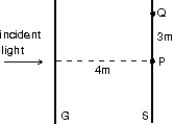
(Multiple Choice)
4.9/5 (82)
(82) An x-ray beam of wavelength 3 *10-11 m is incident on a calcite crystal of lattice spacing 0.3 nm. The smallest angle between crystal planes and the x-ray beam which will result in constructive interference is:
(Multiple Choice)
4.9/5 (68)
(68) If we increase the wavelength of the light used to form a double-slit diffraction pattern:
(Multiple Choice)
4.7/5 (84)
(84) A plane wave with a wavelength of 500 nm is incident normally on a single slit with a width of 5.0*10-6 m. Consider waves that reach a point on a far-away screen such that rays from the slit make an angle of 1.0 with the normal. The difference in phase for waves from the top and bottom of the slit is:
(Multiple Choice)
4.9/5 (78)
(78) In a single-slit diffraction pattern, the central maximum is about twice as wide as the other maxima. This is because:
(Multiple Choice)
5.0/5 (79)
(79) Two wavelengths, 800 nm and 600 nm, are used separately in single-slit diffraction experiments. The diagram shows the intensities on a far-away viewing screen as function of the angle made by the rays with the straight-ahead direction. If both wavelengths are then used simultaneously, which point corresponds to the smallest angle at which the light on the screen is purely 800-nm light? 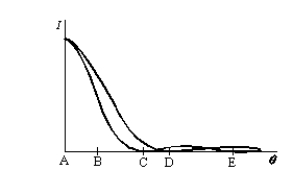
(Multiple Choice)
4.8/5 (92)
(92) The intensity of the single-slit diffraction pattern at any angle θ is given by . For light of wavelength 480 nm falling on a slit of width 3.5 µm, what is the value of α when θ = 18°?
(Multiple Choice)
4.8/5 (79)
(79) What is the minimum number of slits required in a diffraction grating to just resolve light with wavelengths of 471.0 nm and 471.6 nm?
(Multiple Choice)
4.8/5 (57)
(57) A light spectrum is formed on a screen using a diffraction grating. The entire apparatus (source, grating and screen) is now immersed in a liquid of index 1.33. As a result, the pattern on the screen:
(Multiple Choice)
4.8/5 (81)
(81) Consider a single-slit diffraction pattern caused by a slit of width a. There is a minimum at sin equal to:
(Multiple Choice)
4.9/5 (83)
(83) A parallel beam of monochromatic light is incident on a slit of width 2 cm. The light passing through the slit falls on a screen 2 m away. As the slit width is decreased:
(Multiple Choice)
4.8/5 (77)
(77) Light of wavelength 550 nm is incident on a diffraction grating that is 1 cm wide and has 1000 slits. What is the half-width of the m = 1 line?
(Multiple Choice)
5.0/5 (75)
(75) A beam of x-rays of wavelength 0.20 nm is diffracted by a set of planes in a crystal whose separation is 3.1 *10-8 cm. The smallest angle between the beam and the crystal planes for which a reflection occurs is:
(Multiple Choice)
4.9/5 (76)
(76) 
Filters
- Essay(0)
- Multiple Choice(0)
- Short Answer(0)
- True False(0)
- Matching(0)