



 Chat with AI
Exam 2: Motion Along a Straight Line

Exam 1: Measurement31 Questions
Exam 2: Motion Along a Straight Line79 Questions
Exam 3: Vector39 Questions
Exam 4: Motion in Two and Three Dimensions47 Questions
Exam 5: Force and Motion I68 Questions
Exam 6: Force and Motion II71 Questions
Exam 7: Kinetic Energy and Work67 Questions
Exam 8: Potential Energy and Conservation of Energy61 Questions
Exam 9: Center of Mass and Linear Momentum81 Questions
Exam 10: Rotation82 Questions
Exam 11: Rolling, Torque, and Angular Momentum54 Questions
Exam 12: Equilibrium and Elasticity53 Questions
Exam 13: Gravitation55 Questions
Exam 14: Fluids85 Questions
Exam 15: Oscillations62 Questions
Exam 16: Waves I71 Questions
Exam 17: Waves II61 Questions
Exam 18: Temperature, Heat, and the First Law of Thermodynamics82 Questions
Exam 19: The Kinetic Theory of Gases95 Questions
Exam 20: Entropy and the Second Law of Thermodynamics56 Questions
Exam 21: Electric Charge45 Questions
Exam 22: Electric Fields49 Questions
Exam 23: Gauss Law34 Questions
Exam 24: Electric Potential44 Questions
Exam 25: Capacitance55 Questions
Exam 26: Current and Resistance49 Questions
Exam 27: Circuits70 Questions
Exam 28: Magnetic Fields48 Questions
Exam 29: Magnetic Fields Due to Currents47 Questions
Exam 30: Induction and Inductance85 Questions
Exam 31: Electromagnetic Oscillations and Alternating Current84 Questions
Exam 32: Maxwells Equations; Magnetism of Matter81 Questions
Exam 33: Electromagnetic Waves79 Questions
Exam 34: Images72 Questions
Exam 35: Interference40 Questions
Exam 36: Diffraction74 Questions
Exam 37: Relativity65 Questions
Exam 38: Photons and Matter Waves53 Questions
Exam 39: More About Matter Waves41 Questions
Exam 40: All About Atoms76 Questions
Exam 41: Conduction of Electricity in Solids48 Questions
Exam 42: Nuclear Physics67 Questions
Exam 43: Energy From the Nucleus44 Questions
Exam 44: Quarks, Leptons, and the Big Bang52 Questions
Select questions type


An object is thrown straight up from ground level with a speed of 50 m/s. If g = 10 m/s2 its distance above ground level 1.0 second later is:
(Multiple Choice)
4.8/5  (83)
(83) Which one of the following statements is correct for an object released from rest?
(Multiple Choice)
5.0/5 (93)
(93) A car accelerates from rest on a straight road. A short time later, the car decelerates to a stop and then returns to its original position in a similar manner, by speeding up and then slowing to a stop. Which of the following five coordinate versus time graphs best describes the motion? 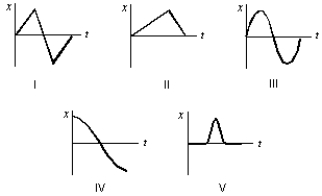
(Multiple Choice)
4.9/5 (68)
(68) At a stop light, a truck traveling at 15 m/s passes a car as it starts from rest. The truck travels at constant velocity and the car accelerates at 3 m/s2. How much time does the car take to catch up to the truck?
(Multiple Choice)
4.9/5 (82)
(82) A projectile is shot vertically upward with a given initial velocity. It reaches a maximum height of 100 m. If, on a second shot, the initial velocity is doubled then the projectile will reach a maximum height of:
(Multiple Choice)
4.8/5 (66)
(66) A car starts from Hither, goes 50 km in a straight line to Yon, immediately turns around, and returns to Hither. The time for this round trip is 2 hours. The average speed of the car for this round trip is:
(Multiple Choice)
5.0/5 (81)
(81) A car, initially at rest, travels 20 m in 4 s along a straight line with constant acceleration. The acceleration of the car is:
(Multiple Choice)
4.9/5 (78)
(78) At a location where g = 9.80 m/s2, an object is thrown vertically down with an initial speed of 1.00 m/s. After 5.00 s the object will have traveled:
(Multiple Choice)
4.8/5 (86)
(86) A stone is released from rest from the edge of a building roof 190 m above the ground. Neglecting air resistance, the speed of the stone, just before striking the ground, is:
(Multiple Choice)
4.8/5 (94)
(94) An object is thrown vertically upward at 35 m/s. Taking g = 10 m/s2, the velocity of the object 5 seconds later is:
(Multiple Choice)
4.8/5 (74)
(74) An object has a constant acceleration of 3 m/s2. The displacement versus time graph for this object has a slope:
(Multiple Choice)
4.9/5 (86)
(86) The coordinate of an object is given as a function of time by x = 4t2 - 3t3, where x is in meters and t is in seconds. Its average acceleration over the interval from t = 0 to t = 2 s is:
(Multiple Choice)
4.8/5 (71)
(71) A car accelerates from rest on a straight road. A short time later, the car decelerates to a stop and then returns to its original position in a similar manner, by speeding up and then slowing to a stop. Which of the following five coordinate versus time graphs best describes the motion? 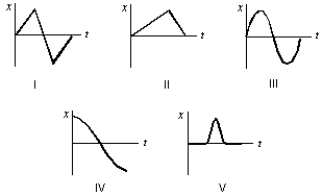
(Multiple Choice)
4.8/5 (86)
(86) Over a short interval, starting at time t = 0, the coordinate of an automobile in meters is given by x(t) = 27t - 4.0t3, where t is in seconds. The magnitudes of the initial (at t = 0) velocity and acceleration of the auto respectively are:
(Multiple Choice)
4.8/5 (78)
(78) The coordinate of an object is given as a function of time by x = 7t - 3t2, where x is in meters and t is in seconds. Its average velocity over the interval from t = 0 to t = 2 s is:
(Multiple Choice)
5.0/5 (76)
(76) A ball is in free fall. Upward is taken to be the positive direction. The displacement of the ball is:
(Multiple Choice)
4.9/5 (81)
(81) The coordinate-time graph of an object is a straight line with a positive slope. The object has:
(Multiple Choice)
4.9/5 (68)
(68) A heavy ball falls freely, starting from rest. Between the third and fourth second of time it travels a distance of:
(Multiple Choice)
4.8/5 (75)
(75) A baseball is thrown vertically into the air. The acceleration of the ball at its highest point is:
(Multiple Choice)
5.0/5 (78)
(78) 
Filters
- Essay(0)
- Multiple Choice(0)
- Short Answer(0)
- True False(0)
- Matching(0)