



 Chat with AI
Exam 7: Kinetic Energy and Work

Exam 1: Measurement31 Questions
Exam 2: Motion Along a Straight Line79 Questions
Exam 3: Vector39 Questions
Exam 4: Motion in Two and Three Dimensions47 Questions
Exam 5: Force and Motion I68 Questions
Exam 6: Force and Motion II71 Questions
Exam 7: Kinetic Energy and Work67 Questions
Exam 8: Potential Energy and Conservation of Energy61 Questions
Exam 9: Center of Mass and Linear Momentum81 Questions
Exam 10: Rotation82 Questions
Exam 11: Rolling, Torque, and Angular Momentum54 Questions
Exam 12: Equilibrium and Elasticity53 Questions
Exam 13: Gravitation55 Questions
Exam 14: Fluids85 Questions
Exam 15: Oscillations62 Questions
Exam 16: Waves I71 Questions
Exam 17: Waves II61 Questions
Exam 18: Temperature, Heat, and the First Law of Thermodynamics82 Questions
Exam 19: The Kinetic Theory of Gases95 Questions
Exam 20: Entropy and the Second Law of Thermodynamics56 Questions
Exam 21: Electric Charge45 Questions
Exam 22: Electric Fields49 Questions
Exam 23: Gauss Law34 Questions
Exam 24: Electric Potential44 Questions
Exam 25: Capacitance55 Questions
Exam 26: Current and Resistance49 Questions
Exam 27: Circuits70 Questions
Exam 28: Magnetic Fields48 Questions
Exam 29: Magnetic Fields Due to Currents47 Questions
Exam 30: Induction and Inductance85 Questions
Exam 31: Electromagnetic Oscillations and Alternating Current84 Questions
Exam 32: Maxwells Equations; Magnetism of Matter81 Questions
Exam 33: Electromagnetic Waves79 Questions
Exam 34: Images72 Questions
Exam 35: Interference40 Questions
Exam 36: Diffraction74 Questions
Exam 37: Relativity65 Questions
Exam 38: Photons and Matter Waves53 Questions
Exam 39: More About Matter Waves41 Questions
Exam 40: All About Atoms76 Questions
Exam 41: Conduction of Electricity in Solids48 Questions
Exam 42: Nuclear Physics67 Questions
Exam 43: Energy From the Nucleus44 Questions
Exam 44: Quarks, Leptons, and the Big Bang52 Questions
Select questions type


Which of the following bodies has the largest kinetic energy?
(Multiple Choice)
4.8/5  (85)
(85) A particle moving along the x axis is acted upon by a single force F = F0e-kx, where F0 and k are constants. The particle is released from rest at x = 0. It will attain a maximum kinetic energy of:
(Multiple Choice)
4.7/5 (77)
(77) At time t = 0 a particle starts moving along the x axis. If its kinetic energy increases uniformly with t the net force acting on it must be:
(Multiple Choice)
4.8/5 (80)
(80) When a certain rubber band is stretched a distance x, it exerts a restoring force of magnitude F = Ax, where A is a constant. The work done by a person in stretching this rubber band from x = 0 to x = L is:
(Multiple Choice)
4.9/5 (94)
(94) A particle moves 5 m in the positive x direction while being acted upon by a constant force  The work done on the particle by this force is:
 (Multiple Choice)
4.8/5 (81)
(81) The amount of work required to stop a moving object is equal to the:
(Multiple Choice)
4.8/5 (91)
(91) An ideal spring is hung vertically from the ceiling. When a 2.0-kg mass hangs at rest from it the spring is extended 6.0 cm from its relaxed length. A downward external force is now applied to the mass to extend the spring an additional 10 cm. While the spring is being extended by the force, the work done by the spring is:
(Multiple Choice)
4.9/5 (69)
(69) A sledge (including load) weighs 5000 N. It is pulled on level snow by a dog team exerting a horizontal force on it. The coefficient of kinetic friction between sledge and snow is 0.05. How much work is done by the dog team pulling the sledge 1000 m at constant speed?
(Multiple Choice)
4.9/5 (67)
(67) An 8-N block slides down an incline. It has an initial speed of 7 m/s. The work done by the resultant force on this block is:
(Multiple Choice)
4.8/5 (89)
(89) A man pushes an 80-N crate a distance of 5.0 m upward along a frictionless slope that makes an angle of 30 ° with the horizontal. His force is parallel to the slope. If the speed of the crate decreases at a rate of 1.5 m/s2, then the work done by the mand is:
(Multiple Choice)
4.9/5 (89)
(89) A man pushes an 80-N crate a distance of 5.0 m upward along a frictionless slope that makes an angle of 30 ° with the horizontal. The force he exerts is parallel to the slope. If the speed of the crate is constant, then the work done by the man is:
(Multiple Choice)
4.9/5 (80)
(80) Which of the following groups does NOT contain a scalar quantity?
(Multiple Choice)
4.8/5 (61)
(61) A person holds a 80-N weight 2 m above the floor for 30 seconds. The power required to do this is:
(Multiple Choice)
4.8/5 (74)
(74) Which of the following five quantities is NOT an expression for energy? Here m is a mass, g is the acceleration due to gravity, h and d are distances, F is a force, v is a speed, a is an acceleration, P is power, and t is time.
(Multiple Choice)
4.7/5 (72)
(72) When a certain rubber band is stretched a distance x, it exerts a restoring force F = ax + bx2, where a and b are constants. The work done in stretching this rubber band from x = 0 to x = L is:
(Multiple Choice)
4.8/5 (75)
(75) A 4-kg cart starts up an incline with a speed of 3 m/s and comes to rest 2 m up the incline. The total work done on the cart is:
(Multiple Choice)
4.9/5 (70)
(70) Three identical springs (X,Y,Z) are arranged as shown. When a 4.0-kg mass is hung on X, the mass descends 3.0 cm. When a 6.0-kg mass is hung on Y, the mass descends: 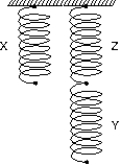
(Multiple Choice)
4.9/5 (81)
(81) The weight of an object on the moon is one-sixth of its weight on the Earth. The ratio of the kinetic energy of a body on the Earth moving with speed V to that of the same body moving with speed V on the moon is:
(Multiple Choice)
4.8/5 (88)
(88) A 50-N force on is the only force a 2-kg crate that starts from rest. At the instant the object has gone 2 m the rate at which the force is doing work is:
(Multiple Choice)
4.8/5 (88)
(88) 
Filters
- Essay(0)
- Multiple Choice(0)
- Short Answer(0)
- True False(0)
- Matching(0)