



 Chat with AI
Exam 8: Potential Energy and Conservation of Energy

Exam 1: Measurement31 Questions
Exam 2: Motion Along a Straight Line79 Questions
Exam 3: Vector39 Questions
Exam 4: Motion in Two and Three Dimensions47 Questions
Exam 5: Force and Motion I68 Questions
Exam 6: Force and Motion II71 Questions
Exam 7: Kinetic Energy and Work67 Questions
Exam 8: Potential Energy and Conservation of Energy61 Questions
Exam 9: Center of Mass and Linear Momentum81 Questions
Exam 10: Rotation82 Questions
Exam 11: Rolling, Torque, and Angular Momentum54 Questions
Exam 12: Equilibrium and Elasticity53 Questions
Exam 13: Gravitation55 Questions
Exam 14: Fluids85 Questions
Exam 15: Oscillations62 Questions
Exam 16: Waves I71 Questions
Exam 17: Waves II61 Questions
Exam 18: Temperature, Heat, and the First Law of Thermodynamics82 Questions
Exam 19: The Kinetic Theory of Gases95 Questions
Exam 20: Entropy and the Second Law of Thermodynamics56 Questions
Exam 21: Electric Charge45 Questions
Exam 22: Electric Fields49 Questions
Exam 23: Gauss Law34 Questions
Exam 24: Electric Potential44 Questions
Exam 25: Capacitance55 Questions
Exam 26: Current and Resistance49 Questions
Exam 27: Circuits70 Questions
Exam 28: Magnetic Fields48 Questions
Exam 29: Magnetic Fields Due to Currents47 Questions
Exam 30: Induction and Inductance85 Questions
Exam 31: Electromagnetic Oscillations and Alternating Current84 Questions
Exam 32: Maxwells Equations; Magnetism of Matter81 Questions
Exam 33: Electromagnetic Waves79 Questions
Exam 34: Images72 Questions
Exam 35: Interference40 Questions
Exam 36: Diffraction74 Questions
Exam 37: Relativity65 Questions
Exam 38: Photons and Matter Waves53 Questions
Exam 39: More About Matter Waves41 Questions
Exam 40: All About Atoms76 Questions
Exam 41: Conduction of Electricity in Solids48 Questions
Exam 42: Nuclear Physics67 Questions
Exam 43: Energy From the Nucleus44 Questions
Exam 44: Quarks, Leptons, and the Big Bang52 Questions
Select questions type


The potential energy of a 0.20-kg particle moving along the x axis is given by U(x) =(8.0J/m2)x2 + (2.0J/m4)x4.
When the particle is at x = 1.0 m its magnituede of its acceleration is:
(Multiple Choice)
4.9/5  (84)
(84) A 0.75-kg block slides on a rough horizontal table top. Just before it hits a horizontal ideal spring its speed is 3.5 m/s. It compresses the spring 5.7 cm before coming to rest. If the spring constant is 1200 N/m, the thermal energy of the block and the table top must have:
(Multiple Choice)
4.8/5 (73)
(73) The first graph shows the potential energy U(x) for a particle moving on the x axis. Which of the following five graphs correctly gives the force F exerted on the particle? 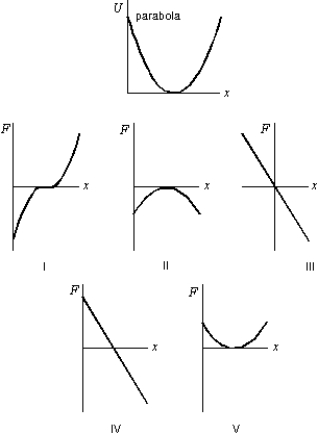
(Multiple Choice)
4.8/5 (74)
(74) A 0.50-kg block attached to an ideal spring with a spring constant of 80 N/m oscillates on a horizontal frictionless surface. The total mechanical energy is 0.12 J. The greatest extension of the spring from its equilibrium length is:
(Multiple Choice)
4.7/5 (74)
(74) A 25-g ball is released from rest 80 m above the surface of the Earth. During the fall the total thermal energy of the ball and air increases by15 J. Just before it hits the surface its speed is
(Multiple Choice)
4.8/5 (78)
(78) A 5-kg projectile is fired over level ground with a velocity of 200 m/s at an angle of 25 ° above the horizontal. Just before it hits the ground its speed is 150 m/s. Over the entire trip the change in the thermal energy of the projectile and air is:
(Multiple Choice)
4.9/5 (79)
(79) A block slides across a rough horizontal table top. The work done by friction changes:
(Multiple Choice)
5.0/5 (81)
(81) A ball is held at a height H above a floor. It is then released and falls to the floor. If air resistance can be ignored, which of the five graphs below correctly gives the mechanical energy E of the Earth-ball system as a function of the altitude y of the ball? 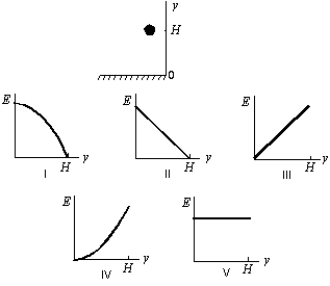
(Multiple Choice)
4.9/5 (77)
(77) For a block of mass m to slide without friction up the rise of height h shown, it must have a minimum initial kinetic energy of: 
(Multiple Choice)
4.9/5 (77)
(77) An elevator is rising at constant speed. Consider the following statements: I. the upward cable force is constant
II. the kinetic energy of the elevator is constant
III. the gravitational potential energy of the Earth-elevator system is constant
IV. the acceleration of the elevator is zero
V. the mechanical energy of the Earth-elevator system is constant
(Multiple Choice)
4.9/5 (82)
(82) A particle moves along the x axis under the influence of a stationary object. The net force on the particle, which is conservative, is given by F = (8N/m3)x3. If the potential energy is taken to be zero for x = 0 then the potential energy is given by:
(Multiple Choice)
4.9/5 (81)
(81) A 2.2-kg block starts from rest on a rough inclined plane that makes an angle of 25 ° with the horizontal. The coefficient of kinetic friction is 0.25. As the block goes 2.0 m down the plane, the mechanical energy of the Earth-block system changes by:
(Multiple Choice)
5.0/5 (93)
(93) A 2-kg block is thrown upward from a point 20 m above the Earth's surface. At what height above Earth's surface will the gravitational potential energy of the Earth-block system have increased by 500 J?
(Multiple Choice)
4.8/5 (85)
(85) A small object of mass m starts at rest at the position shown and slides along the frictionless loop-the-loop track of radius R. What is the smallest value of y such that the object will slide without losing contact with the track? 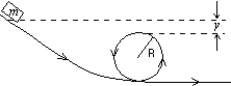
(Multiple Choice)
4.9/5 (72)
(72) A ball of mass m, at one end of a string of length L, rotates in a vertical circle just fast enough to prevent the string from going slack at the top of the circle. The speed of the ball at the bottom of the circle is: 
(Multiple Choice)
4.8/5 (83)
(83) An ideal spring is used to fire a 15.0-g block horizontally. The spring has a spring constant of 20 N/m and is initially compressed by 7.0 cm. The kinetic energy of the pellet as it leaves the spring is:
(Multiple Choice)
4.9/5 (71)
(71) Which one of the following five quantities CANNOT be used as a unit of potential energy?
(Multiple Choice)
4.9/5 (84)
(84) 
Filters
- Essay(0)
- Multiple Choice(0)
- Short Answer(0)
- True False(0)
- Matching(0)