



 Chat with AI
Exam 14: Fluids

Exam 1: Measurement31 Questions
Exam 2: Motion Along a Straight Line79 Questions
Exam 3: Vector39 Questions
Exam 4: Motion in Two and Three Dimensions47 Questions
Exam 5: Force and Motion I68 Questions
Exam 6: Force and Motion II71 Questions
Exam 7: Kinetic Energy and Work67 Questions
Exam 8: Potential Energy and Conservation of Energy61 Questions
Exam 9: Center of Mass and Linear Momentum81 Questions
Exam 10: Rotation82 Questions
Exam 11: Rolling, Torque, and Angular Momentum54 Questions
Exam 12: Equilibrium and Elasticity53 Questions
Exam 13: Gravitation55 Questions
Exam 14: Fluids85 Questions
Exam 15: Oscillations62 Questions
Exam 16: Waves I71 Questions
Exam 17: Waves II61 Questions
Exam 18: Temperature, Heat, and the First Law of Thermodynamics82 Questions
Exam 19: The Kinetic Theory of Gases95 Questions
Exam 20: Entropy and the Second Law of Thermodynamics56 Questions
Exam 21: Electric Charge45 Questions
Exam 22: Electric Fields49 Questions
Exam 23: Gauss Law34 Questions
Exam 24: Electric Potential44 Questions
Exam 25: Capacitance55 Questions
Exam 26: Current and Resistance49 Questions
Exam 27: Circuits70 Questions
Exam 28: Magnetic Fields48 Questions
Exam 29: Magnetic Fields Due to Currents47 Questions
Exam 30: Induction and Inductance85 Questions
Exam 31: Electromagnetic Oscillations and Alternating Current84 Questions
Exam 32: Maxwells Equations; Magnetism of Matter81 Questions
Exam 33: Electromagnetic Waves79 Questions
Exam 34: Images72 Questions
Exam 35: Interference40 Questions
Exam 36: Diffraction74 Questions
Exam 37: Relativity65 Questions
Exam 38: Photons and Matter Waves53 Questions
Exam 39: More About Matter Waves41 Questions
Exam 40: All About Atoms76 Questions
Exam 41: Conduction of Electricity in Solids48 Questions
Exam 42: Nuclear Physics67 Questions
Exam 43: Energy From the Nucleus44 Questions
Exam 44: Quarks, Leptons, and the Big Bang52 Questions
Select questions type


Water is pumped into one end of a long pipe at the rate of 40 L/min. It emerges at the other end at 24 L/min. A possible reason for this decrease in flow is:
(Multiple Choice)
4.9/5  (81)
(81) An object floats on the surface of a fluid. For purposes of calculating the torque on it, the buoyant force is taken to act at:
(Multiple Choice)
4.8/5 (81)
(81) Gases may be distinguished from other forms of matter by their:
(Multiple Choice)
4.8/5 (77)
(77) The diagram shows a U-tube having cross-sectional area A and partially filled with oil of density . A solid cylinder, which fits the tube tightly but can slide without friction, is placed in the right arm. The system reaches equilibrium. The weight of the cylinder is: 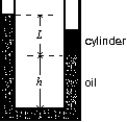
(Multiple Choice)
4.9/5 (64)
(64) A rock, which weighs 1400 N in air, has an apparent weight of 900 N when submerged in fresh water (998 kg/m3). The volume of the rock is:
(Multiple Choice)
4.7/5 (72)
(72) 1.1 0 Rank these fluids according to the volume displaced by the object, least to greatest.
(Multiple Choice)
4.8/5 (77)
(77) A 210-g object apparently loses 30 g when suspended in a liquid of density 2.0 g/cm3. The density of the object is:
(Multiple Choice)
4.9/5 (75)
(75) Two balls have the same shape and size but one is denser than the other. If frictional forces are negligible when they are dropped in air, which has the greater acceleration?
(Multiple Choice)
4.9/5 (74)
(74) A steel ax and an aluminum piston have the same apparent weight in water. When they are weighed in air:
(Multiple Choice)
4.9/5 (83)
(83) A blast of wind tips a sailboat in the clockwise direction when viewed from the stern. When the wind ceases the boat rotates back toward the upright position if, when it is tilted, the center of buoyancy:
(Multiple Choice)
4.8/5 (77)
(77) The pressure exerted on the ground by a man is greatest when:
(Multiple Choice)
4.8/5 (76)
(76) A closed hemispherical shell of radius R is filled with fluid at uniform pressure p. The net force of the fluid on the curved portion of the shell is given by:
(Multiple Choice)
4.9/5 (80)
(80) A block of ice at 0 C containing a piece of cork is floating on the surface of ice water in a beaker. When the ice has melted the water level:
(Multiple Choice)
4.8/5 (66)
(66) A tin can has a volume of 1000 cm3 and a mass of 100 g. Approximately what mass of lead shot can it carry without sinking in water?
(Multiple Choice)
4.9/5 (97)
(97) Mercury is a convenient liquid to use in a barometer because:
(Multiple Choice)
4.9/5 (77)
(77) A certain object floats in fluids of density
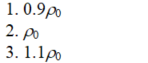 Rank these fluids according to the volume displaced by the object, least to greatest.
 (Multiple Choice)
4.7/5 (83)
(83) A non-viscous incompressible fluid is pumped steadily into the narrow end of a long tapered pipe and emerges from the wide end. The pressure at the input is greater than at the output. A possible explanation is:
(Multiple Choice)
4.8/5 (94)
(94) The density of water is 1.0 g/cm3. The density of the oil in the left column of the U-tube shown below is: 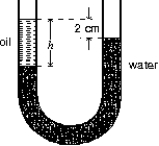
(Multiple Choice)
4.9/5 (84)
(84) 
Filters
- Essay(0)
- Multiple Choice(0)
- Short Answer(0)
- True False(0)
- Matching(0)