



 Chat with AI
Exam 19: The Kinetic Theory of Gases

Exam 1: Measurement31 Questions
Exam 2: Motion Along a Straight Line79 Questions
Exam 3: Vector39 Questions
Exam 4: Motion in Two and Three Dimensions47 Questions
Exam 5: Force and Motion I68 Questions
Exam 6: Force and Motion II71 Questions
Exam 7: Kinetic Energy and Work67 Questions
Exam 8: Potential Energy and Conservation of Energy61 Questions
Exam 9: Center of Mass and Linear Momentum81 Questions
Exam 10: Rotation82 Questions
Exam 11: Rolling, Torque, and Angular Momentum54 Questions
Exam 12: Equilibrium and Elasticity53 Questions
Exam 13: Gravitation55 Questions
Exam 14: Fluids85 Questions
Exam 15: Oscillations62 Questions
Exam 16: Waves I71 Questions
Exam 17: Waves II61 Questions
Exam 18: Temperature, Heat, and the First Law of Thermodynamics82 Questions
Exam 19: The Kinetic Theory of Gases95 Questions
Exam 20: Entropy and the Second Law of Thermodynamics56 Questions
Exam 21: Electric Charge45 Questions
Exam 22: Electric Fields49 Questions
Exam 23: Gauss Law34 Questions
Exam 24: Electric Potential44 Questions
Exam 25: Capacitance55 Questions
Exam 26: Current and Resistance49 Questions
Exam 27: Circuits70 Questions
Exam 28: Magnetic Fields48 Questions
Exam 29: Magnetic Fields Due to Currents47 Questions
Exam 30: Induction and Inductance85 Questions
Exam 31: Electromagnetic Oscillations and Alternating Current84 Questions
Exam 32: Maxwells Equations; Magnetism of Matter81 Questions
Exam 33: Electromagnetic Waves79 Questions
Exam 34: Images72 Questions
Exam 35: Interference40 Questions
Exam 36: Diffraction74 Questions
Exam 37: Relativity65 Questions
Exam 38: Photons and Matter Waves53 Questions
Exam 39: More About Matter Waves41 Questions
Exam 40: All About Atoms76 Questions
Exam 41: Conduction of Electricity in Solids48 Questions
Exam 42: Nuclear Physics67 Questions
Exam 43: Energy From the Nucleus44 Questions
Exam 44: Quarks, Leptons, and the Big Bang52 Questions
Select questions type


The pressure of an ideal gas is doubled in an isothermal process. The root-mean-square speed of the molecules:
(Multiple Choice)
4.9/5  (86)
(86) The mean free path of molecules in a gas is proportional to:
(Multiple Choice)
4.9/5 (81)
(81) According to the kinetic theory of gases, the pressure of a gas is due to:
(Multiple Choice)
4.8/5 (77)
(77) When work W is done on an ideal gas of diatomic molecules in thermal isolation the increase in the total translational kinetic energy of the molecules is:
(Multiple Choice)
4.8/5 (80)
(80) Air is pumped into a bicycle tire at constant temperature. The pressure increases because:
(Multiple Choice)
4.8/5 (84)
(84) An ideal gas of N monatomic molecules is in thermal equilibrium with an ideal gas of the same number of diatomic molecules and equilibrium is maintained as temperature is increased. The ratio of the changes in the internal energies ΔEdia / Emon is:
(Multiple Choice)
4.9/5 (92)
(92) Consider the ratios of the heat capacities = Cp/Cv for the three types of ideal gases: monatomic, diatomic, and polyatomic.
(Multiple Choice)
4.8/5 (72)
(72) The diagram shows three isotherms for an ideal gas, with T3-T2 the same as T2-T1. It also shows five thermodynamic processes caried out on the gas. Rank the processes in order change in the internal energy of the gas, least to greatest. 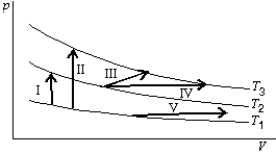
(Multiple Choice)
4.7/5 (82)
(82) Evidence that a gas consists mostly of empty space is the fact that:
(Multiple Choice)
4.8/5 (78)
(78) Evidence that molecules of a gas are in constant motion is:
(Multiple Choice)
5.0/5 (81)
(81) The mass of an oxygen molecule is 16 times that of a hydrogen molecule. At room temperature, the ratio of the rms speed of an oxygen molecule to that of a hydrogen molecule is:
(Multiple Choice)
4.9/5 (75)
(75) 273 cm3 of an ideal gas is at 0 C. It is heated at constant pressure to 10 C. It will now occupy:
(Multiple Choice)
4.9/5 (84)
(84) A gas is confined to a cylindrical container of radius 1 cm and length 1 m. The pressure exerted on an end face, compared with the pressure exerted on the long curved face, is:
(Multiple Choice)
4.8/5 (88)
(88) The force on the walls of a vessel of a contained gas is due to:
(Multiple Choice)
4.8/5 (99)
(99) If the molecules in a tank of hydrogen have the same rms speed as the molecules in a tank of oxygen, we may be sure that:
(Multiple Choice)
4.9/5 (78)
(78) The Maxwellian speed distribution provides a direct explanation of:
(Multiple Choice)
4.8/5 (83)
(83) As the pressure in an ideal gas is increased isothermally the average molecular speed:
(Multiple Choice)
4.7/5 (82)
(82) An ideal gas undergoes an isothermal process starting with a pressure of 2*105 Pa and a volume of 6 cm3. Which of the following might be the pressure and volume of the final state?
(Multiple Choice)
4.8/5 (86)
(86) 
Filters
- Essay(0)
- Multiple Choice(0)
- Short Answer(0)
- True False(0)
- Matching(0)