



 Chat with AI
Exam 26: Current and Resistance

Exam 1: Measurement31 Questions
Exam 2: Motion Along a Straight Line79 Questions
Exam 3: Vector39 Questions
Exam 4: Motion in Two and Three Dimensions47 Questions
Exam 5: Force and Motion I68 Questions
Exam 6: Force and Motion II71 Questions
Exam 7: Kinetic Energy and Work67 Questions
Exam 8: Potential Energy and Conservation of Energy61 Questions
Exam 9: Center of Mass and Linear Momentum81 Questions
Exam 10: Rotation82 Questions
Exam 11: Rolling, Torque, and Angular Momentum54 Questions
Exam 12: Equilibrium and Elasticity53 Questions
Exam 13: Gravitation55 Questions
Exam 14: Fluids85 Questions
Exam 15: Oscillations62 Questions
Exam 16: Waves I71 Questions
Exam 17: Waves II61 Questions
Exam 18: Temperature, Heat, and the First Law of Thermodynamics82 Questions
Exam 19: The Kinetic Theory of Gases95 Questions
Exam 20: Entropy and the Second Law of Thermodynamics56 Questions
Exam 21: Electric Charge45 Questions
Exam 22: Electric Fields49 Questions
Exam 23: Gauss Law34 Questions
Exam 24: Electric Potential44 Questions
Exam 25: Capacitance55 Questions
Exam 26: Current and Resistance49 Questions
Exam 27: Circuits70 Questions
Exam 28: Magnetic Fields48 Questions
Exam 29: Magnetic Fields Due to Currents47 Questions
Exam 30: Induction and Inductance85 Questions
Exam 31: Electromagnetic Oscillations and Alternating Current84 Questions
Exam 32: Maxwells Equations; Magnetism of Matter81 Questions
Exam 33: Electromagnetic Waves79 Questions
Exam 34: Images72 Questions
Exam 35: Interference40 Questions
Exam 36: Diffraction74 Questions
Exam 37: Relativity65 Questions
Exam 38: Photons and Matter Waves53 Questions
Exam 39: More About Matter Waves41 Questions
Exam 40: All About Atoms76 Questions
Exam 41: Conduction of Electricity in Solids48 Questions
Exam 42: Nuclear Physics67 Questions
Exam 43: Energy From the Nucleus44 Questions
Exam 44: Quarks, Leptons, and the Big Bang52 Questions
Select questions type


A car battery is rated at 80 A F. h. An ampere-hour is a unit of:
(Multiple Choice)
4.9/5  (82)
(82) Two wires made of different materials have the same uniform current density. They carry the same current only if:
(Multiple Choice)
4.9/5 (84)
(84) Two conductors are made of the same material and have the same length. Conductor A is a solid wire of diameter 1 m. Conductor B is a hollow tube of inside diameter 1 m and outside diameter 2 m. The ratio of their resistance, RA/RB, is:
(Multiple Choice)
4.8/5 (78)
(78) A wire with a length of 150 m and a radius of 0.15 m carries a current with a uniform current density of 2.8 *107 A/m2. The current is:
(Multiple Choice)
4.7/5 (79)
(79) A certain sample carries a current of 4 A when the potential difference is 2 V and a current of 10 A when the potential difference is 4 V. This sample:
(Multiple Choice)
4.9/5 (80)
(80) A current of 0.3 A is passed through a lamp for 2 minutes using a 6 V power supply. The energy dissipated by this lamp during the 2 minutes is:
(Multiple Choice)
4.8/5 (94)
(94) For an ohmic substance, the electron drift velocity is proportional to:
(Multiple Choice)
5.0/5 (77)
(77) Which one of the following quantities is correctly matched to its unit?
(Multiple Choice)
5.0/5 (76)
(76) If  is the current density and
 is a vector element of area then the integral
 over an area represents:
is the current density and is a vector element of area then the integral over an area represents: (Multiple Choice)
4.8/5 (75)
(75) Which of the following graphs best represents the current-voltage relationship for a device that obeys Ohm's law? 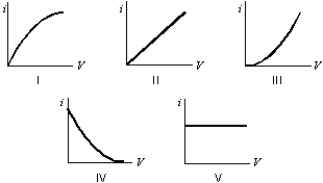
(Multiple Choice)
4.9/5 (81)
(81) A nichrome wire is 1 m long and 1 *10-6 m2 in cross-sectional area. When connected to a potential difference of 2 V, a current of 4 A exists in the wire. The resistivity of this nichrome is:
(Multiple Choice)
4.9/5 (85)
(85) Two substances are identical except that the electron mean free time for substance A is twice the electron mean free time for substance B. If the same electric field exists in both substances the electron drift speed in A is:
(Multiple Choice)
4.9/5 (67)
(67) An ordinary light bulb is marked "60 watt, 120 volt". Its resistance is:
(Multiple Choice)
4.9/5 (74)
(74) The rate at which electrical energy is used may be measured in:
(Multiple Choice)
4.7/5 (80)
(80) Conduction electrons move to the right in a certain wire. This indicates that:
(Multiple Choice)
4.8/5 (77)
(77) A cylindrical copper rod has resistance R. It is reformed to twice its original length with no change of volume. Its new resistance is:
(Multiple Choice)
4.7/5 (88)
(88) 
Filters
- Essay(0)
- Multiple Choice(0)
- Short Answer(0)
- True False(0)
- Matching(0)