



 Chat with AI
Exam 27: Circuits

Exam 1: Measurement31 Questions
Exam 2: Motion Along a Straight Line79 Questions
Exam 3: Vector39 Questions
Exam 4: Motion in Two and Three Dimensions47 Questions
Exam 5: Force and Motion I68 Questions
Exam 6: Force and Motion II71 Questions
Exam 7: Kinetic Energy and Work67 Questions
Exam 8: Potential Energy and Conservation of Energy61 Questions
Exam 9: Center of Mass and Linear Momentum81 Questions
Exam 10: Rotation82 Questions
Exam 11: Rolling, Torque, and Angular Momentum54 Questions
Exam 12: Equilibrium and Elasticity53 Questions
Exam 13: Gravitation55 Questions
Exam 14: Fluids85 Questions
Exam 15: Oscillations62 Questions
Exam 16: Waves I71 Questions
Exam 17: Waves II61 Questions
Exam 18: Temperature, Heat, and the First Law of Thermodynamics82 Questions
Exam 19: The Kinetic Theory of Gases95 Questions
Exam 20: Entropy and the Second Law of Thermodynamics56 Questions
Exam 21: Electric Charge45 Questions
Exam 22: Electric Fields49 Questions
Exam 23: Gauss Law34 Questions
Exam 24: Electric Potential44 Questions
Exam 25: Capacitance55 Questions
Exam 26: Current and Resistance49 Questions
Exam 27: Circuits70 Questions
Exam 28: Magnetic Fields48 Questions
Exam 29: Magnetic Fields Due to Currents47 Questions
Exam 30: Induction and Inductance85 Questions
Exam 31: Electromagnetic Oscillations and Alternating Current84 Questions
Exam 32: Maxwells Equations; Magnetism of Matter81 Questions
Exam 33: Electromagnetic Waves79 Questions
Exam 34: Images72 Questions
Exam 35: Interference40 Questions
Exam 36: Diffraction74 Questions
Exam 37: Relativity65 Questions
Exam 38: Photons and Matter Waves53 Questions
Exam 39: More About Matter Waves41 Questions
Exam 40: All About Atoms76 Questions
Exam 41: Conduction of Electricity in Solids48 Questions
Exam 42: Nuclear Physics67 Questions
Exam 43: Energy From the Nucleus44 Questions
Exam 44: Quarks, Leptons, and the Big Bang52 Questions
Select questions type


The circuit shown was wired for the purpose of measuring the resistance of the lamp L. Inspection shows that: 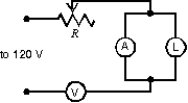
(Multiple Choice)
4.9/5  (83)
(83) Resistor 1 has twice the resistance of resistor 2. They are connected in parallel to a battery. The ratio of the thermal energy dissipation by 1 to that by 2 is:
(Multiple Choice)
4.8/5 (81)
(81) When switch S is open, the ammeter in the circuit shown reads 2.0 A. When S is closed, the ammeter reading: 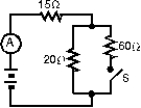
(Multiple Choice)
4.8/5 (77)
(77) A galvanometer has an internal resistance of 12 and requires 0.01 A for full scale deflection. To convert it to a voltmeter reading 3 V full scale, one must use a series resistance of:
(Multiple Choice)
4.8/5 (69)
(69) Resistor 1 has twice the resistance of resistor 2. The two are connected in parallel and a potential difference is maintained across the combination. The rate of thermal energy dissipation in 1 is:
(Multiple Choice)
4.9/5 (78)
(78) In the circuit shown, both resistors have the same value R. Suppose switch S is initially closed. When it is then opened, the circuit has a time constant a Conversely, suppose S is initially open. When it is then closed, the circuit has a time constant b The ratio a/ b is: 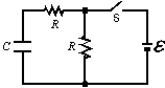
(Multiple Choice)
5.0/5 (86)
(86) Two wires made of the same material have the same length but different diameter. They are connected in parallel to a battery. The quantity that is NOT the same for the wires is:
(Multiple Choice)
4.8/5 (75)
(75) Four circuits have the form shown in the diagram. The capacitor is initially uncharged and the switch S is open. 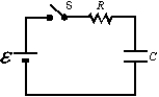 The values of the emf , resistance and R, and capacitance C for each for the circuits are
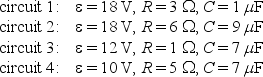 Rank the circuits according to the current just after switch S is closed least to greatest.
The values of the emf , resistance and R, and capacitance C for each for the circuits are Rank the circuits according to the current just after switch S is closed least to greatest. (Multiple Choice)
5.0/5 (83)
(83) In the capacitor discharge formula q = q0e-t/RC the symbol t represents:
(Multiple Choice)
4.9/5 (72)
(72) The positive terminals of two batteries with emf's of ε1 and ε2, respectively, are connected together. Here ε1 > ε2. The circuit is completed by connecting the negative terminals. If each battery has an internal resistance of r, the rate in watts at which electrical energy is converted to chemical energy in the smaller battery is:
(Multiple Choice)
4.8/5 (81)
(81) Two 110-V light bulbs, one "25 W" and the other "100 W", are connected in series to a 110 V source. Then:
(Multiple Choice)
4.9/5 (73)
(73) Two identical batteries, each with an emf of 18 V and an internal resistance of 1 , are wired in parallel by connecting their positive terminals together and connecting their negative terminals together. The combination is then wired across a 4- resistor. The potential difference across the 4- resistor is:
(Multiple Choice)
4.8/5 (72)
(72) Two wires made of the same material have the same length but different diameters. They are connected in series to a battery. The quantity that is the same for the wires is:
(Multiple Choice)
4.9/5 (72)
(72) "The sum of the emf's and potential differences around a closed loop equals zero" is a consequence of:
(Multiple Choice)
4.8/5 (85)
(85) In the diagrams, all light bulbs are identical and all emf devices are identical. In which circuit (I, II, III, IV, V) will the bulbs glow with the same brightness as in circuit X? 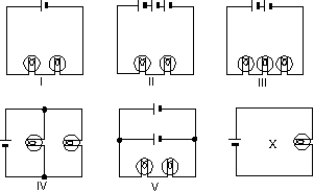
(Multiple Choice)
4.9/5 (69)
(69) Suppose the current charging a capacitor is kept constant. Which graph below correctly gives the potential difference V across the capacitor as a function of time? 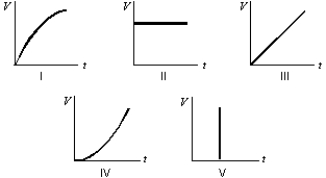
(Multiple Choice)
4.7/5 (73)
(73) Nine identical wires, each of diameter d and length L, are connected in series. The combination has the same resistance as a single similar wire of length L but whose diameter is:
(Multiple Choice)
4.8/5 (82)
(82) A certain voltmeter has an internal resistance of 10,000 and a range from 0 to 12 V. To extend its range to 120 V, use a series resistance of:
(Multiple Choice)
4.8/5 (73)
(73) A portion of a circuit is shown, with the values of the currents given for some branches. What is the direction and value of the current i? 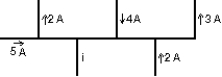
(Multiple Choice)
4.9/5 (91)
(91) The emf of a battery is equal to its terminal potential difference:
(Multiple Choice)
4.9/5 (84)
(84) 
Filters
- Essay(0)
- Multiple Choice(0)
- Short Answer(0)
- True False(0)
- Matching(0)