



 Chat with AI
Exam 33: Electromagnetic Waves

Exam 1: Measurement31 Questions
Exam 2: Motion Along a Straight Line79 Questions
Exam 3: Vector39 Questions
Exam 4: Motion in Two and Three Dimensions47 Questions
Exam 5: Force and Motion I68 Questions
Exam 6: Force and Motion II71 Questions
Exam 7: Kinetic Energy and Work67 Questions
Exam 8: Potential Energy and Conservation of Energy61 Questions
Exam 9: Center of Mass and Linear Momentum81 Questions
Exam 10: Rotation82 Questions
Exam 11: Rolling, Torque, and Angular Momentum54 Questions
Exam 12: Equilibrium and Elasticity53 Questions
Exam 13: Gravitation55 Questions
Exam 14: Fluids85 Questions
Exam 15: Oscillations62 Questions
Exam 16: Waves I71 Questions
Exam 17: Waves II61 Questions
Exam 18: Temperature, Heat, and the First Law of Thermodynamics82 Questions
Exam 19: The Kinetic Theory of Gases95 Questions
Exam 20: Entropy and the Second Law of Thermodynamics56 Questions
Exam 21: Electric Charge45 Questions
Exam 22: Electric Fields49 Questions
Exam 23: Gauss Law34 Questions
Exam 24: Electric Potential44 Questions
Exam 25: Capacitance55 Questions
Exam 26: Current and Resistance49 Questions
Exam 27: Circuits70 Questions
Exam 28: Magnetic Fields48 Questions
Exam 29: Magnetic Fields Due to Currents47 Questions
Exam 30: Induction and Inductance85 Questions
Exam 31: Electromagnetic Oscillations and Alternating Current84 Questions
Exam 32: Maxwells Equations; Magnetism of Matter81 Questions
Exam 33: Electromagnetic Waves79 Questions
Exam 34: Images72 Questions
Exam 35: Interference40 Questions
Exam 36: Diffraction74 Questions
Exam 37: Relativity65 Questions
Exam 38: Photons and Matter Waves53 Questions
Exam 39: More About Matter Waves41 Questions
Exam 40: All About Atoms76 Questions
Exam 41: Conduction of Electricity in Solids48 Questions
Exam 42: Nuclear Physics67 Questions
Exam 43: Energy From the Nucleus44 Questions
Exam 44: Quarks, Leptons, and the Big Bang52 Questions
Select questions type


The order of increasing wavelength for blue (b), green (g), red (r), and yellow (y) light is:
(Multiple Choice)
4.9/5  (92)
(92) An unpolarized beam of light has intensity I0. It is incident on two ideal polarizing sheets. The angle between the axes of polarization of these sheets is . Find 0if the emerging light has intensity I0/4:
(Multiple Choice)
4.8/5 (95)
(95) The electric field for a plane electromagnetic wave traveling in the +y direction is shown. Consider a point where  is in the +z direction. The
 field is:
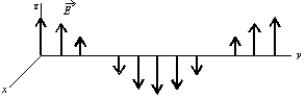
is in the +z direction. The field is: (Multiple Choice)
5.0/5 (86)
(86) The critical angle for total internal reflection at a diamond-air interface is 25 . Suppose light is incident at an angle of with the normal. Total internal reflection will occur if the incident medium is:
(Multiple Choice)
4.9/5 (73)
(73) An electromagnetic wave is transporting energy in the negative y direction. At one point and one instant the magnetic field is in the positive x direction. The electric field at that point and instant is:
(Multiple Choice)
4.7/5 (64)
(64) A point source emits electromagnetic energy at a rate of 100 W. The intensity 10 m from the source is:
(Multiple Choice)
4.8/5 (80)
(80) If nwater = 1.50 and nglass = 1.33, then total internal reflection at an interface between this glass and water:
(Multiple Choice)
4.8/5 (91)
(91) A ray of light passes through three media as shown. The speeds of light in these media obey: 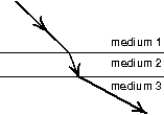
(Multiple Choice)
4.9/5 (83)
(83) A ray of light passes obliquely through a plate of glass having parallel faces. The emerging ray:
(Multiple Choice)
4.9/5 (76)
(76) A pole stands in a river, half in and half out of the water. Another pole of the same length stands vertically on the shore at a place where the ground is level. The shadow cast by the pole in the river on the river bottom is:
(Multiple Choice)
4.8/5 (75)
(75) Three polarizing sheets are placed in a stack with the polarizing directions of the first and third perpendicular to each other. What angle should the polarizing direction of the middle sheet make with the polarizing direction of the first sheet to obtain zero transmitted intensity when unpolarized light is incident on the stack?
(Multiple Choice)
4.9/5 (76)
(76) The magnetic field in a sinusoidal light wave has an amplitude of 3.3 *10-7 T. The intensity of the wave is:
(Multiple Choice)
4.9/5 (77)
(77) A ray of light in water (index n1) is incident on its surface (with air) at the critical angle. Some oil (index n2) is now floated on the water. The angle between the ray in the oil and the normal is:
(Multiple Choice)
4.8/5 (81)
(81) The diagram shows total internal reflection. Which of the following statements is NOT true? 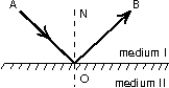
(Multiple Choice)
4.8/5 (92)
(92) Light with an intensity of 1 kW/m2 falls normally on a surface and is completely reflected. The radiation pressure is:
(Multiple Choice)
4.8/5 (72)
(72) When the distance between a point source of light and a light meter is reduced from 6.0 m to 2.0 m, the intensity of illumination at the meter will be the original value multiplied by:
(Multiple Choice)
4.9/5 (76)
(76) 
Filters
- Essay(0)
- Multiple Choice(0)
- Short Answer(0)
- True False(0)
- Matching(0)