



 Chat with AI
Exam 35: Interference

Exam 1: Measurement31 Questions
Exam 2: Motion Along a Straight Line79 Questions
Exam 3: Vector39 Questions
Exam 4: Motion in Two and Three Dimensions47 Questions
Exam 5: Force and Motion I68 Questions
Exam 6: Force and Motion II71 Questions
Exam 7: Kinetic Energy and Work67 Questions
Exam 8: Potential Energy and Conservation of Energy61 Questions
Exam 9: Center of Mass and Linear Momentum81 Questions
Exam 10: Rotation82 Questions
Exam 11: Rolling, Torque, and Angular Momentum54 Questions
Exam 12: Equilibrium and Elasticity53 Questions
Exam 13: Gravitation55 Questions
Exam 14: Fluids85 Questions
Exam 15: Oscillations62 Questions
Exam 16: Waves I71 Questions
Exam 17: Waves II61 Questions
Exam 18: Temperature, Heat, and the First Law of Thermodynamics82 Questions
Exam 19: The Kinetic Theory of Gases95 Questions
Exam 20: Entropy and the Second Law of Thermodynamics56 Questions
Exam 21: Electric Charge45 Questions
Exam 22: Electric Fields49 Questions
Exam 23: Gauss Law34 Questions
Exam 24: Electric Potential44 Questions
Exam 25: Capacitance55 Questions
Exam 26: Current and Resistance49 Questions
Exam 27: Circuits70 Questions
Exam 28: Magnetic Fields48 Questions
Exam 29: Magnetic Fields Due to Currents47 Questions
Exam 30: Induction and Inductance85 Questions
Exam 31: Electromagnetic Oscillations and Alternating Current84 Questions
Exam 32: Maxwells Equations; Magnetism of Matter81 Questions
Exam 33: Electromagnetic Waves79 Questions
Exam 34: Images72 Questions
Exam 35: Interference40 Questions
Exam 36: Diffraction74 Questions
Exam 37: Relativity65 Questions
Exam 38: Photons and Matter Waves53 Questions
Exam 39: More About Matter Waves41 Questions
Exam 40: All About Atoms76 Questions
Exam 41: Conduction of Electricity in Solids48 Questions
Exam 42: Nuclear Physics67 Questions
Exam 43: Energy From the Nucleus44 Questions
Exam 44: Quarks, Leptons, and the Big Bang52 Questions
Select questions type


A lens with a refractive index of 1.5 is coated with a material of refractive index 1.2 in order to minimize reflection. If denotes the wavelength of the incident light in air, what is the thinnest possible such coating? 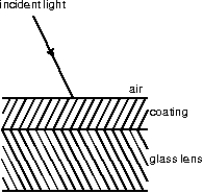
(Multiple Choice)
4.8/5  (73)
(73) The reason there are two slits, rather than one, in a Young's experiment is:
(Multiple Choice)
4.9/5 (61)
(61) Three experiments involving a thin film (in air) are shown. If t denotes the film thickness and denotes the wavelength of the light in the film, which experiments will produce constructive interference as seen by the observer? 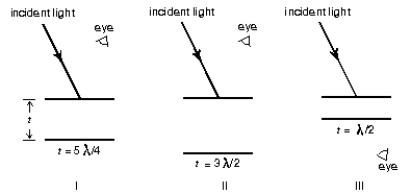
(Multiple Choice)
4.7/5 (73)
(73) Light from a point source X contains only blue and red components. After passing through a mysterious box, the light falls on a screen. Red and blue hands are observed as shown. The box must contain: 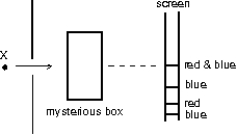
(Multiple Choice)
4.8/5 (90)
(90) The phase difference between the two waves which give rise to a dark spot in a Young's double-slit experiment is (where m = integer):
(Multiple Choice)
4.8/5 (72)
(72) In a Young's double-slit experiment, the slit separation is doubled. To maintain the same fringe spacing on the screen, the screen-to-slit distance D must be changed to:
(Multiple Choice)
4.9/5 (81)
(81) A light wave with an electric field amplitude of E0 and a phase constant of zero is to be combined with one of the following waves. Which of these combinations produces the greatest intensity?
(Multiple Choice)
4.9/5 (74)
(74) An air wedge is formed from two glass plates which are in contact at their left edges. There are ten dark bands when viewed by reflection using monochromatic light. The left edge of the top plate is now slowly lifted until the plates are parallel. During this process:
(Multiple Choice)
4.9/5 (77)
(77) In a Young's double-slit experiment the center of a bright fringe occurs wherever waves from the slits differ in the distance they travel by a multiple of:
(Multiple Choice)
4.8/5 (78)
(78) A glass (n = 1.6) lens is coated with a thin film (n = 1.3) to reduce reflection of certain incident light. If is the wavelength of the light in the film, the least film thickness is:
(Multiple Choice)
5.0/5 (73)
(73) A monochromatic light source illuminates a double slit and the resulting interference pattern is observed on a distant screen. Let d = center-to-center slit spacing, a = individual slit width, D = screen-to-slit distance,  adjacent dark line spacing in the interference pattern. The wavelength of the light is then:
 (Multiple Choice)
4.8/5 (80)
(80) Monochromatic light, at normal incidence, strikes a thin film in air. If denotes the wavelength in the film, what is the thinnest film in which the reflected light will be a maximum?
(Multiple Choice)
4.9/5 (73)
(73) Waves from two slits are in phase at the slits and travel to a distant screen to produce the second minimum of the interference pattern. The difference in the distance traveled by the wave is:
(Multiple Choice)
5.0/5 (60)
(60) In a thin film experiment, a wedge of air is used between two glass plates. If the wavelength of the incident light in air is 480 nm, how much thicker is the air wedge at the 16th dark fringe than it is at the 6th?
(Multiple Choice)
4.9/5 (81)
(81) Red light is viewed through a thin vertical soap film. At the third dark area shown, the thickness of the film, in terms of the wavelength within the film, is: 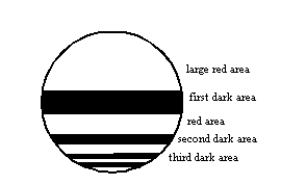
(Multiple Choice)
4.8/5 (82)
(82) In a Young's double-slit experiment, light of wavelength 500 nm illuminates two slits which are separated by 1 mm. The separation between adjacent bright fringes on a screen 5 m from the slits is:
(Multiple Choice)
4.8/5 (88)
(88) Waves from two slits are in phase at the slits and travel to a distant screen to produce the third side maximum of the interference pattern. The difference in the distance traveled by the waves is:
(Multiple Choice)
4.9/5 (83)
(83) 
Filters
- Essay(0)
- Multiple Choice(0)
- Short Answer(0)
- True False(0)
- Matching(0)