



 Chat with AI
Exam 37: Relativity

Exam 1: Measurement31 Questions
Exam 2: Motion Along a Straight Line79 Questions
Exam 3: Vector39 Questions
Exam 4: Motion in Two and Three Dimensions47 Questions
Exam 5: Force and Motion I68 Questions
Exam 6: Force and Motion II71 Questions
Exam 7: Kinetic Energy and Work67 Questions
Exam 8: Potential Energy and Conservation of Energy61 Questions
Exam 9: Center of Mass and Linear Momentum81 Questions
Exam 10: Rotation82 Questions
Exam 11: Rolling, Torque, and Angular Momentum54 Questions
Exam 12: Equilibrium and Elasticity53 Questions
Exam 13: Gravitation55 Questions
Exam 14: Fluids85 Questions
Exam 15: Oscillations62 Questions
Exam 16: Waves I71 Questions
Exam 17: Waves II61 Questions
Exam 18: Temperature, Heat, and the First Law of Thermodynamics82 Questions
Exam 19: The Kinetic Theory of Gases95 Questions
Exam 20: Entropy and the Second Law of Thermodynamics56 Questions
Exam 21: Electric Charge45 Questions
Exam 22: Electric Fields49 Questions
Exam 23: Gauss Law34 Questions
Exam 24: Electric Potential44 Questions
Exam 25: Capacitance55 Questions
Exam 26: Current and Resistance49 Questions
Exam 27: Circuits70 Questions
Exam 28: Magnetic Fields48 Questions
Exam 29: Magnetic Fields Due to Currents47 Questions
Exam 30: Induction and Inductance85 Questions
Exam 31: Electromagnetic Oscillations and Alternating Current84 Questions
Exam 32: Maxwells Equations; Magnetism of Matter81 Questions
Exam 33: Electromagnetic Waves79 Questions
Exam 34: Images72 Questions
Exam 35: Interference40 Questions
Exam 36: Diffraction74 Questions
Exam 37: Relativity65 Questions
Exam 38: Photons and Matter Waves53 Questions
Exam 39: More About Matter Waves41 Questions
Exam 40: All About Atoms76 Questions
Exam 41: Conduction of Electricity in Solids48 Questions
Exam 42: Nuclear Physics67 Questions
Exam 43: Energy From the Nucleus44 Questions
Exam 44: Quarks, Leptons, and the Big Bang52 Questions
Select questions type


The velocity of an electron is changed from c/2 in the -x direction to c/2 in the +x direction. As a result, its kinetic energy changes by:
(Multiple Choice)
4.8/5  (75)
(75) Light from a stationary spaceship is observed, then the spaceship moves directly away from the observer at high speed. As a result, the light seen by the observer has:
(Multiple Choice)
4.9/5 (75)
(75) The length of a meter stick moving at 0.95c in the direction of its length is measured by simultaneously marking its ends on a stationary axis. As measured by clocks moving with the stick, the time interval between the making of the back mark and the making of the front mark is:
(Multiple Choice)
4.8/5 (72)
(72) As a rocket ship moves by at 0.95c a mark is made on a stationary axis at the front end of the rocket and 9 * 10-8 s later a mark is made on the axis at the back end. The marks are found to be 100 m apart. The rest length of the rocket is:
(Multiple Choice)
4.9/5 (97)
(97) Frame S' moves in the positive x direction at 0.6c with respect to frame S. A particle moves in the positive x direction at 0.4c as measured by an observer in S'. The speed of the particle as measured by an observer in S is:
(Multiple Choice)
4.9/5 (67)
(67) Relative to reference frame 1, reference frame 2 moves with speed v in the negative x direction. When the origins of the two frames coincide the clocks in both frames are set to zero. An event occurs at coordinate x1 and time t1 as measured in reference frame 1 and at coordinate x2 and time t2 as measured in frame 2. If 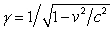 , then the coordinates and times of the event are related by:
 (Multiple Choice)
4.9/5 (86)
(86) Two events occur 100 m apart with an intervening time interval of 0.60 s. The speed of a reference frame in which they occur at the same coordinate is:
(Multiple Choice)
4.8/5 (86)
(86) While emitting light of proper frequency f0, a source moves to the right with speed c/4 relative to reference frame S. A detector, to the left of the source, measures the frequency to be f, which is greater than f0. This means: 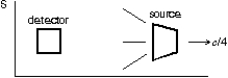
(Multiple Choice)
4.9/5 (92)
(92) Visible light, with a frequency of 6.0 *1014 Hz, is reflected from a spaceship moving directly away at a speed of 0.90c. The frequency of the reflected waves observed at the source is:
(Multiple Choice)
4.9/5 (82)
(82) If the kinetic energy of a free particle is much less than its rest energy then its kinetic energy is proportional to:
(Multiple Choice)
4.8/5 (80)
(80) A meson when at rest decays 2 s after it is created. If moving in the laboratory at 0.99c, its lifetime according to laboratory clocks would be:
(Multiple Choice)
4.8/5 (91)
(91) Two events occur 100 m apart with an intervening time interval of 0.37 s. The speed of a clock that measures the proper time between the events is:
(Multiple Choice)
4.9/5 (75)
(75) Two events occur simultaneously at separated points on the y axis of reference frame S. According to an observer moving in the positive x direction:
(Multiple Choice)
4.8/5 (75)
(75) A source at rest emits light of wavelength 500 nm. When it is moving at 0.90c away from an observer, the observer detects light of wavelength:
(Multiple Choice)
4.7/5 (83)
(83) Two independent events occur 100 m apart with an intervening time interval of 0.42 s. The proper time in s between the events is:
(Multiple Choice)
4.9/5 (82)
(82) If the kinetic energy of a particle is equal to its rest energy then its speed must be:
(Multiple Choice)
4.7/5 (82)
(82) The magnitude of the momentum of a particle can never exceed:
(Multiple Choice)
4.8/5 (82)
(82) An electron (m = 9.11 * 10-31 kg) has a speed of 0.95c. The magnitude of its momentum is:
(Multiple Choice)
4.9/5 (83)
(83) 
Filters
- Essay(0)
- Multiple Choice(0)
- Short Answer(0)
- True False(0)
- Matching(0)