



 Chat with AI
Exam 38: Photons and Matter Waves

Exam 1: Measurement31 Questions
Exam 2: Motion Along a Straight Line79 Questions
Exam 3: Vector39 Questions
Exam 4: Motion in Two and Three Dimensions47 Questions
Exam 5: Force and Motion I68 Questions
Exam 6: Force and Motion II71 Questions
Exam 7: Kinetic Energy and Work67 Questions
Exam 8: Potential Energy and Conservation of Energy61 Questions
Exam 9: Center of Mass and Linear Momentum81 Questions
Exam 10: Rotation82 Questions
Exam 11: Rolling, Torque, and Angular Momentum54 Questions
Exam 12: Equilibrium and Elasticity53 Questions
Exam 13: Gravitation55 Questions
Exam 14: Fluids85 Questions
Exam 15: Oscillations62 Questions
Exam 16: Waves I71 Questions
Exam 17: Waves II61 Questions
Exam 18: Temperature, Heat, and the First Law of Thermodynamics82 Questions
Exam 19: The Kinetic Theory of Gases95 Questions
Exam 20: Entropy and the Second Law of Thermodynamics56 Questions
Exam 21: Electric Charge45 Questions
Exam 22: Electric Fields49 Questions
Exam 23: Gauss Law34 Questions
Exam 24: Electric Potential44 Questions
Exam 25: Capacitance55 Questions
Exam 26: Current and Resistance49 Questions
Exam 27: Circuits70 Questions
Exam 28: Magnetic Fields48 Questions
Exam 29: Magnetic Fields Due to Currents47 Questions
Exam 30: Induction and Inductance85 Questions
Exam 31: Electromagnetic Oscillations and Alternating Current84 Questions
Exam 32: Maxwells Equations; Magnetism of Matter81 Questions
Exam 33: Electromagnetic Waves79 Questions
Exam 34: Images72 Questions
Exam 35: Interference40 Questions
Exam 36: Diffraction74 Questions
Exam 37: Relativity65 Questions
Exam 38: Photons and Matter Waves53 Questions
Exam 39: More About Matter Waves41 Questions
Exam 40: All About Atoms76 Questions
Exam 41: Conduction of Electricity in Solids48 Questions
Exam 42: Nuclear Physics67 Questions
Exam 43: Energy From the Nucleus44 Questions
Exam 44: Quarks, Leptons, and the Big Bang52 Questions
Select questions type


Electromagnetic radiation with a wavelength of 3.5 * 10-12 m is scattered from stationary electrons and photons that have been scattered through 50 are detected. An electron from which one of these photons was scattered receives an energy of:
(Multiple Choice)
4.8/5  (73)
(73) If the kinetic energy of a non-relativistic free electron doubles, the frequency of its wave function changes by the factor:
(Multiple Choice)
4.8/5 (87)
(87) In Compton scattering from stationary electrons the frequency of the emitted light is independent of:
(Multiple Choice)
4.8/5 (75)
(75) Rank following electromagnetic radiations according to the energies of their photons, from least to greatest. 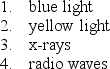
(Multiple Choice)
4.8/5 (84)
(84) In Compton scattering from stationary particles the maximum change in wavelength can be made smaller by using:
(Multiple Choice)
4.9/5 (86)
(86) An electron with energy E is incident on a potential energy barrier of height Epot and thickness L. The probability of tunneling increases if:
(Multiple Choice)
4.9/5 (82)
(82) Electromagnetic radiation with a wavelength of 3.5 * 10-12 m is scattered from stationary electrons and photons that have been scattered through 50 are detected. After a scattering event the magnitude of the electron's momentum is:
(Multiple Choice)
4.8/5 (71)
(71) A free electron in motion along the x axis has a localized wave function. The uncertainty in its momentum is decreased if:
(Multiple Choice)
4.9/5 (84)
(84) Identical particles, each with energy E, are incident on the following four potential energy barriers: 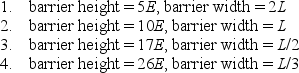 Rank the barriers in terms of the probability that the particles tunnel through them, from least probability to greatest probability.
 (Multiple Choice)
4.9/5 (77)
(77) Of the following which is the best evidence for the wave nature of matter?
(Multiple Choice)
4.9/5 (86)
(86) The frequency and wavelength of the matter wave associated with a 10-eV free electron are:
(Multiple Choice)
4.8/5 (86)
(86) Consider the following three particles: 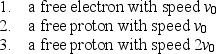 Rank them according to the wavlengths of their matter waves, least to greatest.
 (Multiple Choice)
4.8/5 (82)
(82) A free electron and a free proton have the same kinetic energy. This means that, compared to the matter wave associated with the proton, the matter wave associated with the electron has:
(Multiple Choice)
4.9/5 (74)
(74) In Compton scattering from stationary electrons the largest change in wavelength that can occur is:
(Multiple Choice)
4.8/5 (72)
(72) Separate Compton effect experiments are carried out using visible light and x rays. The scattered radiation is observed at the same scattering angle. For these experiments:
(Multiple Choice)
4.8/5 (84)
(84) In a photoelectric effect experiment at a frequency above cut off, the stopping potential is proportional to:
(Multiple Choice)
5.0/5 (67)
(67) In a photoelectric effect experiment the stopping potential is:
(Multiple Choice)
4.7/5 (83)
(83) The stopping potential for electrons ejected by 6.8 *1014-Hz electromagnetic radiation incident on a certain sample is 1.8 V. The kinetic energy of the most energetic electrons ejected and the work function of the sample, respectively, are:
(Multiple Choice)
4.9/5 (92)
(92) A free electron has a momentum of 5.0 *10-24kg. m/s. The wavelength of its wave function is:
(Multiple Choice)
4.8/5 (77)
(77) (x) is the wave function for a particle moving along the x axis. The probability that the particle is in the interval from x = a to x = b is given by:
(Multiple Choice)
4.8/5 (63)
(63) 
Filters
- Essay(0)
- Multiple Choice(0)
- Short Answer(0)
- True False(0)
- Matching(0)