



 Chat with AI
Exam 14: Financial Crises, Stabilization, and Deficits

Exam 1: The Scope and Method of Economics238 Questions
Exam 2: The Economic Problem: Scarcity and Choice220 Questions
Exam 3: Demand, Supply, and Market Equilibrium298 Questions
Exam 4: Demand and Supply Applications173 Questions
Exam 5: Introduction to Macroeconomics241 Questions
Exam 6: Measuring National Output and National Income292 Questions
Exam 7: Unemployment, Inflation, and Long-Run Growth297 Questions
Exam 8: Aggregate Expenditure and Equilibrium Output355 Questions
Exam 9: The Government and Fiscal Policy362 Questions
Exam 10: Money, the Federal Reserve, and the Interest Rate358 Questions
Exam 11: The Determination of Aggregate Output, the Price Level, and the Interest Rate243 Questions
Exam 12: Policy Effects and Cost Shocks in the Asad Model200 Questions
Exam 13: The Labor Market in the Macroeconomy287 Questions
Exam 14: Financial Crises, Stabilization, and Deficits260 Questions
Exam 15: Household and Firm Behavior in the Macroeconomy: a Further Look364 Questions
Exam 16: Long-Run Growth196 Questions
Exam 17: Alternative Views in Macroeconomics294 Questions
Exam 18: International Trade, Comparative Advantage, and Protectionism301 Questions
Exam 19: Open-Economy Macroeconomics: the Balance of Payments and Exchange Rates308 Questions
Exam 20: Economic Growth in Developing Economies133 Questions
Exam 21: Critical Thinking About Research105 Questions
Select questions type


The time it takes policy makers to see that the economy is going into a recession or an inflation is known as the recognition lag.
(True/False)
4.9/5  (74)
(74) During periods of high growth and inflationary pressures, the Federal Reserve will likely
(Multiple Choice)
4.9/5 (82)
(82) A positive demand shock increases consumer and investment spending and tends to decrease the budget deficit.
(True/False)
5.0/5 (75)
(75) Refer to the information provided in Figure 14.1 below to answer the questions that follow. 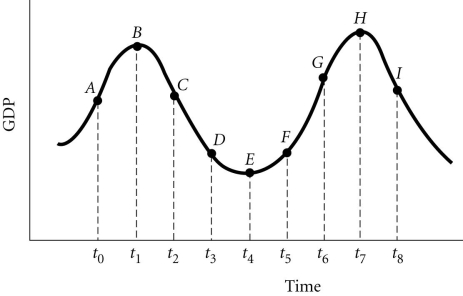 Figure 14.1
-Refer to Figure 14.1. If policy makers take an action at time t2, the impact on the economy will not be at time t2 because
Figure 14.1
-Refer to Figure 14.1. If policy makers take an action at time t2, the impact on the economy will not be at time t2 because (Multiple Choice)
4.9/5 (79)
(79) If the federal government ________ during the financial crisis of 2008-2009, the negative wealth effect would likely have been larger.
(Multiple Choice)
4.9/5 (78)
(78) When the ratio of a housing price index to the GDP deflator is rising, this means that housing prices are rising faster than the overall price level.
(True/False)
4.9/5 (73)
(73) An index based on 30 actively traded large companies on the New York Stock Exchange is the
(Multiple Choice)
4.8/5 (77)
(77) Discretionary government policy ensures the stabilization of the economy.
(True/False)
4.9/5 (85)
(85) If the Fed buys U.S. Treasury bills and bonds to finance deficits, this means that the government is financing the deficit by
(Multiple Choice)
5.0/5 (78)
(78) The Dow-Jones Industrial Average index is all of the following except
(Multiple Choice)
4.9/5 (92)
(92) Related to the Economics in Practice on p. 270: The severity of the 2008-2009 recession was being predicted by policy makers and economists
(Multiple Choice)
4.9/5 (89)
(89) The ________ lag of stabilization policy represents the time that it takes for policy makers to recognize a change in the economy.
(Multiple Choice)
4.9/5 (79)
(79) Which of the following chances has the biggest expected return?
(Multiple Choice)
4.8/5 (91)
(91) Which of the following chances has the biggest expected return?
(Multiple Choice)
4.8/5 (75)
(75) The economic impact of ________ during expansionary periods is to moderate growth.
(Multiple Choice)
4.8/5 (67)
(67) 
Filters
- Essay(0)
- Multiple Choice(0)
- Short Answer(0)
- True False(0)
- Matching(0)