



 Chat with AI
Exam 14: Financial Crises, Stabilization, and Deficits

Exam 1: The Scope and Method of Economics238 Questions
Exam 2: The Economic Problem: Scarcity and Choice220 Questions
Exam 3: Demand, Supply, and Market Equilibrium298 Questions
Exam 4: Demand and Supply Applications173 Questions
Exam 5: Introduction to Macroeconomics241 Questions
Exam 6: Measuring National Output and National Income292 Questions
Exam 7: Unemployment, Inflation, and Long-Run Growth297 Questions
Exam 8: Aggregate Expenditure and Equilibrium Output355 Questions
Exam 9: The Government and Fiscal Policy362 Questions
Exam 10: Money, the Federal Reserve, and the Interest Rate358 Questions
Exam 11: The Determination of Aggregate Output, the Price Level, and the Interest Rate243 Questions
Exam 12: Policy Effects and Cost Shocks in the Asad Model200 Questions
Exam 13: The Labor Market in the Macroeconomy287 Questions
Exam 14: Financial Crises, Stabilization, and Deficits260 Questions
Exam 15: Household and Firm Behavior in the Macroeconomy: a Further Look364 Questions
Exam 16: Long-Run Growth196 Questions
Exam 17: Alternative Views in Macroeconomics294 Questions
Exam 18: International Trade, Comparative Advantage, and Protectionism301 Questions
Exam 19: Open-Economy Macroeconomics: the Balance of Payments and Exchange Rates308 Questions
Exam 20: Economic Growth in Developing Economies133 Questions
Exam 21: Critical Thinking About Research105 Questions
Select questions type


If the stock market crashes, then the economy will go into a recession.
(True/False)
4.9/5  (82)
(82) Refer to the information provided in Figure 14.1 below to answer the questions that follow. 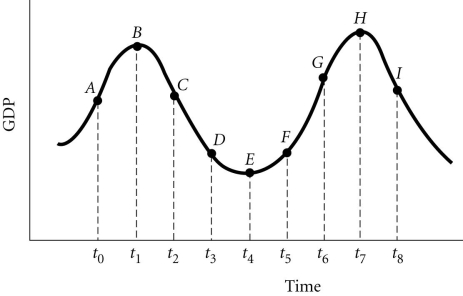 Figure 14.1
-Refer to Figure 14.1. If policy makers take an action at time t4, the impact on the economy will not be at time t4 because
Figure 14.1
-Refer to Figure 14.1. If policy makers take an action at time t4, the impact on the economy will not be at time t4 because (Multiple Choice)
4.8/5 (78)
(78) At the end of 2014, the economy was ________ and the deficit was ________.
(Multiple Choice)
4.9/5 (82)
(82) Refer to the information provided in Figure 14.1 below to answer the questions that follow. Figure 14.1
-Refer to Figure 14.1. If policy makers decide on a policy at point t3 but it does not affect the economy until period t6, then the policy choice is likely to be
Figure 14.1
-Refer to Figure 14.1. If policy makers decide on a policy at point t3 but it does not affect the economy until period t6, then the policy choice is likely to be (Multiple Choice)
4.9/5 (70)
(70) From 1948 to 1980, the S&P 500 stock price index remained relatively stable.
(True/False)
4.9/5 (67)
(67) The multiplier means that the response to fiscal policy is completed immediately.
(True/False)
4.8/5 (80)
(80) Among the factors that determine the price of a share of stock in a firm is
(Multiple Choice)
5.0/5 (83)
(83) Refer to the information provided in Figure 14.1 below to answer the questions that follow. Figure 14.1
-Refer to Figure 14.1. If policy makers decide on a policy at point t3 but it does not affect the economy until period t6, then the policy choice is likely to be
Figure 14.1
-Refer to Figure 14.1. If policy makers decide on a policy at point t3 but it does not affect the economy until period t6, then the policy choice is likely to be (Multiple Choice)
4.9/5 (94)
(94) The economic impact of automatic stabilizers during ________ periods is to decrease taxes.
(Multiple Choice)
4.9/5 (74)
(74) If the federal government had not bailed out the large financial institutions during the financial crisis of 2008-2009,
(Multiple Choice)
4.9/5 (94)
(94) Without targeting the deficit, which of the following is likely to occur after a negative aggregate demand shock?
(Multiple Choice)
4.8/5 (93)
(93) The economic impact of automatic stabilizers during ________ periods is to moderate economic downturns.
(Multiple Choice)
4.9/5 (76)
(76) The time it takes for a new economic policy to affect behavior in the economy is
(Multiple Choice)
4.7/5 (89)
(89) Between the first quarter of 2000 and the first quarter of 2006, the value of housing wealth decreased by about $600 billion per quarter.
(True/False)
4.8/5 (79)
(79) Without targeting the deficit, the following is likely to occur after a ________ shock: Y↓ ⇒ T↓ ⇒ deficit↑.
(Multiple Choice)
4.9/5 (81)
(81) Refer to the information provided in Figure 14.2 below to answer the questions that follow. 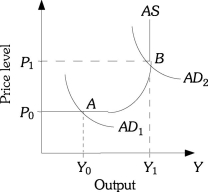 Figure 14.2
-Refer to Figure 14.2. If the economy is currently at Point B and policy makers implement a policy which shifts the aggregate demand curve to AD1, the time the economy needs to make the adjustment is known as the
Figure 14.2
-Refer to Figure 14.2. If the economy is currently at Point B and policy makers implement a policy which shifts the aggregate demand curve to AD1, the time the economy needs to make the adjustment is known as the (Multiple Choice)
4.8/5 (78)
(78) Refer to the information provided in Figure 14.1 below to answer the questions that follow. Figure 14.1
-Refer to Figure 14.1. If the condition of the economy at point E is realized by policy makers when the economy is at point G, policy is likely to be inappropriate due to
Figure 14.1
-Refer to Figure 14.1. If the condition of the economy at point E is realized by policy makers when the economy is at point G, policy is likely to be inappropriate due to (Multiple Choice)
4.8/5 (65)
(65) 
Filters
- Essay(0)
- Multiple Choice(0)
- Short Answer(0)
- True False(0)
- Matching(0)