



 Chat with AI
Exam 14: Financial Crises, Stabilization, and Deficits

Exam 1: The Scope and Method of Economics238 Questions
Exam 2: The Economic Problem: Scarcity and Choice220 Questions
Exam 3: Demand, Supply, and Market Equilibrium298 Questions
Exam 4: Demand and Supply Applications173 Questions
Exam 5: Introduction to Macroeconomics241 Questions
Exam 6: Measuring National Output and National Income292 Questions
Exam 7: Unemployment, Inflation, and Long-Run Growth297 Questions
Exam 8: Aggregate Expenditure and Equilibrium Output355 Questions
Exam 9: The Government and Fiscal Policy362 Questions
Exam 10: Money, the Federal Reserve, and the Interest Rate358 Questions
Exam 11: The Determination of Aggregate Output, the Price Level, and the Interest Rate243 Questions
Exam 12: Policy Effects and Cost Shocks in the Asad Model200 Questions
Exam 13: The Labor Market in the Macroeconomy287 Questions
Exam 14: Financial Crises, Stabilization, and Deficits260 Questions
Exam 15: Household and Firm Behavior in the Macroeconomy: a Further Look364 Questions
Exam 16: Long-Run Growth196 Questions
Exam 17: Alternative Views in Macroeconomics294 Questions
Exam 18: International Trade, Comparative Advantage, and Protectionism301 Questions
Exam 19: Open-Economy Macroeconomics: the Balance of Payments and Exchange Rates308 Questions
Exam 20: Economic Growth in Developing Economies133 Questions
Exam 21: Critical Thinking About Research105 Questions
Select questions type


The way the U.S. government borrows money to finance deficits is by the U.S. Treasury selling bills and bonds.
(True/False)
4.9/5  (79)
(79) The gain that occurs when the owner of an asset actually sells it for more than she paid for it is called a(n)
(Multiple Choice)
4.8/5 (96)
(96) Firms can finance capital spending by doing all of the following except
(Multiple Choice)
4.9/5 (83)
(83) Under the ________, the federal deficit was to be eliminated by 1991.
(Multiple Choice)
4.9/5 (80)
(80) Refer to the information provided in Figure 14.1 below to answer the questions that follow. 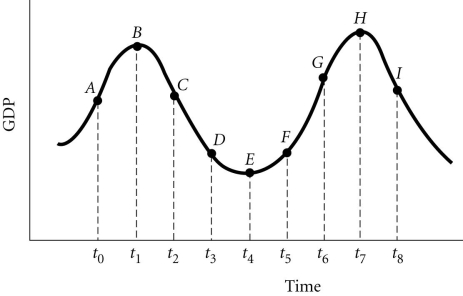 Figure 14.1
-Refer to Figure 14.1. If policy makers decide on a policy at Point t4 but it does not affect the economy until period t7, then the policy choice is likely to be
Figure 14.1
-Refer to Figure 14.1. If policy makers decide on a policy at Point t4 but it does not affect the economy until period t7, then the policy choice is likely to be (Multiple Choice)
4.8/5 (90)
(90) Refer to the information provided in Figure 14.2 below to answer the questions that follow. 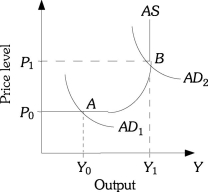 Figure 14.2
-Refer to Figure 14.2. If the economy is currently at Point A and policy makers implement a policy to increase aggregate demand, the time the economy needs to make the adjustment is known as the
Figure 14.2
-Refer to Figure 14.2. If the economy is currently at Point A and policy makers implement a policy to increase aggregate demand, the time the economy needs to make the adjustment is known as the (Multiple Choice)
4.9/5 (88)
(88) The way the U.S. government borrows money to finance deficits is by
(Multiple Choice)
4.8/5 (80)
(80) During periods of ________ growth, the Federal Reserve will likely increase the money supply to ________ interest rates.
(Multiple Choice)
4.7/5 (73)
(73) The enacted Gramm-Rudman-Hollings Act would tend to have an
(Multiple Choice)
4.8/5 (77)
(77) The legislative intent of the Gramm-Rudman-Hollings Act was to increase the nation's spending on public transfers.
(True/False)
4.8/5 (73)
(73) Without deficit targeting, a negative demand shock results in a decrease in income, but with deficit targeting, a negative demand shock results in an increase in income.
(True/False)
4.8/5 (76)
(76) Which of the following chances has the biggest expected return?
(Multiple Choice)
4.7/5 (84)
(84) Other things being equal, if the government tries to stimulate the economy through tax cuts, the government deficit will decrease.
(True/False)
4.8/5 (74)
(74) Refer to the information provided in Figure 14.1 below to answer the questions that follow. Figure 14.1
-Refer to Figure 14.1. If policy makers decide at time t5 that the economy is expanding too fast, but the policy changes start affecting the economy at t7, then the policy will be
Figure 14.1
-Refer to Figure 14.1. If policy makers decide at time t5 that the economy is expanding too fast, but the policy changes start affecting the economy at t7, then the policy will be (Multiple Choice)
4.7/5 (85)
(85) Between the first quarter of 2000 and the first quarter of 2006, the value of housing wealth
(Multiple Choice)
4.8/5 (75)
(75) 
Filters
- Essay(0)
- Multiple Choice(0)
- Short Answer(0)
- True False(0)
- Matching(0)