



 Chat with AI
Exam 11: Money Demand and the Equilibrium Interest Rate

Exam 1: The Scope and Method of Economics65 Questions
Exam 2: The Economic Problem: Scarcity and Choice107 Questions
Exam 3: Demand, Supply, and Market Equilibrium86 Questions
Exam 4: Demand and Supply Applications37 Questions
Exam 5: Introduction to Macroeconomics64 Questions
Exam 6: Measuring National Output and National Income84 Questions
Exam 7: Unemployment, Inflation, and Long-Run Growth81 Questions
Exam 8: Aggregate Expenditure and Equilibrium Output58 Questions
Exam 9: The Government and Fiscal Policy71 Questions
Exam 10: The Money Supply and the Federal Reserve System96 Questions
Exam 11: Money Demand and the Equilibrium Interest Rate96 Questions
Exam 12: The Determination of Aggregate Output, the Price Level, and the Interest Rate100 Questions
Exam 13: Policy Effects and Costs Shocks in the Asad Model89 Questions
Exam 14: The Labor Market in the Macroeconomy111 Questions
Exam 15: Financial Crises, Stabilization, and Deficits102 Questions
Exam 16: Household and Firm Behavior in the Macroeconomy: a Further Look92 Questions
Exam 17: Long-Run Growth59 Questions
Exam 18: Alternative Views in Macroeconomics88 Questions
Exam 19: International Trade, Comparative Advantage, and Protectionism63 Questions
Exam 20: Open-Economy Macroeconomics: the Balance of Payments and Exchange Rates105 Questions
Exam 21: Economic Growth in Developing and Transitional Economies48 Questions
Select questions type


Critically evaluate the following statement. "Higher bond prices are what causes lower interest rates."
(Essay)
4.8/5  (76)
(76) Assume that Kelly could decide to deposit his entire paycheck ($1,200) into her checking account at the start of the month and run her balance down to zero by the end of the month. Illustrate this with the use of a graph and determine her average monthly holdings. What is the economic cost of this money management strategy?
(Essay)
4.9/5 (74)
(74) Assume the money market is initially in equilibrium. Now, suppose that the aggregate price level falls. Graphically illustrate and explain what effect this reduction in the aggregate price level will have on the money market.
(Essay)
4.8/5 (78)
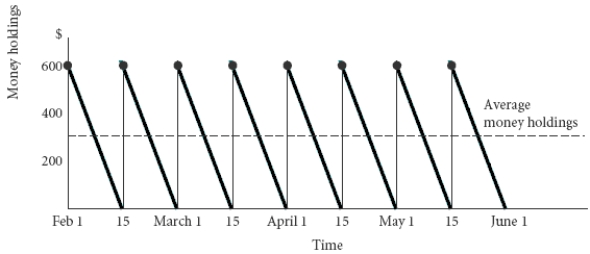
(78) Assume that Joe chooses to deposit half his paycheck of $1200 and invests the remaining $600 in an interst-bearing account and runs his balance down evenly throughout the course of the month. Show with the use of a graph what his average monthly holdings would look like.
(Essay)
4.9/5 (77)
(77) Suppose there is an excess supply for money. Explain what will happen in the money market as a result of this.
(Essay)
4.9/5 (81)
(81) Assume for some reason that the demand for money has risen. In addition, the Fed has responded to this development by increasing the money supply. Explain why the movement of the interest rate is largely indeterminate. In other words, what information are we lacking in order to make a definitive statement about the direction of the interest rate?
(Essay)
4.8/5 (72)
(72) Draw the demand curve for money balances and explain how the interest rate affects the number of switches that an individual would make between money balances and bonds.
(Essay)
4.8/5 (85)
(85) Explain what is meant by the "speculation motive" for holding money.
(Essay)
4.9/5 (100)
(100) Assume that Joe chooses to deposit his entire paycheck of $1200 and runs his balance down evenly throughout the course of the month. Show with the use of a graph what his average monthly holdings would look like.
(Essay)
4.8/5 (70)
(70) Critically evaluate the following statement. "A decrease in the interest rate will not increase the demand for money."
(Essay)
5.0/5 (87)
(87) Label each of the following events as either leading to an increase or a decrease in the equilibrium interest rate?

(Essay)
4.8/5 (75)
(75) Draw the demand and the supply for money and identify the equilibrium interest rate. Make sure to draw a money supply curve that is independent of the interest rate. Draw the curves so that the equilibrium interest rate is 8%. Explain why interest rates above or below 8% are not stable.
(Essay)
4.9/5 (82)
(82) It is clear that the Fed can affect short-term interest rates by changing the money supply. Can it also affect long-term interest rates? That is, if it can affect the interest rate on a one-year security can it also affect the interest rate on a two-year security? If so, explain your reasoning.
(Essay)
4.8/5 (88)
(88) Briefly explain the concept of the "term structure of interest rates."
(Essay)
4.9/5 (73)
(73) Graphically demonstrate the effect on the interest rate of a decrease of the money supply by the Fed.
(Essay)
4.9/5 (85)
(85) Summarize the determinants of the demand for money.
(a) aggregate output
(b) the prices of goods and services
(Essay)
4.8/5 (73)
(73) 
Filters
- Essay(0)
- Multiple Choice(0)
- Short Answer(0)
- True False(0)
- Matching(0)