



 Chat with AI
Exam 11: Money Demand and the Equilibrium Interest Rate

Exam 1: The Scope and Method of Economics65 Questions
Exam 2: The Economic Problem: Scarcity and Choice107 Questions
Exam 3: Demand, Supply, and Market Equilibrium86 Questions
Exam 4: Demand and Supply Applications37 Questions
Exam 5: Introduction to Macroeconomics64 Questions
Exam 6: Measuring National Output and National Income84 Questions
Exam 7: Unemployment, Inflation, and Long-Run Growth81 Questions
Exam 8: Aggregate Expenditure and Equilibrium Output58 Questions
Exam 9: The Government and Fiscal Policy71 Questions
Exam 10: The Money Supply and the Federal Reserve System96 Questions
Exam 11: Money Demand and the Equilibrium Interest Rate96 Questions
Exam 12: The Determination of Aggregate Output, the Price Level, and the Interest Rate100 Questions
Exam 13: Policy Effects and Costs Shocks in the Asad Model89 Questions
Exam 14: The Labor Market in the Macroeconomy111 Questions
Exam 15: Financial Crises, Stabilization, and Deficits102 Questions
Exam 16: Household and Firm Behavior in the Macroeconomy: a Further Look92 Questions
Exam 17: Long-Run Growth59 Questions
Exam 18: Alternative Views in Macroeconomics88 Questions
Exam 19: International Trade, Comparative Advantage, and Protectionism63 Questions
Exam 20: Open-Economy Macroeconomics: the Balance of Payments and Exchange Rates105 Questions
Exam 21: Economic Growth in Developing and Transitional Economies48 Questions
Select questions type


Suppose there is an excess demand for money. Explain what will happen in the money market as a result of this.
(Essay)
4.8/5  (78)
(78) By the middle of 2008 the Fed had driven the short-term interest rate close to zero, and it remained at essentially zero through the middle of 2010. How do you think this affected people's decision of whether to hold on to money or hold bonds instead?
(Essay)
4.8/5 (82)
(82) 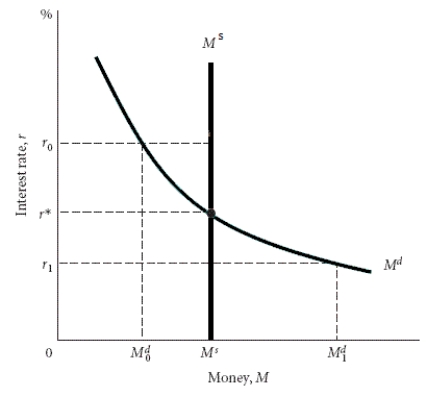 -Using the graph above, answer the following questions.
a. Which interest rate would result in an excess demand for money? What would eventually happen to the interest rate?
b. Which interest rate would result in an excess supply for money? What would eventually happen to the interest rate?
-Using the graph above, answer the following questions.
a. Which interest rate would result in an excess demand for money? What would eventually happen to the interest rate?
b. Which interest rate would result in an excess supply for money? What would eventually happen to the interest rate? (Essay)
4.8/5 (73)
(73) Assume the money market is initially in equilibrium. Now, suppose the Fed sells bonds. Graphically illustrate and explain what effect this Fed open-market sale of bonds will have on the money market.
(Essay)
4.8/5 (91)
(91) In simple terms how is the interest rate determined in the economy and explain why?
(Essay)
4.8/5 (77)
(77) Assume that the interest rate paid on bonds rises from 4% to 6%. Explain what would happen to the level of optimal (money) balances.
(Essay)
5.0/5 (88)
(88) Draw a graph illustrating the idea behind the non-synchronization of income and spending.
(Essay)
4.7/5 (76)
(76) Draw a demand curve for money. Explain the two factors that could cause an increase in the demand for money.
(Essay)
4.8/5 (73)
(73) Why are money demand and saving not really the same thing for the household?
(Essay)
4.9/5 (82)
(82) What do economists mean when they say that there is an "excess supply of money" in the economy? Illustrate this situation graphically. If there is an excess supply of money, what happens to the interest rate? How does the change in the interest rate influence the trade-off between holding money and holding bonds?
(Essay)
4.9/5 (89)
(89) Explain how people will switch between bonds and money if the interest rate is initially below the market-clearing level. Explain your answer in terms of opportunity costs.
(Essay)
4.9/5 (78)
(78) Assume that the current interest rate is 9% . Assume that investors know that normally interest rates are 7%. How would this affect investors' decisions with regard to how much money and bold holdings to keep?
(Essay)
4.9/5 (93)
(93) Show on a graph what the effect on the demand for money would be after an increase in income.
(Essay)
4.8/5 (84)
(84) Assume the money market is initially in equilibrium. Now suppose there is an increase in income. Explain what effect this increase in income will have on the equilibrium interest rate. Also explain what the Fed would have to do if it wants to prevent this change in Y from affecting the interest rate.
(Essay)
4.9/5 (69)
(69) Explain the trade-off between holding bonds and holding money. Why don't people keep all their assets in the forms that are the easiest to use for making transactions?
(Essay)
4.8/5 (72)
(72) 
Filters
- Essay(0)
- Multiple Choice(0)
- Short Answer(0)
- True False(0)
- Matching(0)