



 Chat with AI
Exam 24: Standard Cost Systems

Exam 1: Accounting: Information for Decision Making118 Questions
Exam 2: Basic Financial Statements142 Questions
Exam 3: The Accounting Cycle: Capturing Economic Events150 Questions
Exam 4: The Accounting Cycle: Accruals and Deferrals131 Questions
Exam 5: The Accounting Cycle: Reporting Financial Results126 Questions
Exam 6: Merchandising Activities121 Questions
Exam 7: Financial Assets206 Questions
Exam 8: Inventories and the Cost of Goods Sold147 Questions
Exam 9: Plant and Intangible Assets147 Questions
Exam 10: Liabilities197 Questions
Exam 11: Stockholders Equity: Paid-In Capital148 Questions
Exam 12: Income and Changes in Retained Earnings133 Questions
Exam 13: Statement of Cash Flows163 Questions
Exam 14: Financial Statement Analysis146 Questions
Exam 15: Global Business and Accounting82 Questions
Exam 16: Management Accounting112 Questions
Exam 17: Job Order Cost Systems and Overhead Allocations103 Questions
Exam 18: Process Costing83 Questions
Exam 19: Costing and the Value Chain70 Questions
Exam 20: Cost-Volume-Profit Analysis121 Questions
Exam 21: Incremental Analysis97 Questions
Exam 22: Responsibility Accounting and Transfer Pricing88 Questions
Exam 23: Operational Budgeting93 Questions
Exam 24: Standard Cost Systems110 Questions
Exam 25: Rewarding Business Performance69 Questions
Exam 26: Capital Budgeting99 Questions
Exam 27: the Time Value of Money: Future Amounts and Present Values49 Questions
Exam 28: Forms of Business Organization51 Questions
Select questions type


Standard cost system-disposition of variances
The cost of goods sold at standard cost for Field Company for 2018 amounted to $425,000 and was 60% of net sales.As of the end of 2018,the total of balances remaining in cost variance accounts was a net unfavorable cost variance of $8,000,which is not considered material.
(a)What is the amount shown in Field 's 2018 income statement for cost of goods sold? $________
(b)What is the amount reported in Field 's 2018 income statement for gross profit on sales? $________
(If required,round your answer to nearest whole dollar value. )
(Essay)
4.9/5  (78)
(78) [The following information applies to the questions displayed below.]
Roman Mfg.'s July production involved actual direct labor costs of $46,287 for 3,700 direct labor hours.The budget for the July level of production called for 3,800 direct labor hours at $12.50 per hour,using a standard cost system.
-With respect to labor costs,Roman's production manager is responsible for:
(Multiple Choice)
4.9/5 (73)
(73) [The following information applies to the questions displayed below.]
Maple Company's flexible budget,based upon the number of equivalent units produced,called for the use of 5,000 square yards of fabric at a standard cost of $2.45 per square yard.The Production Department actually used 5,200 square yards costing $2.35 per square yard during June.
-The journal entry to record the cost of direct materials used in June includes:
(Multiple Choice)
4.9/5 (74)
(74) Which of the following is not an advantage of using a standard cost system?
(Multiple Choice)
4.9/5 (83)
(83) In establishing standard costs for labor,management must look at all of the following except:
(Multiple Choice)
4.9/5 (75)
(75) If the actual amount of direct materials used in production was less than the standard amount allowed for units produced,there was:
(Multiple Choice)
4.9/5 (77)
(77) A favorable variance would be credited to a cost variance account.
(True/False)
4.9/5 (70)
(70) A materials quantity variance is the standard price multiplied by standard quantity,less actual quantity.
(True/False)
4.9/5 (86)
(86) [The following information applies to the questions displayed below.]
James Inc.'s flexible budget for June,based upon actual output,called for the use of 10,500 pounds of materials at a standard cost of $7.40 per pound.The Production Department actually used 10,700 pounds of materials costing $7.10 per pound during June.
-James's materials price variance for June is:
(Multiple Choice)
4.7/5 (73)
(73) The Delux Company purchased and used 2,900 yards of material in its manufacturing process.The actual cost of the materials was $2.20 per yard.Standard materials and costs were 2,700 yards at $2.00 per yard.
Required:
(a)Compute the materials quantity variance.
(b)Compute the materials price variance.
(c)Compute the total material variance.
(Essay)
5.0/5 (90)
(90) In a standard cost system actual costs are recorded in Material,Direct Labor,and Overhead accounts,but standard costs are charged to Work in Process.
(True/False)
4.8/5 (74)
(74) A total cost variance for materials can be caused by differences in the quantity used,or in the price paid,but not by both.
(True/False)
4.8/5 (84)
(84) [The following information applies to the questions displayed below.]
Cooper Corporation produces decorator wall coverings.Budgeted production is 240,000 square feet per month,and the standard direct labor requirement to make this amount is 6,000 hours.All overhead is allocated based on direct labor hours.The following information is available:
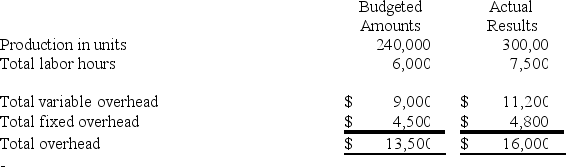 -The overhead volume variance for the month in question was:
 (Multiple Choice)
4.7/5 (68)
(68) Dawson Company has a union contract that calls for an 8% cost of living increase in the wages paid to all factory workers as of July 1 of the current year.This suggests that:
(Multiple Choice)
4.9/5 (86)
(86) A standard cost is the per unit cost actually incurred under normal operating conditions.
(True/False)
4.8/5 (78)
(78) EJB Company used a "normal" production level of 10,000 units to determine the standard per-unit cost of manufacturing overhead.Which of the following is not true?
(Multiple Choice)
4.9/5 (78)
(78) [The following information applies to the questions displayed below.]
James Inc.'s flexible budget for June,based upon actual output,called for the use of 10,500 pounds of materials at a standard cost of $7.40 per pound.The Production Department actually used 10,700 pounds of materials costing $7.10 per pound during June.
-Greenleaf's flexible budget for June,based on actual output,called for the use of 10,000 square feet of materials at a standard cost of $9.90 per square foot.Company records show that the actual price paid for the materials used in June was $9.70 per square foot,and that the direct materials price variance for the month was $2,090 favorable.The materials quantity variance for Greenleaf's June operations was:
(Multiple Choice)
4.9/5 (73)
(73) Favorable standard cost variances are normally closed at the end of the period by:
(Multiple Choice)
4.8/5 (75)
(75) 
Filters
- Essay(0)
- Multiple Choice(0)
- Short Answer(0)
- True False(0)
- Matching(0)