



 Chat with AI
Exam 24: Standard Cost Systems

Exam 1: Accounting: Information for Decision Making118 Questions
Exam 2: Basic Financial Statements142 Questions
Exam 3: The Accounting Cycle: Capturing Economic Events150 Questions
Exam 4: The Accounting Cycle: Accruals and Deferrals131 Questions
Exam 5: The Accounting Cycle: Reporting Financial Results126 Questions
Exam 6: Merchandising Activities121 Questions
Exam 7: Financial Assets206 Questions
Exam 8: Inventories and the Cost of Goods Sold147 Questions
Exam 9: Plant and Intangible Assets147 Questions
Exam 10: Liabilities197 Questions
Exam 11: Stockholders Equity: Paid-In Capital148 Questions
Exam 12: Income and Changes in Retained Earnings133 Questions
Exam 13: Statement of Cash Flows163 Questions
Exam 14: Financial Statement Analysis146 Questions
Exam 15: Global Business and Accounting82 Questions
Exam 16: Management Accounting112 Questions
Exam 17: Job Order Cost Systems and Overhead Allocations103 Questions
Exam 18: Process Costing83 Questions
Exam 19: Costing and the Value Chain70 Questions
Exam 20: Cost-Volume-Profit Analysis121 Questions
Exam 21: Incremental Analysis97 Questions
Exam 22: Responsibility Accounting and Transfer Pricing88 Questions
Exam 23: Operational Budgeting93 Questions
Exam 24: Standard Cost Systems110 Questions
Exam 25: Rewarding Business Performance69 Questions
Exam 26: Capital Budgeting99 Questions
Exam 27: the Time Value of Money: Future Amounts and Present Values49 Questions
Exam 28: Forms of Business Organization51 Questions
Select questions type


[The following information applies to the questions displayed below.]
The Starbright Corporation has compiled the following data.The company intends to use this information to develop standard costs per unit for its single product:
Direct materials = $50 per ton
Direct labor = $12.75 per hour
Variable manufacturing overhead = $5 per direct labor hour
Fixed manufacturing overhead = $18,700
Expected production = 1,700 units
Each unit of the company's single product requires 2.5 tons of direct materials and 22.5 hours to manufacture.
-What is the standard total manufacturing overhead cost?
(Multiple Choice)
4.9/5  (70)
(70) If fewer units are produced than had been estimated when standard unit costs were determined,there would normally be:
(Multiple Choice)
4.9/5 (83)
(83) [The following information applies to the questions displayed below.]
James Inc.'s flexible budget for June,based upon actual output,called for the use of 10,500 pounds of materials at a standard cost of $7.40 per pound.The Production Department actually used 10,700 pounds of materials costing $7.10 per pound during June.
-The materials quantity variance for James's June operations is:
(Multiple Choice)
4.8/5 (77)
(77) Standard cost systems are generally compatible with job cost systems or with process cost systems.
(True/False)
4.9/5 (96)
(96) A favorable variance occurs when actual costs are less than standard costs.
(True/False)
4.9/5 (95)
(95) In setting standard costs,management's expectations are that the standard costs will always be met.
(True/False)
4.8/5 (85)
(85) Standard cost system-using variance data
During its first month of operations,the Beech Company charged Work in Process Inventory with $40,000 of direct materials,$46,000 of direct labor costs,and $80,000 of manufacturing overhead costs.Beech Company uses a standard cost system,and the variances at the end of this first month are as follows: 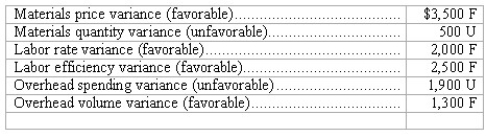 (a)Compute the actual cost of direct materials placed into production during the month.$________
(b)Compute the actual cost of direct labor hours worked during this month.$________
(c)Compute the actual cost of manufacturing overhead for this month.$________
(d)Assume that the balance in the Work in Process account is $6,000 at the end of this first month.If total standard unit cost is $20 per unit,the number of units completed during this month and transferred to Finished Goods Inventory is ________ units.
(a)Compute the actual cost of direct materials placed into production during the month.$________
(b)Compute the actual cost of direct labor hours worked during this month.$________
(c)Compute the actual cost of manufacturing overhead for this month.$________
(d)Assume that the balance in the Work in Process account is $6,000 at the end of this first month.If total standard unit cost is $20 per unit,the number of units completed during this month and transferred to Finished Goods Inventory is ________ units. (Essay)
4.8/5 (77)
(77) [The following information applies to the questions displayed below.]
Eagle Company uses a standard cost system that has provided the following data:
 -The direct labor efficiency variance for the period was:
 (Multiple Choice)
4.9/5 (71)
(71) If actual direct labor cost was $7,560 and standard labor cost was $7,000,the journal entry to record this would include:
(Multiple Choice)
4.9/5 (93)
(93) An unfavorable labor efficiency variance is most likely to occur if:
(Multiple Choice)
4.8/5 (81)
(81) An unfavorable labor rate variance could most likely result from all of the following except:
(Multiple Choice)
4.9/5 (91)
(91) A materials price variance is arrived at by taking standard quantity multiplied by actual price,less standard price.
(True/False)
4.8/5 (76)
(76) If the standard quantity of materials is 84,500 units at $0.15 per unit and the actual quantity is 95,000 units at $0.12 per unit,then the materials price variance is:
(Multiple Choice)
4.8/5 (72)
(72) A labor efficiency variance relates to the number of hours actually worked,compared to the standard hours.
(True/False)
4.8/5 (77)
(77) Standard costs are established only for direct labor and direct materials.
(True/False)
4.8/5 (78)
(78) A favorable materials price variance indicates that actual prices paid in acquiring materials were more than standard prices.
(True/False)
4.8/5 (88)
(88) The journal entry to record the cost of direct labor used in this period includes:
(Multiple Choice)
5.0/5 (90)
(90) 
Filters
- Essay(0)
- Multiple Choice(0)
- Short Answer(0)
- True False(0)
- Matching(0)