



 Chat with AI
Exam 11: Capital Budgeting and Investment Analysis

Exam 1: Managerial Accounting Concepts and Principles251 Questions
Exam 2: Job Order Costing and Analysis216 Questions
Exam 3: Process Costing and Analysis231 Questions
Exam 4: Activity-Based Costing and Analysis223 Questions
Exam 5: Cost Behavior and Cost-Volume-Profit Analysis248 Questions
Exam 6: Variable Costing and Analysis202 Questions
Exam 7: Master Budgets and Performance Planning215 Questions
Exam 8: Flexible Budgets and Standard Costs221 Questions
Exam 9: Performance Measurement and Responsibility Accounting210 Questions
Exam 10: Relevant Costing for Managerial Decisions145 Questions
Exam 11: Capital Budgeting and Investment Analysis157 Questions
Exam 12: Reporting Cash Flows240 Questions
Exam 13: Analysis of Financial Statements235 Questions
Exam 14: Time Value of Money83 Questions
Exam 15: Lean Principles and Accounting27 Questions
Exam 16: Accounting for Business Transactions251 Questions
Select questions type


A company can buy a machine that is expected to have a three-year life and a $30,000 salvage value. The machine will cost $1,800,000 and is expected to produce a $200,000 after-tax net income to be received at the end of each year. If a table of present values of $1 at 12% shows values of 0.8929 for one year, 0.7972 for two years, and 0.7118 for three years, what is the net present value of the cash flows from the investment, discounted at 12%?
(Multiple Choice)
4.9/5  (82)
(82) When making capital budgeting decisions, companies usually prefer shorter payback periods. Explain why shorter payback periods are desirable.
(Essay)
4.9/5 (76)
(76) The calculation of annual net cash flow from a particular investment project should include all of the following except:
(Multiple Choice)
4.9/5 (80)
(80) The minimum acceptable rate of return on an investment, often the company's cost of capital, is called the ________.
(Short Answer)
5.0/5 (88)
(88) In calculating the accounting rate of return using the straight-line method of depreciation, the annual average investment is calculated as (beginning book value + ending book value)/2.
(True/False)
4.8/5 (85)
(85) A project requires a $30,000 investment and is expected to generate end-of-period annual cash inflows as follows: Year 1 Year 2 Year 3 Total \ 12,000 \ 8,000 \ 10,000 \ 30,000 Assuming a discount rate of 10%, what is the net present value of this investment? Selected present value factors for a single sum are shown in the table below:
=10\% i=10\% i=10\% n=1 n=2 n=3 0.9091 0.8264 0.7513
(Multiple Choice)
4.9/5 (77)
(77) Using a profitability index allows management to rank projects of similar risks with different investment amounts.
(True/False)
4.7/5 (74)
(74) The net present value decision rule requires that when an asset's expected cash flows are discounted at the required rate and yield a positive net present value, the project should be ________.
(Essay)
4.7/5 (86)
(86) Projects with shorter payback periods have higher risk, as the company has less time to respond to unanticipated changes.
(True/False)
4.9/5 (78)
(78) A positive profitability index indicates a positive net present value.
(True/False)
4.9/5 (81)
(81) The accounting rate of return uses cash flows in its calculation.
(True/False)
4.8/5 (73)
(73) A disadvantage of using the payback period to compare investment alternatives is that:
(Multiple Choice)
4.9/5 (67)
(67) In evaluating capital budgeting alternatives, there are two primary methods that do not consider the time value of money. These methods are ________ and ________. There are also two primary methods that consider the time value of money; these are ________ and ________.
(Essay)
4.9/5 (90)
(90) A company is considering a 5-year project. The company plans to invest $60,000 now and it forecasts cash flows for each year of $16,200. The company requires a hurdle rate of 12%. Calculate the internal rate of return to determine whether it should accept this project. Selected factors for a present value of an annuity of $1 for five years are shown below: 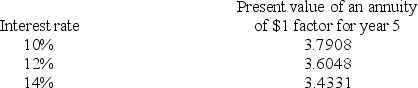
(Multiple Choice)
4.9/5 (72)
(72) When comparing investments with similar lives and risks, a company will prefer the investment with the higher rate of return.
(True/False)
4.8/5 (74)
(74) The net present value decision rule is: When an asset's expected cash flows yield a positive net present value when discounted at the required rate of return, the asset should be acquired.
(True/False)
4.8/5 (91)
(91) The ________ is computed by discounting the future net cash flows from the investment at the project's required rate of return and then subtracting the initial amount invested.
(Short Answer)
4.8/5 (78)
(78) The capital budgeting process involves all of the following except:
(Multiple Choice)
4.8/5 (76)
(76) A minimum acceptable rate of return for an investment decision is called the:
(Multiple Choice)
4.9/5 (80)
(80) 
Filters
- Essay(0)
- Multiple Choice(0)
- Short Answer(0)
- True False(0)
- Matching(0)