



 Chat with AI
Exam 11: Capital Budgeting and Investment Analysis

Exam 1: Managerial Accounting Concepts and Principles251 Questions
Exam 2: Job Order Costing and Analysis216 Questions
Exam 3: Process Costing and Analysis231 Questions
Exam 4: Activity-Based Costing and Analysis223 Questions
Exam 5: Cost Behavior and Cost-Volume-Profit Analysis248 Questions
Exam 6: Variable Costing and Analysis202 Questions
Exam 7: Master Budgets and Performance Planning215 Questions
Exam 8: Flexible Budgets and Standard Costs221 Questions
Exam 9: Performance Measurement and Responsibility Accounting210 Questions
Exam 10: Relevant Costing for Managerial Decisions145 Questions
Exam 11: Capital Budgeting and Investment Analysis157 Questions
Exam 12: Reporting Cash Flows240 Questions
Exam 13: Analysis of Financial Statements235 Questions
Exam 14: Time Value of Money83 Questions
Exam 15: Lean Principles and Accounting27 Questions
Exam 16: Accounting for Business Transactions251 Questions
Select questions type


The payback period method, unlike the net present value method, does not ignore cash flows after the point of cost recovery.
(True/False)
4.9/5  (85)
(85) A company is considering the purchase of a new piece of equipment for $90,000. Predicted annual cash inflows from this investment are $36,000 (year 1), $30,000 (year 2), $18,000 (year 3), $12,000 (year 4) and $6,000 (year 5). The payback period is:
(Multiple Choice)
4.9/5 (75)
(75) Accounting rate of return gives managers an estimate of how soon they will recover their initial investment.
(True/False)
4.7/5 (74)
(74) Capital budgeting is the process of analyzing alternative long-term investments and deciding which assets to acquire or sell.
(True/False)
4.9/5 (79)
(79) A company is trying to decide which of two new product lines to introduce in the coming year. The company requires a 12% return on investment. The predicted revenue and cost data for each product line follows:
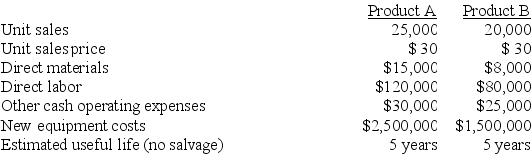 The company has a 30% tax rate and it uses the straight-line depreciation method. The present value of an annuity of 1 for 5 years at 12% is 3.6048. Compute the net present value for each piece of equipment under each of the two product lines. Which, if either of these two investments is acceptable?
 (Essay)
4.8/5 (73)
(73) Neither the payback period nor the accounting rate of return methods of evaluating investments considers the time value of money.
(True/False)
4.9/5 (72)
(72) All projects with a profitability index of less than 1 should be accepted.
(True/False)
4.8/5 (80)
(80) ________ is the process of analyzing alternative long-term investments and deciding which assets to acquire or sell.
(Short Answer)
5.0/5 (80)
(80) The following present value factors are provided for use in this problem. 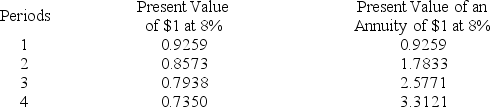 Xavier Co. wants to purchase a machine for $37,000 with a four year life and a $1,000 salvage value. Xavier requires an 8% return on investment. The expected year-end net cash flows are $12,000 in each of the four years. What is the machine's net present value?
 (Multiple Choice)
5.0/5 (80)
(80) A machine costs $180,000 and will have an eight-year life, a $20,000 salvage value, and straight-line depreciation is used. Management estimates the machine will yield an after-tax net income of $12,500 each year. Compute the accounting rate of return for the investment.
(Multiple Choice)
4.9/5 (75)
(75) Alfarsi Industries uses the net present value method to make investment decisions and requires a 15% annual return on all investments. The company is considering two different investments. Each require an initial investment of $15,000 and will produce cash flows as follows: 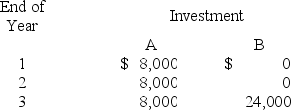 The present value factors of $1 each year at 15% are:
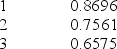 The present value of an annuity of $1 for 3 years at 15% is 2.2832
Which investment should Alfarsi choose?
The present value factors of $1 each year at 15% are:
The present value of an annuity of $1 for 3 years at 15% is 2.2832
Which investment should Alfarsi choose? (Multiple Choice)
4.8/5 (83)
(83) Two investments with exactly the same payback periods are not equally valuable to an investor because the timing of net cash flows may be different.
(True/False)
4.9/5 (85)
(85) The payback period method of evaluating an investment ignores cash inflows after the point where an investment's costs are fully recovered.
(True/False)
4.9/5 (74)
(74) Neither the net present value nor the internal rate of return methods of evaluating investments consider the time value of money.
(True/False)
4.7/5 (74)
(74) A company buys a machine for $60,000 that has an expected life of 9 years and no salvage value. The company uses straight-line depreciation. The company anticipates a yearly net income of $2,850 after taxes of 30%, with the cash flows to be received evenly throughout each year. What is the accounting rate of return?
(Multiple Choice)
4.8/5 (79)
(79) The following present value factors are provided for use in this problem. 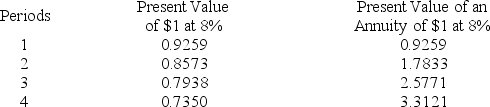 Cliff Co. wants to purchase a machine for $40,000, but needs to earn a return of 8%. The expected year-end net cash flows are $12,000 in each of the first three years, and $16,000 in the fourth year. What is the machine's net present value?
 (Multiple Choice)
4.8/5 (55)
(55) The following relates to a proposed equipment purchase:  The annual average investment amount used to calculate the accounting rate of return is:
 (Multiple Choice)
4.8/5 (93)
(93) Turk Manufacturing is considering purchasing two machines. Each machine costs $9,000 and will produce cash flows as follows: 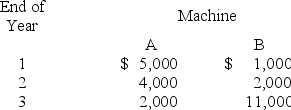 Turk Manufacturing uses the net present value method to make the decision, and it requires a 15% annual return on its investments. The present value factors of 1 at 15% are: 1 year, 0.8696; 2 years, 0.7561; 3 years, 0.6575. Which machine should Turk purchase?
 (Multiple Choice)
4.8/5 (97)
(97) A company is considering a proposal to invest $40,000 in a project that would provide the following net cash flows:
Year 1 $ 6,500
Year 2 12,700
Year 3 15,000
Year 4 12,800
Compute the project's payback period.
(Essay)
4.8/5 (73)
(73) 
Filters
- Essay(0)
- Multiple Choice(0)
- Short Answer(0)
- True False(0)
- Matching(0)