



 Chat with AI
Exam 14: Economic Growth, the Financial System, and Business Cycles

Exam 1: Economics: Foundations and Models145 Questions
Exam 2: Trade-Offs, comparative Advantage, and the Market System151 Questions
Exam 3: Where Prices Come From: the Interaction of Demand and Supply149 Questions
Exam 4: Market Efficiency and Market Failure171 Questions
Exam 5: The Economics of Health Care117 Questions
Exam 6: Firms, the Stock Market, and Corporate Governance126 Questions
Exam 7: Consumer Choice and Elasticity193 Questions
Exam 8: Technology,production,and Costs147 Questions
Exam 9: Firms in Perfectly Competitive Markets153 Questions
Exam 10: Monopoly and Antitrust Policy148 Questions
Exam 11: Monopolistic Competition and Oligopoly200 Questions
Exam 12: GDP: Measuring Total Production and Income135 Questions
Exam 13: Unemployment and Inflation148 Questions
Exam 14: Economic Growth, the Financial System, and Business Cycles130 Questions
Exam 15: Aggregate Demand and Aggregate Supply Analysis145 Questions
Exam 16: Money, banks, and the Federal Reserve System144 Questions
Exam 17: Monetary Policy145 Questions
Exam 18: Fiscal Policy143 Questions
Exam 19: Comparative Advantage,international Trade,and Exchange Rates158 Questions
Select questions type


Table 14-1
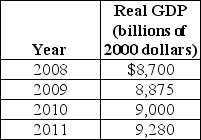 -Refer to Table 14-1.Using the table above,what is the approximate growth rate of real GDP from 2010 to 2011?
 (Multiple Choice)
4.9/5  (82)
(82) Under which of the following circumstances would private saving be positive in a closed economy?
(Multiple Choice)
4.9/5 (91)
(91) The demand for loanable funds is downward sloping because the ________ the interest rate,the ________ the number of profitable investment projects a firm can undertake,and the ________ the quantity demanded of loanable funds.
(Multiple Choice)
4.9/5 (76)
(76) An increase in the real interest rate will decrease consumption and investment.
(True/False)
4.9/5 (89)
(89) Explain and show graphically how government deficits can "crowd out" private investment.
(Essay)
4.7/5 (93)
(93) According to the "Rule of 70",it will take 4 years for real GDP per capita to double when the growth rate of real GDP per capita is
(Multiple Choice)
4.8/5 (55)
(55) Scenario 14-1
Consider the following data for a closed economy:
Y = $12 trillion
C = $8 trillion
I= $2 trillion
G = $2 trillion
TR = $2 trillion
T = $3 trillion
-Refer to Scenario 14-1.Based on the information above,what is the level of private saving in the economy?
(Multiple Choice)
4.8/5 (78)
(78) How would the equilibrium quantity of loanable funds respond to a change from an income tax to a consumption tax?
(Multiple Choice)
4.8/5 (80)
(80) According to the "Rule of 70",how many years will it take for real GDP per capita to double when the growth rate of real GDP per capita is 5%?
(Multiple Choice)
4.9/5 (76)
(76) If net taxes rise by $150 billion would you expect household saving to fall by $150 billion,by more than $150 billion,or by less than $150 billion?
(Essay)
4.8/5 (81)
(81) The response of investment spending to an increase in the government budget deficit is called
(Multiple Choice)
4.8/5 (80)
(80) How will an increase in the government budget surplus as a result of lower government spending (with no change in net taxes)affect private saving in the economy?
(Multiple Choice)
4.8/5 (67)
(67) What is "human capital," and how does human capital affect labor productivity and economic growth?
(Essay)
4.8/5 (79)
(79) If the growth rate of real GDP rises from 3% to 4% per year,then the number of years required to double real GDP will decrease from
(Multiple Choice)
4.9/5 (83)
(83) The period of expansion ends with a ________ and the period of recession ends with a ________.
(Multiple Choice)
4.9/5 (74)
(74) Purchases of which of the following goods would be dramatically reduced during a recession?
(Multiple Choice)
4.9/5 (62)
(62) 
Filters
- Essay(0)
- Multiple Choice(0)
- Short Answer(0)
- True False(0)
- Matching(0)