



 Chat with AI
Exam 2: Trade-Offs, comparative Advantage, and the Market System

Exam 1: Economics: Foundations and Models145 Questions
Exam 2: Trade-Offs, comparative Advantage, and the Market System151 Questions
Exam 3: Where Prices Come From: the Interaction of Demand and Supply149 Questions
Exam 4: Market Efficiency and Market Failure171 Questions
Exam 5: The Economics of Health Care117 Questions
Exam 6: Firms, the Stock Market, and Corporate Governance126 Questions
Exam 7: Consumer Choice and Elasticity193 Questions
Exam 8: Technology,production,and Costs147 Questions
Exam 9: Firms in Perfectly Competitive Markets153 Questions
Exam 10: Monopoly and Antitrust Policy148 Questions
Exam 11: Monopolistic Competition and Oligopoly200 Questions
Exam 12: GDP: Measuring Total Production and Income135 Questions
Exam 13: Unemployment and Inflation148 Questions
Exam 14: Economic Growth, the Financial System, and Business Cycles130 Questions
Exam 15: Aggregate Demand and Aggregate Supply Analysis145 Questions
Exam 16: Money, banks, and the Federal Reserve System144 Questions
Exam 17: Monetary Policy145 Questions
Exam 18: Fiscal Policy143 Questions
Exam 19: Comparative Advantage,international Trade,and Exchange Rates158 Questions
Select questions type


Figure 2-7 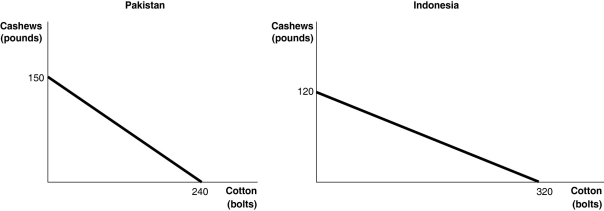 Figure 2-7 shows the production possibilities frontiers for Pakistan and Indonesia.Each country produces two goods,cotton and cashews.
-Refer to Figure 2-7.Which country has a comparative advantage in the production of cashews?
Figure 2-7 shows the production possibilities frontiers for Pakistan and Indonesia.Each country produces two goods,cotton and cashews.
-Refer to Figure 2-7.Which country has a comparative advantage in the production of cashews? (Multiple Choice)
5.0/5  (81)
(81) Figure 2-5 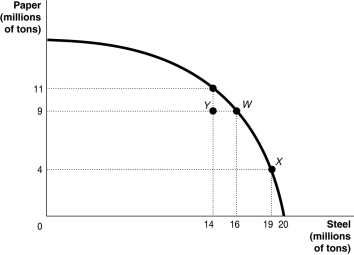 -Refer to Figure 2-5.If the economy is currently producing at point W,what is the opportunity cost of moving to point X?
 (Multiple Choice)
4.9/5 (73)
(73) For a person to have a comparative advantage in producing a product,she must be able to produce that product at a lower opportunity cost than her competitors.
(True/False)
4.9/5 (75)
(75) The resource income earned by those who supply ________ is called wages.
(Multiple Choice)
4.8/5 (75)
(75) Figure 2-4 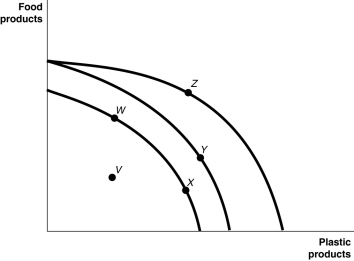 Figure 2-4 shows various points on three different production possibilities frontiers for a nation.
-Refer to Figure 2-4.Consider the following movements: a.from point V to point W
B.from point W to point Y
C.from point Y to point Z
Which of the movements listed above represents economic growth?
Figure 2-4 shows various points on three different production possibilities frontiers for a nation.
-Refer to Figure 2-4.Consider the following movements: a.from point V to point W
B.from point W to point Y
C.from point Y to point Z
Which of the movements listed above represents economic growth? (Multiple Choice)
4.8/5 (73)
(73) In the circular flow model,households supply resources such as labor services in the product market.
(True/False)
4.8/5 (74)
(74) Table 2-4
 Table 2-4 shows the number of labor hours required to produce a digital camera and a pound of wheat in China and South Korea.
-Refer to Table 2-4.If the two countries specialize and trade,who should export digital cameras?
Table 2-4 shows the number of labor hours required to produce a digital camera and a pound of wheat in China and South Korea.
-Refer to Table 2-4.If the two countries specialize and trade,who should export digital cameras? (Multiple Choice)
4.8/5 (86)
(86) Consider the following items: a.the novel "The DaVinci Code" by Dan Brown
B.the "The Spirited Shipper",an innovative wine shipping box
C.a Swiss chef's award-winning recipe
D.an original fabric design,for example,the fabric used for "Coach" bags and luggage
Which of the items listed is an example of intellectual property?
(Multiple Choice)
4.9/5 (82)
(82) Economic decline (negative growth)is represented on a production possibilities frontier model by the production possibility frontier
(Multiple Choice)
4.8/5 (81)
(81) 
Filters
- Essay(0)
- Multiple Choice(0)
- Short Answer(0)
- True False(0)
- Matching(0)