



 Chat with AI
Exam 6: Bonds

Exam 1: Corporate Finance and the Financial Manager86 Questions
Exam 2: Introduction to Financial Statement Analysis106 Questions
Exam 3: Time Value of Money: an Introduction112 Questions
Exam 4: Time Value of Money: Valuing Cash Flow Streams62 Questions
Exam 5: Interest Rates109 Questions
Exam 6: Bonds109 Questions
Exam 7: Stock Valuation63 Questions
Exam 8: Investment Decision Rules124 Questions
Exam 9: Fundamentals of Capital Budgeting111 Questions
Exam 10: Stock Valuation: a Second Look48 Questions
Exam 11: Risk and Return in Capital Markets110 Questions
Exam 12: Systematic Risk and the Equity Risk Premium103 Questions
Exam 13: The Cost of Capital110 Questions
Exam 14: Raising Equity Capital110 Questions
Exam 15: Debt Financing99 Questions
Exam 16: Capital Structure109 Questions
Exam 17: Payout Policy110 Questions
Exam 18: Financial Modeling and Pro Forma Analysis95 Questions
Exam 19: Working Capital Management110 Questions
Exam 20: Short-Term Financial Planning108 Questions
Exam 21: Option Applications and Corporate Finance102 Questions
Exam 22: Mergers and Acquisitions47 Questions
Exam 23: International Corporate Finance108 Questions
Exam 24: Leasing46 Questions
Exam 25: Insurance and Risk Management38 Questions
Exam 26: Corporate Governance45 Questions
Select questions type


A 20-year bond with a $1,000 face value was issued with a yield to maturity of 4.3% and pays coupons semi-annually. After ten years, the yield to maturity is still 4.3% and the clean price of the bond is $959.71. After three more months go by, what would you expect the dirty price to be?
(Multiple Choice)
4.8/5  (87)
(87) What is the yield to maturity of a ten-year, $10,000 bond with a 5.4% coupon rate and semiannual coupons if this bond is currently trading for a price of $9207.93?
(Multiple Choice)
4.9/5 (74)
(74) Why is the yield to maturity of a zero-coupon, risk-free bond that matures at the end of a given period the risk-free interest rate for that period?
(Multiple Choice)
4.9/5 (77)
(77) What care, if any, should be taken regarding the timing of the cash flows while drawing the timeline and associated cash flows of a coupon bond?
(Essay)
4.9/5 (80)
(80) Which of the following bonds will be most sensitive to a change in interest rates if all bonds have the same initial yield to maturity?
(Multiple Choice)
4.8/5 (57)
(57)  Lloyd Industries raised $28 million in order to upgrade its roller kiln furnace for the production of ceramic tiles. The company funded this by issuing 15-year bonds with a face value of $1,000 and a coupon rate of 6.2%, paid annually. The above table shows the yield to maturity for similar 15-year corporate bonds of different ratings issued at the same time. When Lloyd Industries issued their bonds, they received a price of $962.63. Which of the following is most likely to be the rating these bonds received?
 (Multiple Choice)
4.8/5 (83)
(83) Consider the following yields to maturity on various one-year, zero-coupon securities:
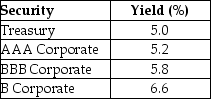 The credit spread of the BBB corporate bond is closest to ________.
 (Multiple Choice)
4.9/5 (82)
(82) How are investors in zero-coupon bonds compensated for making such an investment?
(Multiple Choice)
4.7/5 (61)
(61) Use the information for the question(s) below.  -Which of the following best describes a bond rated by Standard & Poor's and Moody as B?
 (Multiple Choice)
4.9/5 (91)
(91) What issues should one be careful of when calculating the bond price from its yield to maturity using the "cash flow" (CF) keys of a financial calculator?
(Essay)
4.8/5 (90)
(90) Which of the following statements regarding bonds and their terms is FALSE?
(Multiple Choice)
4.8/5 (65)
(65) A five-year bond with a $1,000 face value has a yield to maturity is 5.0% and it's coupon rate is 6.0% paid annually. The dirty price of this bond exactly 6 months after its second coupon payment is closest to ________.
(Multiple Choice)
4.9/5 (69)
(69) A risk-free, zero-coupon bond has 15 years to maturity. Which of the following is closest to the price per $1000 of face value that the bond will trade at if the YTM is 6.1%?
(Multiple Choice)
4.7/5 (64)
(64) A company releases a five-year bond with a face value of $1000 and coupons paid semiannually. If market interest rates imply a YTM of 6%, what should be the coupon rate offered if the bond is to trade at par?
(Multiple Choice)
4.8/5 (80)
(80) What must be the price of a $1000 bond with a 5.8% coupon rate, annual coupons, and 20 years to maturity if YTM is 7.8% APR?
(Multiple Choice)
5.0/5 (81)
(81) What must be the price of a $10,000 bond with a 6.1% coupon rate, semiannual coupons, and five years to maturity if it has a yield to maturity of 10% APR?
(Multiple Choice)
4.8/5 (86)
(86) An investor holds a Ford bond with a face value of $5000, a coupon rate of 8.5%, and semiannual payments that matures on January 15, 2029. How much will the investor receive on January 15, 2029?
(Multiple Choice)
4.9/5 (78)
(78)  Consolidated Insurance wants to raise $35 million in order to build a new headquarters. The company will fund this by issuing 10-year bonds with a face value of $1,000 and a coupon rate of 6.3%, paid semiannually. The above table shows the yield to maturity for similar 10-year corporate bonds of different ratings. Which of the following is closest to how many more bonds Consolidated Insurance would have to sell to raise this money if their bonds received an A rating rather than an AA rating?
 (Multiple Choice)
4.8/5 (68)
(68) 
Filters
- Essay(0)
- Multiple Choice(0)
- Short Answer(0)
- True False(0)
- Matching(0)