



 Chat with AI
Exam 14: Raising Equity Capital

Exam 1: Corporate Finance and the Financial Manager86 Questions
Exam 2: Introduction to Financial Statement Analysis106 Questions
Exam 3: Time Value of Money: an Introduction112 Questions
Exam 4: Time Value of Money: Valuing Cash Flow Streams62 Questions
Exam 5: Interest Rates109 Questions
Exam 6: Bonds109 Questions
Exam 7: Stock Valuation63 Questions
Exam 8: Investment Decision Rules124 Questions
Exam 9: Fundamentals of Capital Budgeting111 Questions
Exam 10: Stock Valuation: a Second Look48 Questions
Exam 11: Risk and Return in Capital Markets110 Questions
Exam 12: Systematic Risk and the Equity Risk Premium103 Questions
Exam 13: The Cost of Capital110 Questions
Exam 14: Raising Equity Capital110 Questions
Exam 15: Debt Financing99 Questions
Exam 16: Capital Structure109 Questions
Exam 17: Payout Policy110 Questions
Exam 18: Financial Modeling and Pro Forma Analysis95 Questions
Exam 19: Working Capital Management110 Questions
Exam 20: Short-Term Financial Planning108 Questions
Exam 21: Option Applications and Corporate Finance102 Questions
Exam 22: Mergers and Acquisitions47 Questions
Exam 23: International Corporate Finance108 Questions
Exam 24: Leasing46 Questions
Exam 25: Insurance and Risk Management38 Questions
Exam 26: Corporate Governance45 Questions
Select questions type


Which of the following statements regarding best efforts IPOs is FALSE?
(Multiple Choice)
4.9/5  (78)
(78) The founder of a company issues 200,000 shares of stock of series A stock for his own $250,000 investment. He then goes through three further rounds of investment, as shown below:
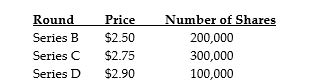 Which of the following is closest to the percentage of the company owned by the founder of the company?
 (Multiple Choice)
4.9/5 (80)
(80) How does the total cost of issuing stock for the first time compare to the costs of other securities?
(Multiple Choice)
4.9/5 (83)
(83) Which of the following best describes a limited partnership that specializes in raising money to invest in the private equity of young firms?
(Multiple Choice)
4.9/5 (79)
(79) 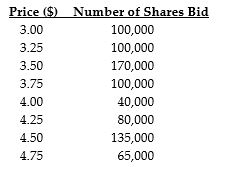 Bejeweled, a chain of crafting shops, is selling 500,000 shares of stock in an auction IPO. At the end of the bidding period they have received the bids shown above. Which of the following is closest to the price at which the shares will be offered?
 (Multiple Choice)
4.9/5 (83)
(83) What is the major reason that underwriters tend to offer stocks in an IPO at a price that is below that which the market will pay?
(Multiple Choice)
4.8/5 (64)
(64) As part of the registration statement, the preliminary prospectus circulates to investors before the stock is offered. This preliminary prospectus is also called a(n) ________.
(Multiple Choice)
4.9/5 (79)
(79) The cost of issuing an IPO in the U.S. is higher than most other security issuance fees. A typical spread is ________.
(Multiple Choice)
4.9/5 (81)
(81) Chambers Industries has a market capitalization of $800 million and 250 million shares outstanding. The management of this firm plans to raise further capital through a rights issue. Which of the following rights schemes will raise the most money, if all shareholders exercise their rights?
(Multiple Choice)
4.8/5 (83)
(83) Valiant Industries has 30 million shares of stock outstanding at a price of $28 per share. The company wishes to raise more money and plans to do so through a rights issue. Every existing stockholder will receive one right for each share of stock held. For every four rights held by the stockholder, they can buy one share at a price of $28. If all rights are exercised, how much money will be raised in this offer?
(Multiple Choice)
4.8/5 (87)
(87) Which of the following statements concerning the volume and number of IPOs issued over time is most correct?
(Multiple Choice)
4.8/5 (88)
(88) What is the difference between preferred stocks issued by a private company and a mature company?
(Essay)
4.9/5 (71)
(71) 
Filters
- Essay(0)
- Multiple Choice(0)
- Short Answer(0)
- True False(0)
- Matching(0)