



 Chat with AI
Exam 15: Debt Financing

Exam 1: Corporate Finance and the Financial Manager86 Questions
Exam 2: Introduction to Financial Statement Analysis106 Questions
Exam 3: Time Value of Money: an Introduction112 Questions
Exam 4: Time Value of Money: Valuing Cash Flow Streams62 Questions
Exam 5: Interest Rates109 Questions
Exam 6: Bonds109 Questions
Exam 7: Stock Valuation63 Questions
Exam 8: Investment Decision Rules124 Questions
Exam 9: Fundamentals of Capital Budgeting111 Questions
Exam 10: Stock Valuation: a Second Look48 Questions
Exam 11: Risk and Return in Capital Markets110 Questions
Exam 12: Systematic Risk and the Equity Risk Premium103 Questions
Exam 13: The Cost of Capital110 Questions
Exam 14: Raising Equity Capital110 Questions
Exam 15: Debt Financing99 Questions
Exam 16: Capital Structure109 Questions
Exam 17: Payout Policy110 Questions
Exam 18: Financial Modeling and Pro Forma Analysis95 Questions
Exam 19: Working Capital Management110 Questions
Exam 20: Short-Term Financial Planning108 Questions
Exam 21: Option Applications and Corporate Finance102 Questions
Exam 22: Mergers and Acquisitions47 Questions
Exam 23: International Corporate Finance108 Questions
Exam 24: Leasing46 Questions
Exam 25: Insurance and Risk Management38 Questions
Exam 26: Corporate Governance45 Questions
Select questions type


A company issues a callable (at par) 20-year, 5% coupon bond with annual coupon payments. The bond can be called at par in one year after release or any time after that on a coupon payment date. On release, it has a price of $102 per $100 of face value. What is the yield to maturity of this bond when it is released?
(Multiple Choice)
4.8/5  (84)
(84) A company issues a callable (at par) ten-year, 6% coupon bond with annual coupon payments. The bond can be called at par in one year after release or any time after that on a coupon payment date. On release, it has a price of $104 per $100 of face value. What is the yield to worst of this bond when it is released?
(Multiple Choice)
4.9/5 (69)
(69) A callable bond will typically have a ________ yield than an otherwise identical bond without a call feature because ________.
(Multiple Choice)
4.7/5 (73)
(73) 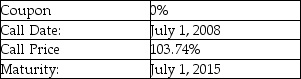 A firm issues the convertible debt shown above. The price of stock in this company on July 1, 2008 is $27.24. What is the minimum conversion ratio that would make a bondholder prefer to convert rather than accept the call price?
 (Multiple Choice)
4.7/5 (72)
(72) Eurobonds issued in the United Kingdom could NOT be issued in which of the following denominations?
(Multiple Choice)
4.9/5 (66)
(66) Which of the following is NOT an advantage of private debt over public debt?
(Multiple Choice)
4.8/5 (78)
(78) Which of the following terms best describes a loan where a larger line of credit or lower interest rate has been obtained by providing collateral to back that loan?
(Multiple Choice)
4.7/5 (72)
(72) A company issues a callable (at par) ten-year, 6% coupon bond with annual coupon payments. The bond can be called at par in one year after release or any time after that on a coupon payment date. On release, it has a price of $104 per $100 of face value. What is the yield to call of this bond when it is released?
(Multiple Choice)
4.9/5 (85)
(85) Kruller A.G. issues a bond that is offered for sale simultaneously in Europe, the United States, and Japan. Which of the following best describes this bond?
(Multiple Choice)
4.9/5 (89)
(89) Which of the following statements regarding the private debt market is FALSE?
(Multiple Choice)
4.8/5 (65)
(65) If a bond covenant is not met, then the bond goes into technical default and the bondholder can demand immediate repayment or force the company to renegotiate the terms of the bond.
(True/False)
4.8/5 (84)
(84) Supreme Industries issues the following announcement to holders of an issue of callable, convertible notes:
"Prior to the close of business on May 17, 2008, holders may convert their Notes into shares of Supreme Industries common stock at 33.25 shares of Supreme Industries common stock per $1,000 principal amount of the Notes. Cash will be paid in lieu of fractional shares. On April 16, 2008, the last reported sale price of Supreme Industries common stock on the NYSE was $21.60 per share."
If on May 17, Supreme Industries is trading as $24.60, what is the value of common stock a holder of a $1,000 note would receive?
(Multiple Choice)
4.9/5 (82)
(82) Which of the following statements concerning the use of sinking funds to repurchase a bond issue is NOT true?
(Multiple Choice)
4.8/5 (78)
(78) A company issues a callable (at par) 20-year, 5% coupon bond with annual coupon payments. The bond can be called at par in one year after release or any time after that on a coupon payment date. On release, it has a price of $102 per $100 of face value. What is the yield to call of this bond when it is released?
(Multiple Choice)
4.8/5 (91)
(91) 
Filters
- Essay(0)
- Multiple Choice(0)
- Short Answer(0)
- True False(0)
- Matching(0)