



 Chat with AI
Exam 7: The Genetics of Populations

Exam 1: An Overview of Evolutionary Biology49 Questions
Exam 2: Early Evolutionary Ideas and Darwin S Insight49 Questions
Exam 3: Natural Selection47 Questions
Exam 4: Phylogeny and Evolutionary History47 Questions
Exam 5: Inferring Phylogeny46 Questions
Exam 6: Transmission Genetics and the Sources of Genetic Variation50 Questions
Exam 7: The Genetics of Populations46 Questions
Exam 8: Evolution in Finite Populations50 Questions
Exam 9: Evolution at Multiple Loci47 Questions
Exam 10: Genome Evolution49 Questions
Exam 11: The Origin and Evolution of Early Life50 Questions
Exam 12: Major Transitions47 Questions
Exam 13: Evolution and Development45 Questions
Exam 14: Species and Speciation48 Questions
Exam 15: Extinction and Evolutionary Trends49 Questions
Exam 16: The Evolution of Sex49 Questions
Exam 17: The Evolution of Sociality50 Questions
Exam 18: Coevolution50 Questions
Exam 19: Human Evolution49 Questions
Exam 20: Evolution and Medicine50 Questions
Select questions type


The figure shows the change in allele frequencies over many generations. What differs between the populations represented by the three colors? 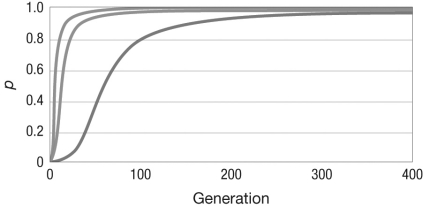
(Multiple Choice)
4.8/5  (87)
(87) Proponents of eugenics sought to eliminate alleles for so-called undesirable traits by not allowing people with those traits to reproduce. Which of the following scenarios would prevent the elimination of these alleles?
(Multiple Choice)
4.7/5 (77)
(77) Which of the following processes will result in more heterozygotes than expected under Hardy-Weinberg?
(Multiple Choice)
4.7/5 (78)
(78) Consider a locus with two alleles, A and A. If the rate of mutation from A to a is twice the rate from a to A, what will be the equilibrium frequency of the A allele? (Assume that there are no other evolutionary forces acting on these alleles. Recall that the equilibrium allele frequency under mutation is p v v, where p is the equilibrium frequency of the A allele, is the rate of mutation from A to a, and v is the rate of mutation from a to A.
(Multiple Choice)
4.7/5 (81)
(81) The Hardy-Weinberg model assumes that none of the five important evolutionary processes are operating. What are those processes?
(Essay)
5.0/5 (81)
(81) Which of the following genotypic fitness values would result in the most rapid fixation of the beneficial allele, A?
(Multiple Choice)
4.8/5 (68)
(68) Under ________ individuals tend to mate with others of the same genotype. Under ________ individuals tend to mate with others of different genotypes.
(Multiple Choice)
4.9/5 (79)
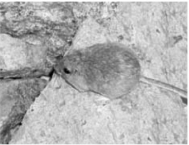
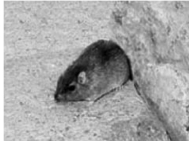
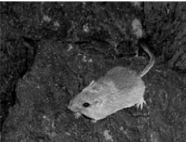
(79) Pocket mice have light- or dark-colored coats and live in dark- or light-colored habitats. Pocket mice whose coat colors match their environment are less susceptible to predation. In the scenarios shown in the figure, which of the following selection coefficients might you expect (on each genotype in each habitat)? A
 B
 C
 D
B
C
D
(Multiple Choice)
4.9/5 (97)
(97) Consider a beneficial allele in a population at a frequency of 0.9. Will that allele go to fixation more quickly if it is recessive or dominant? Explain why.
(Essay)
4.8/5 (77)
(77) Consider two events that are mutually exclusive, that is, if one occurs, the other cannot occur. The probability that either one will occur is ________, and the probability that both will occur is ________.
(Multiple Choice)
4.7/5 (70)
(70) Consider a population where individuals preferentially mate with other individuals of the same genotype. If the population starts in Hardy-Weinberg equilibrium, will this mating strategy result in changes in allele frequencies? Why or why not?
(Essay)
4.7/5 (83)
(83) The rate of mutation to a recessive lethal allele is 0.000001. What is the equilibrium frequency this allele? (Recall that the equilibrium frequency for a recessive allele under mutation-selection balance is q = s, where is the rate of mutation to the disease allele and s is the selection coefficient against that allele. In the case of a lethal allele, s 1.)
(Multiple Choice)
4.9/5 (73)
(73) A sample of 2,000 individuals from a human population was scored for MN blood group. The following frequencies were found: 1,600 MM, 250 MN, and 150 NN. How do these numbers compare to those expected under Hardy-Weinberg equilibrium?
(Multiple Choice)
4.8/5 (74)
(74) Which of the following processes can increase genetic variation in a population?
(Multiple Choice)
4.7/5 (81)
(81) Which of the following is an assumption of the Hardy-Weinberg model?
(Multiple Choice)
5.0/5 (97)
(97) Five percent of quarter horses in the United States are heterozygous for the recessive lethal allele that causes glycogen branching enzyme deficiency (GBED). Assuming that quarter horses are randomly mated, this means that the frequency of this allele is q 0.025. If the GBED allele is maintained in the population by mutation-selection balance, what is the mutation rate to the disease allele? (Recall that the equilibrium frequency for a recessive allele under mutation-selection balance is q = s, where is the rate of mutation to the disease allele and s is the selection coefficient against that allele. In the case of a lethal allele, s 1.)
(Multiple Choice)
4.9/5 (83)
(83) What type of equilibrium does the figure shown represent? If the marble is moved from its current location by a small amount, what will happen to it? 
(Essay)
5.0/5 (76)
(76) Consider a locus with two alleles, A and a. Under which of the following scenarios will the frequency of the A allele increase?
(Multiple Choice)
4.8/5 (87)
(87) 
Filters
- Essay(0)
- Multiple Choice(0)
- Short Answer(0)
- True False(0)
- Matching(0)