



 Chat with AI
Exam 14: Species and Speciation

Exam 1: An Overview of Evolutionary Biology49 Questions
Exam 2: Early Evolutionary Ideas and Darwin S Insight49 Questions
Exam 3: Natural Selection47 Questions
Exam 4: Phylogeny and Evolutionary History47 Questions
Exam 5: Inferring Phylogeny46 Questions
Exam 6: Transmission Genetics and the Sources of Genetic Variation50 Questions
Exam 7: The Genetics of Populations46 Questions
Exam 8: Evolution in Finite Populations50 Questions
Exam 9: Evolution at Multiple Loci47 Questions
Exam 10: Genome Evolution49 Questions
Exam 11: The Origin and Evolution of Early Life50 Questions
Exam 12: Major Transitions47 Questions
Exam 13: Evolution and Development45 Questions
Exam 14: Species and Speciation48 Questions
Exam 15: Extinction and Evolutionary Trends49 Questions
Exam 16: The Evolution of Sex49 Questions
Exam 17: The Evolution of Sociality50 Questions
Exam 18: Coevolution50 Questions
Exam 19: Human Evolution49 Questions
Exam 20: Evolution and Medicine50 Questions
Select questions type


A small population of a species invades an island where the species is not found. The island population subsequently diverges from the ancestral population and becomes a new species. This is an example of
(Multiple Choice)
4.7/5  (78)
(78) A population of plants experiences divergence as a result of a newly established environmental gradient. Although there is not a geographic barrier, reproduction between the two populations is increasingly rare and a hybrid zone has clearly established. As speciation continues, the hybrids experience lower and lower fecundity, and, increasingly, seeds that are produced by the hybrids are sterile. This is an example of what process?
(Multiple Choice)
5.0/5 (70)
(70) How did the morphology of the Lake Apoyo cichlids help scientists understand the sympatric speciation process in this lake?
(Multiple Choice)
4.9/5 (78)
(78) What lines of evidence led researchers to hypothesize that black spruce and red spruce form a progenitor-derivative pair?
(Essay)
4.9/5 (77)
(77) In this figure illustrating the ring species concept, which population of salamanders was the most genetically distinct from the other salamander populations? 
(Multiple Choice)
4.8/5 (74)
(74) Which of the following statements describes a challenge of applying the phenetic species concept?
(Multiple Choice)
4.8/5 (77)
(77) Which of the following is NOT a postzygotic isolating mechanism?
(Multiple Choice)
4.8/5 (76)
(76) In order to determine if individuals from separate populations are indeed distinct species, Drosophila biologists often test to see if individuals from different populations will mate with each other. This is an application of the ________ species concept.
(Multiple Choice)
4.9/5 (80)
(80) Scientists studying speciation often look at both nuclear DNA and mitochondrial DNA. Why is the genetic information obtained from mitochondrial DNA different from information obtained through nuclear DNA in sexually reproducing species?
(Multiple Choice)
4.8/5 (77)
(77) What is the most common reason for the disappearance of a hybrid zone, resulting in the completion of the speciation process?
(Multiple Choice)
4.8/5 (84)
(84) How can reproductive isolation in plants be mediated through pollinators?
(Essay)
4.9/5 (68)
(68) How is the phenetic species concept similar to the phylogenetic species concept, and how do they differ?
(Essay)
4.7/5 (84)
(84) Haldane's rule states that in hybrid offspring, the sex that is heterogametic is the sex observed to be absent, rare, or sterile. Which statement is the most likely explanation for this phenomena?
(Multiple Choice)
4.9/5 (72)
(72) Using the information provided in the table, apply Haldane's rule and indicate which sex is the heterogametic sex for each species.
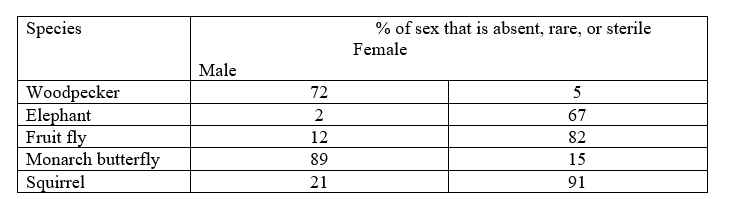
(Essay)
4.9/5 (65)
(65) Scientists have hypothesized that resource competition may facilitate sympatric speciation. These graphs illustrate two scenarios: graph A illustrates a normal distribution of both beak size and seed size, while graph B illustrates a normal distribution of beak size but a flat distribution of seed size. Which graph illustrates resource competition? 
(Multiple Choice)
5.0/5 (71)
(71) In the course of studying plant communities living on an elevational gradient in Rocky Mountain National Park, researchers observed that a plant species growing in the park appears to actually be three species. The low elevation (LE) species is more clearly distinct from the high elevation (HE) species, but the middle elevation (ME) species has characteristics of both. After taking seeds from all three populations back to their greenhouse for a reproductive study, the researchers discovered that ME plants could not successfully pollinate HE plants, but ME did produce sterile seeds with the LE plants. Which statement best describes the reproductive isolating mechanisms between these populations?
(Multiple Choice)
4.8/5 (63)
(63) The ________ species concept defines a species as a cluster of individuals that occupy a particular niche.
(Multiple Choice)
4.8/5 (79)
(79) How does the evolutionary species concept differ from the phylogenetic species concept?
(Essay)
4.9/5 (90)
(90) The figure shows the geological history of North and South America and the closing of the Isthmus of Panama. If a single species was distributed throughout the region indicated by the arrow in the left-most panel, and today is found as two separate species, one in the Atlantic Ocean and one in the Pacific, is this allopatric speciation likely to be an example of the vicariance model or the peripheral isolate model of allopatric speciation? Why? 
(Essay)
4.9/5 (83)
(83) 
Filters
- Essay(0)
- Multiple Choice(0)
- Short Answer(0)
- True False(0)
- Matching(0)