



 Chat with AI
Exam 15: Extinction and Evolutionary Trends

Exam 1: An Overview of Evolutionary Biology49 Questions
Exam 2: Early Evolutionary Ideas and Darwin S Insight49 Questions
Exam 3: Natural Selection47 Questions
Exam 4: Phylogeny and Evolutionary History47 Questions
Exam 5: Inferring Phylogeny46 Questions
Exam 6: Transmission Genetics and the Sources of Genetic Variation50 Questions
Exam 7: The Genetics of Populations46 Questions
Exam 8: Evolution in Finite Populations50 Questions
Exam 9: Evolution at Multiple Loci47 Questions
Exam 10: Genome Evolution49 Questions
Exam 11: The Origin and Evolution of Early Life50 Questions
Exam 12: Major Transitions47 Questions
Exam 13: Evolution and Development45 Questions
Exam 14: Species and Speciation48 Questions
Exam 15: Extinction and Evolutionary Trends49 Questions
Exam 16: The Evolution of Sex49 Questions
Exam 17: The Evolution of Sociality50 Questions
Exam 18: Coevolution50 Questions
Exam 19: Human Evolution49 Questions
Exam 20: Evolution and Medicine50 Questions
Select questions type


How did the cause(s) of the K-Pg extinction event differ from the Permian extinction? How were they the same?
(Essay)
4.8/5  (96)
(96) Fossil evidence from the Cambrian period indicated a large, rapid spike in speciation of marine species accompanied by increases in the number of genera and families. This would support which model of evolutionary change?
(Multiple Choice)
4.9/5 (86)
(86) Which of the following scenarios may produce an active trend in evolutionary change? Briefly justify your answer.
A. The mechanic stability of the exoskeleton of a group of terrestrial arthropods imposes an upper limit on the body size of these organisms.
B. The evolution of an endoparasitic lifestyle results in overall smaller body size as parasite species diversify to utilize small-bodied hosts, which are more common than large-bodied hosts.
(Essay)
4.8/5 (82)
(82) Why is the Permian mass extinction event often referred to as an event where life almost died? What do scientists believe caused this event and why did it result in such a catastrophic loss of diversity? 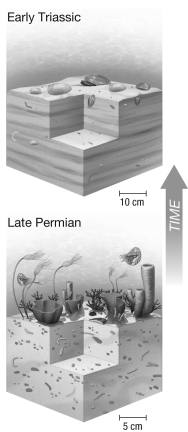
(Essay)
4.9/5 (61)
(61) The history of life on Earth as recorded by fossil evidence of one type or another is referred to as
(Multiple Choice)
4.9/5 (84)
(84) Yellowstone National Park in the United States has a caldera, essentially a super volcano, lying beneath its picturesque surface. When the caldera erupts again, it will blanket all of North America in varying depths of volcanic ash in addition to temporarily changing the atmosphere for at least a decade. This alteration of continental ecosystems will likely result in the extinction of some species. Which of the following species would be the most likely to become extinct?
(Multiple Choice)
4.9/5 (79)
(79) What does this figure tell about the differences in extinction probabilities between planktotrophic and nonplanktotrophic species? Planktotrophic
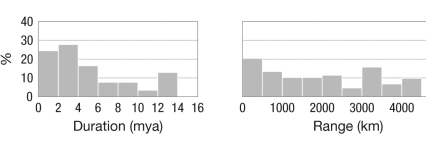 Nonplanktotrophic
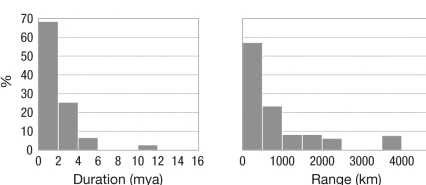
Nonplanktotrophic
(Multiple Choice)
4.8/5 (83)
(83) Explain the difference between preserving "species diversity" and preserving "phylogenetic diversity."
(Essay)
4.8/5 (85)
(85) 
Filters
- Essay(0)
- Multiple Choice(0)
- Short Answer(0)
- True False(0)
- Matching(0)