



 Chat with AI
Exam 16: The Evolution of Sex

Exam 1: An Overview of Evolutionary Biology49 Questions
Exam 2: Early Evolutionary Ideas and Darwin S Insight49 Questions
Exam 3: Natural Selection47 Questions
Exam 4: Phylogeny and Evolutionary History47 Questions
Exam 5: Inferring Phylogeny46 Questions
Exam 6: Transmission Genetics and the Sources of Genetic Variation50 Questions
Exam 7: The Genetics of Populations46 Questions
Exam 8: Evolution in Finite Populations50 Questions
Exam 9: Evolution at Multiple Loci47 Questions
Exam 10: Genome Evolution49 Questions
Exam 11: The Origin and Evolution of Early Life50 Questions
Exam 12: Major Transitions47 Questions
Exam 13: Evolution and Development45 Questions
Exam 14: Species and Speciation48 Questions
Exam 15: Extinction and Evolutionary Trends49 Questions
Exam 16: The Evolution of Sex49 Questions
Exam 17: The Evolution of Sociality50 Questions
Exam 18: Coevolution50 Questions
Exam 19: Human Evolution49 Questions
Exam 20: Evolution and Medicine50 Questions
Select questions type


Which of the following is NOT a reason why the twofold cost of sex is sometimes referred to as the "cost of males"?
(Multiple Choice)
4.9/5  (74)
(74) Which of the following is NOT a problem associated with distinguishing the Fisherian sexual selection model from the good genes model?
(Multiple Choice)
4.8/5 (72)
(72) Would there be any disadvantage of sex if sexual reproduction was isogamous?
(Multiple Choice)
5.0/5 (77)
(77) In a population that is polymorphic for sexual/asexual reproduction, a sexually transmitted disease has just eliminated most of the sexually reproducing individuals. When you expose samples of asexuals and sexuals from this population to harsh environmental conditions in the lab, you discover that the sexual individuals are worse at adapting to the new environment than the asexual individuals. (Note that your lab population is free from the sexually transmitted disease.) Which of the following statements is a likely explanation for your results?
(Multiple Choice)
4.8/5 (75)
(75) Which of the following statements describes an element of the Fisher-Muller hypothesis for adaptive advantage of sexual reproduction?
(Multiple Choice)
4.9/5 (77)
(77) Why is sexual reproduction believed to be the ancestral state in eukaryotes?
(Multiple Choice)
4.8/5 (79)
(79) Under what conditions are asexual and sexual reproduction favored by the three evolutionary models shown in the figure, involving environmental unpredictability, number of niches, and parasite load? State whether a high or low value for each condition will favor sexual or asexual reproduction. 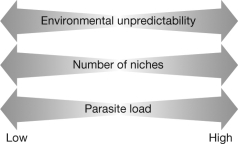 A) Low environmental unpredictability
B) High environmental unpredictability
C) Low number of niches
D) High number of niches
E) Low parasite load
F) High parasite load
A) Low environmental unpredictability
B) High environmental unpredictability
C) Low number of niches
D) High number of niches
E) Low parasite load
F) High parasite load (Essay)
5.0/5 (70)
(70) Why is male reproductive success limited by the number of eggs?
(Multiple Choice)
4.9/5 (79)
(79) 
Filters
- Essay(0)
- Multiple Choice(0)
- Short Answer(0)
- True False(0)
- Matching(0)