



 Chat with AI
Exam 18: Coevolution

Exam 1: An Overview of Evolutionary Biology49 Questions
Exam 2: Early Evolutionary Ideas and Darwin S Insight49 Questions
Exam 3: Natural Selection47 Questions
Exam 4: Phylogeny and Evolutionary History47 Questions
Exam 5: Inferring Phylogeny46 Questions
Exam 6: Transmission Genetics and the Sources of Genetic Variation50 Questions
Exam 7: The Genetics of Populations46 Questions
Exam 8: Evolution in Finite Populations50 Questions
Exam 9: Evolution at Multiple Loci47 Questions
Exam 10: Genome Evolution49 Questions
Exam 11: The Origin and Evolution of Early Life50 Questions
Exam 12: Major Transitions47 Questions
Exam 13: Evolution and Development45 Questions
Exam 14: Species and Speciation48 Questions
Exam 15: Extinction and Evolutionary Trends49 Questions
Exam 16: The Evolution of Sex49 Questions
Exam 17: The Evolution of Sociality50 Questions
Exam 18: Coevolution50 Questions
Exam 19: Human Evolution49 Questions
Exam 20: Evolution and Medicine50 Questions
Select questions type


Why do woodland star flowers likely abort flower heads with Greya moth eggs in geographic locations where other non-flower-feeding pollinators are present?
(Multiple Choice)
4.8/5  (71)
(71) Which of the following is a relationship between organisms that CANNOT evolve into a mutualistic relationship?
(Multiple Choice)
4.9/5 (87)
(87) Yellow-eyed salamanders have been cited as an example of Batesian mimicry; their orange body color and yellow eyes mimic the coloration of the toxic California newt. Although the salamanders are palatable, their mimicry of a nonpalatable species tends to prevent predators from attacking. In a follow-up study, Kuchta et al. observed the reaction of Western scrub jays (predators with toxic newt experience) when presented with both a yellow-eyed salamander and a closely related species after being presented with a toxic newt. What was significant about this study?
(Multiple Choice)
4.9/5 (84)
(84) New York City rats are famous for their scavenging ability, particularly when selecting which pizzeria dumpster yields the best garbage. In an attempt to quantify the selective pizza scavenging choices of rats in Manhattan, scientists discovered that when rats revisited their dumpster of choice, 86% of rats returned with other rats from the same age group within their colony. This behavior was repeated at multiple sites throughout the borough, suggesting that rats were transmitting information about forage sites. What type of cultural transmission would this be?
(Multiple Choice)
4.8/5 (81)
(81) How does the obligate mutualism between Glochidion trees and Epicephala moths affect cospeciation events between the two genera?
(Multiple Choice)
4.8/5 (86)
(86) Studies of rough-skinned newts have documented their ability to produce toxins in defense against a predator attack. The common garter snake, a predator of rough-skinned newts, exhibits a resistance to the toxin produced by the newt. In response, newts have been observed to produce increasingly potent toxins, which in turn results in selection for snakes with even greater resistance to the toxin. What phrase best describes this interaction between rough-skinned newts and garter snakes?
(Multiple Choice)
4.8/5 (93)
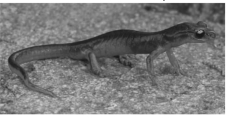
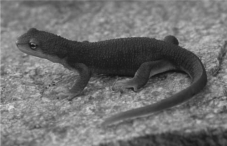
(93) Explain the dynamics of mimicry between Ensatina eschscholtzii xanthoptica and Taricha torosa. A
 B
B
(Essay)
4.8/5 (91)
(91) Which of the following differs between intra- and interspecific interactions when it comes to the evolution and maintenance of cooperation?
(Multiple Choice)
4.9/5 (79)
(79) What is the role of the bacteria found in the whitish-gray crust on the ants who tend fungal gardens? 
(Multiple Choice)
4.7/5 (65)
(65) Which of the following is a difference between genetic and cultural transmission?
(Multiple Choice)
5.0/5 (78)
(78) Which of the following is an example of an intraspecific interaction?
(Multiple Choice)
4.8/5 (81)
(81) Assume that the transmission of antibiotic-producing bacteria that live as mutualists with leaf cutter ants is strictly vertical (i.e., bacteria are only transmitted from queens to their offspring). What would you expect the topology of a phylogeny for the bacteria to look like relative to the phylogeny of their ant partners?
(Multiple Choice)
4.9/5 (68)
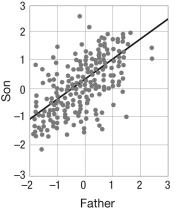
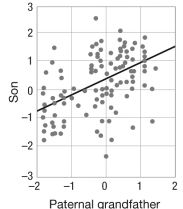
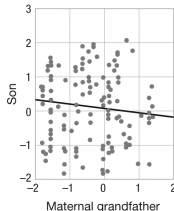
(68) How can cultural transmission of male songs facilitate the early stages of new species formation in Darwin's finches? A
 B
 C
B
C
(Essay)
4.8/5 (74)
(74) Suppose that Epicephala moths are part of a larger group of moths whose members are all seed feeders, but none of the other seed-feeding genera are involved in the pollination of their host plant. What would you conclude to be the most parsimonious pathway for the evolution of the mutualistic relationship between Epicephala and Glochidion plants?
(Multiple Choice)
4.7/5 (73)
(73) A scientist studying the migratory patterns of Pacific salmon species wanted to determine if juvenile salmon who were translocated to a different watershed would be able to learn their new migratory route from the resident fish who were unrelated to the translocated fish. This scientist was studying ________ cultural transmission.
(Multiple Choice)
4.7/5 (78)
(78) 
Filters
- Essay(0)
- Multiple Choice(0)
- Short Answer(0)
- True False(0)
- Matching(0)