



 Chat with AI
Exam 19: Human Evolution

Exam 1: An Overview of Evolutionary Biology49 Questions
Exam 2: Early Evolutionary Ideas and Darwin S Insight49 Questions
Exam 3: Natural Selection47 Questions
Exam 4: Phylogeny and Evolutionary History47 Questions
Exam 5: Inferring Phylogeny46 Questions
Exam 6: Transmission Genetics and the Sources of Genetic Variation50 Questions
Exam 7: The Genetics of Populations46 Questions
Exam 8: Evolution in Finite Populations50 Questions
Exam 9: Evolution at Multiple Loci47 Questions
Exam 10: Genome Evolution49 Questions
Exam 11: The Origin and Evolution of Early Life50 Questions
Exam 12: Major Transitions47 Questions
Exam 13: Evolution and Development45 Questions
Exam 14: Species and Speciation48 Questions
Exam 15: Extinction and Evolutionary Trends49 Questions
Exam 16: The Evolution of Sex49 Questions
Exam 17: The Evolution of Sociality50 Questions
Exam 18: Coevolution50 Questions
Exam 19: Human Evolution49 Questions
Exam 20: Evolution and Medicine50 Questions
Select questions type


As an archaeologist, a colleague asks you to confirm her identification of some fossilized burial remains of a hominin. The fossils were discovered relatively undisturbed, deep in a cave where the body was protected from scavengers. The hands of the skeleton were deliberately folded across the chest and a crude flute was clasped between the hands. The skull had a greatly reduced brow ridge and a flat face. Charcoal remains near the entrance of the cave included charred bones of a large game animal that date to approximately the same time as the skeleton; the bones were clearly scored by a tool. As which species of hominin would you identify the remains?
(Multiple Choice)
4.9/5  (68)
(68) What does this figure tell us about the relationship between heterozygosity of H. pylori and its geographic origin? 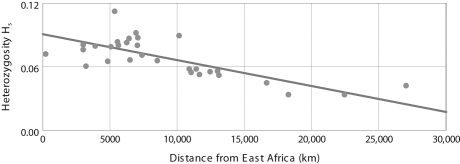
(Multiple Choice)
4.9/5 (81)
(81) If the population of the last common ancestor of humans, chimpanzees, and gorillas was very large, and humans split from chimpanzees very quickly after the gorilla lineage diverged, how might this influence the relationship between gene trees and species trees in this clade?
(Essay)
4.9/5 (93)
(93) Which of the following evidence does NOT support the out-of-Africa hypothesis?
(Multiple Choice)
4.9/5 (75)
(75) Based on the figure, is the common-language practice of referring to chimpanzees as monkeys accurate? Are monkeys a monophyletic group? 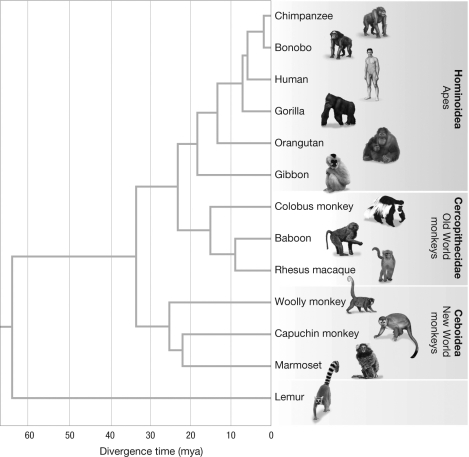
(Essay)
4.9/5 (85)
(85) What is the advantage of using DNA sequences from many genes to reconstruct the evolutionary history of humans?
(Essay)
4.9/5 (80)
(80) What do these data on mean haplotype heterozygosity from 938 human samples from around the world tell us about human migration? 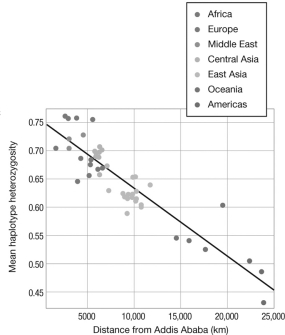
(Essay)
4.8/5 (75)
(75) Researchers studied the genetics of Helicobacter pylori, a stomach bacterium that is present in about half of the world, to see if H. pylori geographic patterns reflect those of their human host. What were the results of their study?
(Multiple Choice)
4.8/5 (86)
(86) As the African tropics changed to savanna, hominins moved onto the savanna while other apes remained in the forest. A major adaptation to the savanna was the evolution of bipedal locomotion. Which of the following is NOT a skeletal change associated with bipedal locomotion?
(Multiple Choice)
4.8/5 (78)
(78) Which of the following is NOT a feature of the revised model of human evolution? 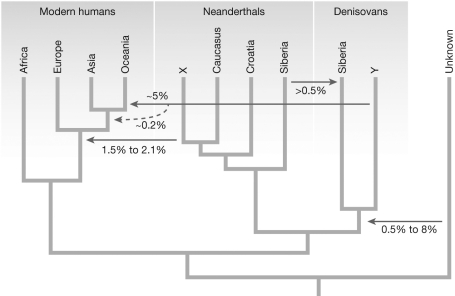
(Multiple Choice)
4.8/5 (74)
(74) What is the "serial founder effect," and what are the dynamics of genetic diversity as each new population is established?
(Essay)
4.8/5 (84)
(84) Gene trees for modern human populations were constructed using blood group data, mtDNA, and the Y chromosome. What did the research using mtDNA and Y chromosome data determine that the blood group data did not about the origin of modern humans?
(Multiple Choice)
4.8/5 (84)
(84) How did migration patterns factor in to Richard Green et al.'s hypothesis about interbreeding among Neanderthals and modern humans?
(Multiple Choice)
4.8/5 (79)
(79) What is the primary distinction between the multiregional hypothesis for human evolution and the out-of-Africa hypothesis for human evolution?
(Multiple Choice)
4.8/5 (86)
(86) What skull characteristics distinguish Paranthropus from other hominin lineages?
(Multiple Choice)
4.9/5 (78)
(78) Who was "mitochondrial Eve" and how does she support the out-of-Africa hypothesis?
(Multiple Choice)
4.8/5 (83)
(83) What does this figure tell us about diversification and effective population size in the Y chromosome and mtDNA? 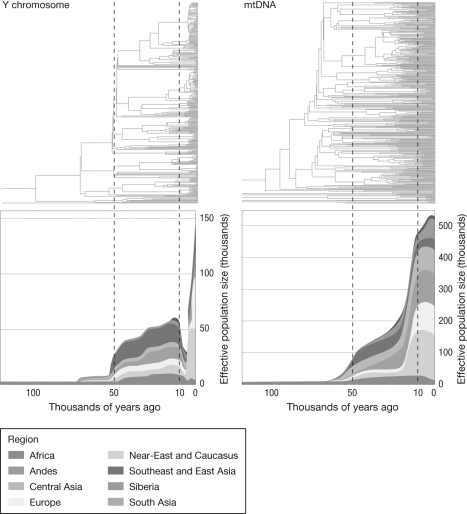
(Multiple Choice)
4.7/5 (78)
(78) What are the primary difficulties of host-pathogen coevolution studies?
(Essay)
4.7/5 (82)
(82) 
Filters
- Essay(0)
- Multiple Choice(0)
- Short Answer(0)
- True False(0)
- Matching(0)