



 Chat with AI
Exam 22: Cost-Volume-Profit Analysis

Exam 1: Accounting in Business245 Questions
Exam 2: Analyzing and Recording Transactions201 Questions
Exam 3: Adjusting Accounts and Preparing Financial Statements227 Questions
Exam 4: Completing the Accounting Cycle177 Questions
Exam 5: Accounting for Merchandising Operations189 Questions
Exam 6: Inventories and Cost of Sales194 Questions
Exam 7: Accounting Information Systems166 Questions
Exam 8: Cash and Internal Controls195 Questions
Exam 9: Accounting for Receivables162 Questions
Exam 10: Long-Term Assets208 Questions
Exam 11: Current Liabilities and Payroll Accounting178 Questions
Exam 12: Accounting for Partnerships141 Questions
Exam 13: Accounting for Corporations210 Questions
Exam 14: Long-Term Liabilities158 Questions
Exam 15: Investments and International Operations156 Questions
Exam 16: Statement of Cash Flows173 Questions
Exam 17: Analysis of Financial Statements182 Questions
Exam 18: Managerial Accounting Concepts and Principles199 Questions
Exam 19: Job Order Cost Accounting165 Questions
Exam 20: Process Cost Accounting172 Questions
Exam 21: Cost Allocation and Performance Measurement173 Questions
Exam 22: Cost-Volume-Profit Analysis190 Questions
Exam 23: Master Budgets and Planning166 Questions
Exam 24: Flexible Budgets and Standard Costs178 Questions
Exam 25: Capital Budgeting and Managerial Decisions153 Questions
Select questions type


Dunkin Company manufactures and sells a single product that sells for $480 per unit; variable costs are $300. Annual fixed costs are $990,000. Current sales volume is $4,200,000. Compute the contribution margin ratio.
(Multiple Choice)
4.9/5  (95)
(95) Wilton Company is analyzing two alternative methods of producing its product. The production manager indicates that variable costs can be reduced 40% by installing a machine that automates production, but fixed costs would increase. Alternative 1 shows costs before installing the machine; Alternative 2 shows costs after the machine is installed. (a) Compute the break-even point in units and dollars for both alternatives. (b) Prepare a forecasted income statement for both alternatives assuming that 30,000 units will be sold. The statements should report sales, total variable costs, contribution margin, fixed costs, income before taxes, income taxes, and net income. Below the income statement, compute the degree of operating leverage. Which alternative would you recommend and why?
(Essay)
4.8/5 (73)
(73) Variable costs per unit increase proportionately with increases in output activity.
(True/False)
4.9/5 (74)
(74) Solving problems to determine the relationship of cost, volume, and profit often commences with the measurement of the _____________ point. Further analysis emphasizing profitability may be accomplished by measuring the _______________ and ________________.
(Essay)
4.8/5 (66)
(66) To calculate the break-even point in units, one must know unit fixed cost, unit variable cost, and sales price.
(True/False)
4.8/5 (72)
(72) Three important assumptions in cost-volume-profit analysis is that (1) _______________ per unit is constant, (2) _____________ per unit is constant, and (3) ______________ are constant in total.
(Essay)
4.9/5 (79)
(79) The contribution margin ratio is the percent by which the margin of safety exceeds the break-even point.
(True/False)
4.9/5 (76)
(76) The high-low method is used to derive an estimated line of cost behavior by graphically connecting the two cost amounts identified with the highest and lowest volume levels.
(True/False)
4.9/5 (83)
(83) Davison Company has fixed costs of $315,000 and a contribution margin ratio of 24%. If sales are expected to be $1,500,000, what is the percentage of the margin of safety?
(Essay)
5.0/5 (82)
(82) A company has total fixed costs of $200,000. Its product sells for $25 per unit and variable costs amount to $15 per unit. The company wishes to earn an after-tax income of $35,000. Assume that the company has a 30% tax rate. How many units must be sold to achieve this after-tax income level?
(Essay)
4.7/5 (67)
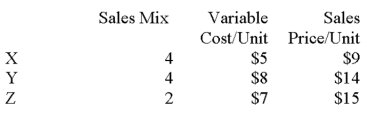
(67) Browning Company sells a mix of three related products. Total fixed costs are $144,000. The following additional information is available for Browning Company.
Use the weighted average method to determine the company's break-even point for composite units.
(Essay)
4.8/5 (79)
(79) The sales mix of Palm Company is 5 units of A, 3 units of B, and 1 unit ofC. Per unit sales prices for each product are $30, $40, and $50, respectively. Variable costs per unit are $14, $24, and $34, respectively. Fixed costs are $597,600. What is the break-even point in composite units and in units of A, B, and C?
(Essay)
4.9/5 (84)
(84) Dunkin Company manufactures and sells a single product that sells for $480 per unit; variable costs are $300. Annual fixed costs are $990,000. Current sales volume is $4,200,000. Compute the break-even point in units.
(Multiple Choice)
4.8/5 (89)
(89) A company manufactures and sells a product for $120 per unit. The company's fixed costs are $68,760, and its variable costs are $90 per unit. The company's break-even point in dollars is:
(Multiple Choice)
4.8/5 (70)
(70) A firm provides the following sales data:
Required: (a) Calculate the break-even point in dollar sales.
(b) Calculate the margin of safety in dollar sales.

(Essay)
4.9/5 (71)
(71) Joseph Co. has three products A, B, and C, and its fixed costs are $69,000. The sales mix for its products are 3 units of A, 4 units of B, and 1 unit of C. Information about the three products follows:
(a) Calculate the company's break-even point in composite units and sales dollars.
(b) Calculate the number of units of each individual product to be sold at the break-even point.

(Essay)
4.8/5 (73)
(73) Baines Brothers manufactures and sells two products, A and Z in the ratio of 4:2. Product A sells for $75; Z sells for $95. Variable costs for product A are $35; for Z $40. Fixed costs are $418,500. Compute the contribution margin per composite unit.
(Multiple Choice)
4.8/5 (87)
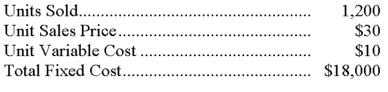
(87) Duxbury Co. reports the following data for the current year:
Required:
(a) Calculate Duxbury's pretax income.
(b) Calculate Duxbury's degree of operating leverage.
(Essay)
4.8/5 (80)
(80) The following information describes a product expected to be produced and sold by Hadley Company:
Required:
(a) Calculate the contribution margin ratio.
(b) Calculate the break-even point in dollar sales.
(c) What dollar amount of sales would be necessary to achieve a pretax income of $120,000?

(Essay)
4.7/5 (68)
(68) A company's normal operating range, which excludes extremely high and low volumes that are not likely to occur, is called the:
(Multiple Choice)
4.8/5 (86)
(86) 
Filters
- Essay(0)
- Multiple Choice(0)
- Short Answer(0)
- True False(0)
- Matching(0)