



 Chat with AI
Exam 22: Cost-Volume-Profit Analysis

Exam 1: Accounting in Business245 Questions
Exam 2: Analyzing and Recording Transactions201 Questions
Exam 3: Adjusting Accounts and Preparing Financial Statements227 Questions
Exam 4: Completing the Accounting Cycle177 Questions
Exam 5: Accounting for Merchandising Operations189 Questions
Exam 6: Inventories and Cost of Sales194 Questions
Exam 7: Accounting Information Systems166 Questions
Exam 8: Cash and Internal Controls195 Questions
Exam 9: Accounting for Receivables162 Questions
Exam 10: Long-Term Assets208 Questions
Exam 11: Current Liabilities and Payroll Accounting178 Questions
Exam 12: Accounting for Partnerships141 Questions
Exam 13: Accounting for Corporations210 Questions
Exam 14: Long-Term Liabilities158 Questions
Exam 15: Investments and International Operations156 Questions
Exam 16: Statement of Cash Flows173 Questions
Exam 17: Analysis of Financial Statements182 Questions
Exam 18: Managerial Accounting Concepts and Principles199 Questions
Exam 19: Job Order Cost Accounting165 Questions
Exam 20: Process Cost Accounting172 Questions
Exam 21: Cost Allocation and Performance Measurement173 Questions
Exam 22: Cost-Volume-Profit Analysis190 Questions
Exam 23: Master Budgets and Planning166 Questions
Exam 24: Flexible Budgets and Standard Costs178 Questions
Exam 25: Capital Budgeting and Managerial Decisions153 Questions
Select questions type


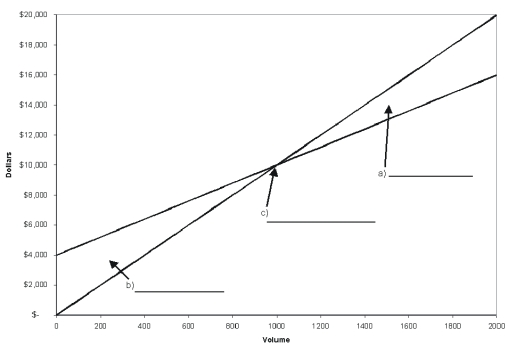
Identify items a, b, and c in the cost-volume-profit graph shown below.
(Essay)
4.8/5  (87)
(87) A company's product sells at $12 per unit and has a $5 per unit variable cost. The company's total fixed costs are $98,000. The break-even point in units is:
(Multiple Choice)
4.8/5 (70)
(70) Dunkin Company manufactures and sells a single product that sells for $480 per unit; variable costs are $300. Annual fixed costs are $990,000. Current sales volume is $4,200,000. Dunkin company management targets an annual after-tax income of $843,750. The company is subject to a 25% income tax rate. Compute the unit sales to earn the target after-tax net income.
(Multiple Choice)
4.8/5 (89)
(89) Thomas Company has total fixed costs of $360,000 and variable costs of $14 per unit. If the unit sales price is reduced from $24 to $20 and advertising is increased by $10,000, sales will increase from 40,000 to 65,000 units. Should Thomas reduce its per unit sales price and pay for the additional advertising? (Support your answer with calculations.)
(Essay)
4.9/5 (80)
(80) In cost-volume-profit analysis, the unit contribution margin is:
(Multiple Choice)
4.7/5 (61)
(61) Use the following information to determine the margin of safety in dollars:
(Multiple Choice)
4.8/5 (87)
(87) The method most likely to produce the most precise line of cost behavior is the scatter diagram.
(True/False)
4.9/5 (92)
(92) A company's product sells at $12 per unit and has a $5 per unit variable cost. The company's total fixed costs are $98,000.The contribution margin per unit is:
(Multiple Choice)
4.8/5 (75)
(75) Contribution margin is the amount of sales that exceeds total variable costs.
(True/False)
4.8/5 (87)
(87) A _______________ cost is one that remains unchanged in amount when volume of activity varies from period to period within a relevant range. A ______________ cost is one that changes in proportion to changes in volume of activity.
(Essay)
4.9/5 (89)
(89) A company has fixed costs of $90,000. Its contribution margin ratio is 30% and the product sells for $75 per unit. What is the company's break-even point in dollar sales?
(Multiple Choice)
4.9/5 (84)
(84) A firm sells two different products, A andA. Total fixed costs for this firm are $1,260,000. Additional selling prices and cost information for both products follow:
Required: (a) Calculate the contribution margin per composite unit.
(b) Calculate the break-even point in units of each individual product.
(c) If pretax income before taxes of $294,000 is desired, how many units of A and B must be sold?
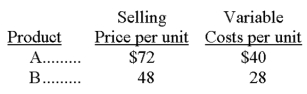 B. For each unit of B, the firm sells two units of
 (Essay)
4.9/5 (83)
(83) Baines Brothers manufactures and sells two products, A and Z in the ratio of 4:2. Product A sells for $75; Z sells for $95. Variable costs for product A are $35; for Z $40. Fixed costs are $418,500. Compute the break-even point in composite units.
(Multiple Choice)
4.9/5 (72)
(72) What are the basic assumptions of CVP analysis with regard to variable cost, fixed cost, and selling price per unit? (Assume a single product).
(Essay)
4.9/5 (80)
(80) ___________________________ is a statistical method of identifying an estimated line of cost behavior.
(Essay)
4.9/5 (81)
(81) Brown Company's contribution margin ratio is 24%. Total fixed costs are $84,000. What is Brown's break-even point in sales dollars?
(Multiple Choice)
4.9/5 (64)
(64) Hiller Co. anticipates total fixed costs of $120,000 and variable costs equal to 40% of sales. What is the pretax income if sales are $650,000?
(Essay)
4.9/5 (89)
(89) The margin of safety is the amount that sales can drop before the company incurs a loss.
(True/False)
5.0/5 (92)
(92) A graph used to analyze past cost behaviors by displaying costs and volume levels for each period as points on the diagram is called a:
(Multiple Choice)
4.8/5 (79)
(79) Which of the following is the correct interpretation of a degree of operating leverage of 5?
(Multiple Choice)
4.9/5 (96)
(96) 
Filters
- Essay(0)
- Multiple Choice(0)
- Short Answer(0)
- True False(0)
- Matching(0)