



 Chat with AI
Exam 24: Flexible Budgets and Standard Costs

Exam 1: Accounting in Business245 Questions
Exam 2: Analyzing and Recording Transactions201 Questions
Exam 3: Adjusting Accounts and Preparing Financial Statements227 Questions
Exam 4: Completing the Accounting Cycle177 Questions
Exam 5: Accounting for Merchandising Operations189 Questions
Exam 6: Inventories and Cost of Sales194 Questions
Exam 7: Accounting Information Systems166 Questions
Exam 8: Cash and Internal Controls195 Questions
Exam 9: Accounting for Receivables162 Questions
Exam 10: Long-Term Assets208 Questions
Exam 11: Current Liabilities and Payroll Accounting178 Questions
Exam 12: Accounting for Partnerships141 Questions
Exam 13: Accounting for Corporations210 Questions
Exam 14: Long-Term Liabilities158 Questions
Exam 15: Investments and International Operations156 Questions
Exam 16: Statement of Cash Flows173 Questions
Exam 17: Analysis of Financial Statements182 Questions
Exam 18: Managerial Accounting Concepts and Principles199 Questions
Exam 19: Job Order Cost Accounting165 Questions
Exam 20: Process Cost Accounting172 Questions
Exam 21: Cost Allocation and Performance Measurement173 Questions
Exam 22: Cost-Volume-Profit Analysis190 Questions
Exam 23: Master Budgets and Planning166 Questions
Exam 24: Flexible Budgets and Standard Costs178 Questions
Exam 25: Capital Budgeting and Managerial Decisions153 Questions
Select questions type


Fairfield Co. collected the following information about its production activities for the current year.
a. Compute the direct materials price and quantity variances and indicate whether each is favorable or unfavorable.
b. Prepare the journal entry to record the issuance of direct materials into production.
Actual costs and quantities:
Direct materials used 95,000 lbs. @ $6.30 per lb.
Units completed during the year, 50,000 units
Standard costs and quantities:
Price per lb. of direct material, $6.05
Two lbs. of direct material per unit
(Essay)
4.8/5  (81)
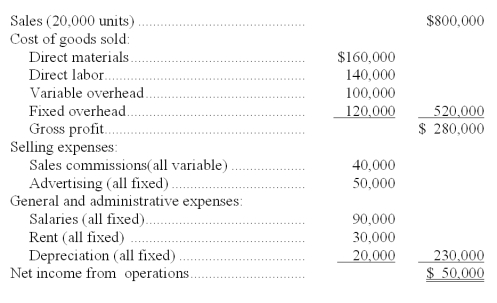
(81) Calais Company's fixed budget for the first quarter of the calendar year appears below. Prepare flexible budgets that show variable costs per unit, fixed costs and two different flexible budgets for sales volumes of 22,000 and 24,000.
(Essay)
4.8/5 (89)
(89) In the analysis of variances, management commonly focuses on four categories of production costs: __________________ cost, ___________________ cost; _________________ cost; and _________________ cost.
(Essay)
4.7/5 (86)
(86) Jacques Company planned to use 18,000 pounds of material costing $2.50 per pound to make 4,000 units of its product. In actually making 4,000 units, the company used 18,800 pounds that cost $2.54 per pound. Calculate the direct materials price variance.
(Essay)
4.9/5 (74)
(74) The difference between the actual sales and the flexible budget sales is called the ______________________ variance.
(Essay)
4.8/5 (87)
(87) A company has established 5 pounds of Material M at $2 per pound as the standard for the material in its Product A. The company has just produced 1,000 units of this product, using 5,200 pounds of Material M that cost $9,880. The direct materials quantity variance is:
(Multiple Choice)
4.7/5 (73)
(73) Use the following data to find the direct labor cost variance.
(Multiple Choice)
4.8/5 (74)
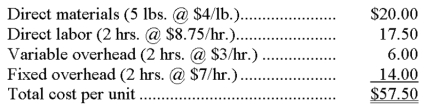
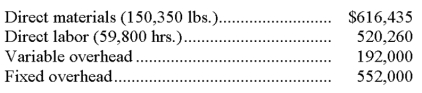
(74) Woods, Inc. budgeted the following overhead costs for the current year assuming operations at 80% of capacity, or 40,000 units:
The standard cost per unit when operating at this same 80% capacity level is:
The actual production achieved in the current year was 60% of capacity, or 30,000 units. The actual costs were:
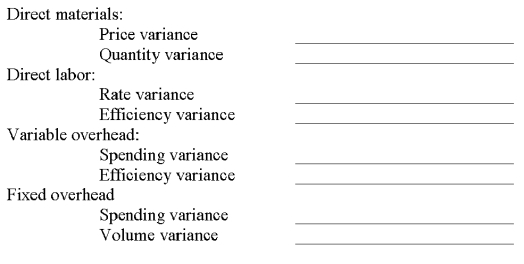
Calculate the following variances and indicate whether each is favorable or unfavorable.

(Essay)
4.8/5 (72)
(72) Brewer Company specializes in selling used cars. During the month, the dealership sold 22 cars at an average price of $15,000 each. The budget for the month was to sell 20 cars at an average price of $16,000. Compute the dealership's sales volume variance for the month.
(Multiple Choice)
4.7/5 (72)
(72) Sales variances may be computed in a manner similar to cost variances-that is, computing both price and volume variances.
(True/False)
4.9/5 (82)
(82) During November, Heim Company allocated overhead to products at the rate of $26.00 per direct labor hour. This figure was based on 80% of capacity or 1,600 direct labor hours. However, Heim Company operated at only 70% of capacity, or 1,400 direct labor hours. Budgeted overhead at 70% of capacity is $38,900, and overhead actually incurred was $38,000. What is the company's volume variance for November? (Indicate whether the variance is favorable or unfavorable)
(Essay)
4.8/5 (86)
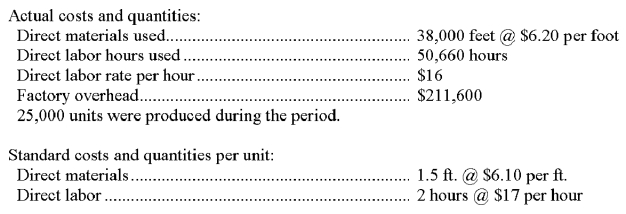
(86) The following information comes from the records of Dina Co. for the current period.
a. Compute the overhead controllable and volume variances. In each case, state whether the variance is favorable or unfavorable.
b. Prepare the journal entries to charge overhead costs to goods in process and the overhead variances to their proper accounts.
Factory overhead (based on budgeted production of 24,500 units)
Variable overhead $2.25/direct labor hour
Fixed overhead $1.95/direct labor hour
(Essay)
4.9/5 (92)
(92) One possible explanation for direct labor rate and efficiency variances is the use of workers with different skill levels.
(True/False)
4.9/5 (83)
(83) At the end of the accounting period, immaterial variances are closed to ____________________.
(Essay)
4.8/5 (78)
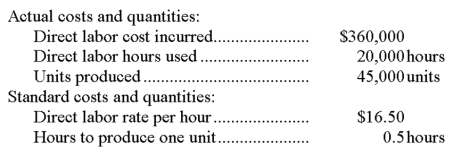
(78) Use the following cost information to calculate the direct labor rate and efficiency variances and indicate whether they are favorable or unfavorable.
(Essay)
4.7/5 (73)
(73) A company's flexible budget for 60,000 units of production showed sales of $96,000, variable costs of $36,000, and fixed costs of $26,000. What operating income would be expected if the company produces and sells 70,000 units?
(Essay)
4.8/5 (65)
(65) A company's flexible budget for 36,000 units of production showed variable overhead costs of $54,000 and fixed overhead costs of $50,000. The company actually incurred total overhead costs of $95,300 while operating at a volume of 32,000 units. What is the controllable variance?
(Essay)
4.9/5 (79)
(79) While companies strive to achieve ideal standards, reality implies that some loss of materials usually occurs with any process.
(True/False)
4.7/5 (74)
(74) Standard costs can serve as a basis for evaluating actual performance.
(True/False)
4.8/5 (69)
(69) 
Filters
- Essay(0)
- Multiple Choice(0)
- Short Answer(0)
- True False(0)
- Matching(0)