



 Chat with AI
Exam 24: Flexible Budgets and Standard Costs

Exam 1: Accounting in Business245 Questions
Exam 2: Analyzing and Recording Transactions201 Questions
Exam 3: Adjusting Accounts and Preparing Financial Statements227 Questions
Exam 4: Completing the Accounting Cycle177 Questions
Exam 5: Accounting for Merchandising Operations189 Questions
Exam 6: Inventories and Cost of Sales194 Questions
Exam 7: Accounting Information Systems166 Questions
Exam 8: Cash and Internal Controls195 Questions
Exam 9: Accounting for Receivables162 Questions
Exam 10: Long-Term Assets208 Questions
Exam 11: Current Liabilities and Payroll Accounting178 Questions
Exam 12: Accounting for Partnerships141 Questions
Exam 13: Accounting for Corporations210 Questions
Exam 14: Long-Term Liabilities158 Questions
Exam 15: Investments and International Operations156 Questions
Exam 16: Statement of Cash Flows173 Questions
Exam 17: Analysis of Financial Statements182 Questions
Exam 18: Managerial Accounting Concepts and Principles199 Questions
Exam 19: Job Order Cost Accounting165 Questions
Exam 20: Process Cost Accounting172 Questions
Exam 21: Cost Allocation and Performance Measurement173 Questions
Exam 22: Cost-Volume-Profit Analysis190 Questions
Exam 23: Master Budgets and Planning166 Questions
Exam 24: Flexible Budgets and Standard Costs178 Questions
Exam 25: Capital Budgeting and Managerial Decisions153 Questions
Select questions type


A company uses the following standard costs to produce a single unit of output. During the latest month, the company purchased and used 58,000 pounds of direct materials at a price of $1.00 per pound to produce 10,000 units of output. Direct labor costs for the month totaled $56,350 based on 4,900 direct labor hours worked. Variable manufacturing overhead costs incurred totaled $15,000 and fixed manufacturing overhead incurred was $10,400. Based on this information, the direct labor rate variance for the month was:
(Multiple Choice)
4.8/5  (88)
(88) A process of examining the differences between actual and budgeted costs and describing them in terms of the amounts that resulted from price and quantity differences is called:
(Multiple Choice)
4.7/5 (81)
(81) A cost variance is the difference between actual cost and standard cost.
(True/False)
4.8/5 (78)
(78) An analytical technique used by management to focus on the most significant variances and give less attention to the areas where performance is satisfactory is known as:
(Multiple Choice)
4.7/5 (84)
(84) For the current period, Boggs Company's manufacturing operations yield a $5,250 unfavorable price variance on its direct materials usage. The actual price per pound is $56.50 and the standard price per pound is $55.00. How many pounds of material are used in the current period?
(Multiple Choice)
4.9/5 (89)
(89) Landlubber Company established a standard direct materials cost of 1.5 gallons at $2 per gallon for one unit of its product. During the past month, actual production was 6,500 units. The material quantity variance was $700 favorable and the material price variance was $470 unfavorable. The entry to charge Goods in Process Inventory for the standard material costs during the month and to record the direct material variances in the accounts would include:
(Multiple Choice)
4.8/5 (86)
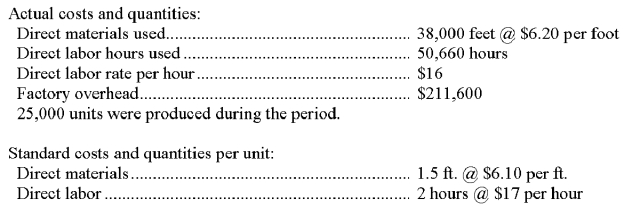
(86) The following information comes from the records of Dina Co. for the current period.
a. Compute the direct materials price and quantity variances, direct labor rate and efficiency variances and state whether the variance is favorable or unfavorable.
b. Prepare the journal entries to charge direct materials and direct labor costs to goods in process and the materials and labor variances to their proper accounts.
Factory overhead (based on budgeted production of 24,500 units)
Variable overhead $2.25/direct labor hour
Fixed overhead $1.95/direct labor hour
(Essay)
4.9/5 (72)
(72) Cabot Company collected the following data regarding production of one of its products. Compute the variable overhead cost variance.
(Multiple Choice)
4.9/5 (99)
(99) Cheshire, Inc. allocates fixed overhead at a rate of $18 per direct labor hour. This amount is based on 90% of capacity or 3,600 direct labor hours for 6,000 units. During May, Cheshire produced 5,500 units. Budgeted fixed overhead is $66,000, and overhead incurred was $67,000.
Required:
Determine the volume variance for May.
(Essay)
4.8/5 (81)
(81) Jacques Company planned to use 18,000 pounds of material costing $2.50 per pound to make 4,000 units of its product. In actually making 4,000 units, the company used 18,800 pounds that cost $2.54 per pound. Calculate the direct materials quantity variance.
(Essay)
4.8/5 (91)
(91) In preparing flexible budgets, the costs that remain constant in total are _______________ costs. Those costs that change in total are _______________ costs.
(Essay)
4.7/5 (70)
(70) Adams, Inc. uses the following standard to produce a single unit of its product: overhead (2 hrs. @ $3/hr.) $6. The flexible budget for overhead is $100,000 plus $1 per direct labor hour. Actual data for the month show overhead costs of $150,000, and 24,000 units produced. The overhead volume variance is:
(Multiple Choice)
4.7/5 (78)
(78) Standard costs provide a basis for assessing the reasonableness of actual costs incurred for producing a product or service.
(True/False)
4.9/5 (78)
(78) Quantity variances for direct cost categories (direct materials and direct labor) are based on differences between the actual inputs used and the standard inputs allowed for the actual output achieved. A key difference in the analysis of quantity variances for direct cost categories and the analysis of the efficiency variance for variable overhead is:
(Multiple Choice)
4.9/5 (80)
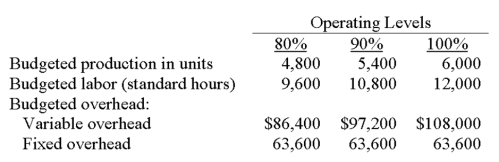
(80) Selected information from Michaels Company's flexible budget is presented below:
Michaels Company applies overhead to production at a rate of $31.25 per unit based on a normal operating level of 80% of capacity. For the current period, Michaels Company produced 5,400 units and incurred $62,000 of fixed overhead costs and $96,000 of variable overhead costs. The company used 11,000 labor hours to produce the 5,400 units. Calculate the variable overhead spending and efficiency variances, and the fixed overhead spending and volume variances. Indicate whether each variance is favorable or unfavorable.
Variable overhead
(Essay)
4.8/5 (70)
(70) 
Filters
- Essay(0)
- Multiple Choice(0)
- Short Answer(0)
- True False(0)
- Matching(0)