



 Chat with AI
Exam 25: Capital Budgeting and Managerial Decisions

Exam 1: Accounting in Business245 Questions
Exam 2: Analyzing and Recording Transactions201 Questions
Exam 3: Adjusting Accounts and Preparing Financial Statements227 Questions
Exam 4: Completing the Accounting Cycle177 Questions
Exam 5: Accounting for Merchandising Operations189 Questions
Exam 6: Inventories and Cost of Sales194 Questions
Exam 7: Accounting Information Systems166 Questions
Exam 8: Cash and Internal Controls195 Questions
Exam 9: Accounting for Receivables162 Questions
Exam 10: Long-Term Assets208 Questions
Exam 11: Current Liabilities and Payroll Accounting178 Questions
Exam 12: Accounting for Partnerships141 Questions
Exam 13: Accounting for Corporations210 Questions
Exam 14: Long-Term Liabilities158 Questions
Exam 15: Investments and International Operations156 Questions
Exam 16: Statement of Cash Flows173 Questions
Exam 17: Analysis of Financial Statements182 Questions
Exam 18: Managerial Accounting Concepts and Principles199 Questions
Exam 19: Job Order Cost Accounting165 Questions
Exam 20: Process Cost Accounting172 Questions
Exam 21: Cost Allocation and Performance Measurement173 Questions
Exam 22: Cost-Volume-Profit Analysis190 Questions
Exam 23: Master Budgets and Planning166 Questions
Exam 24: Flexible Budgets and Standard Costs178 Questions
Exam 25: Capital Budgeting and Managerial Decisions153 Questions
Select questions type


Parker Plumbing has received a special one-time order for 1,500 faucets (units) at $5 per unit. Parker currently produces and sells 7,500 units at $6.00 each. This level represents 75% of its capacity. Production costs for these units are $4.50 per unit, which includes $3.00 variable cost and $1.50 fixed cost. To produce the special order, a new machine needs to be purchased at a cost of $1,000 with a zero salvage value. Management expects no other changes in costs as a result of the additional production. Should the company accept the special order?
(Multiple Choice)
4.9/5  (82)
(82) Beyer Corporation is considering buying a machine for $25,000. Its estimated useful life is 5 years, with no salvage value. Beyer anticipates annual net income after taxes of $1,500 from the new machine. What is the accounting rate of return assuming that Beyer uses straight-line depreciation and that income is earned uniformly throughout each year?
(Multiple Choice)
4.9/5 (66)
(66) A company manufactures two products. Each unit of product X requires 10 machine hours and each unit of product Y requires 4 machine hours. The company's productive capacity is limited to 180,000 machine hours. Each unit of product X sells for $15 and has variable costs of $7. Each unit of product Y sells for $8 and has variable costs of $3. If the company can sell all that it produces of both products, what should the sales mix be?
(Essay)
4.9/5 (80)
(80) A company can buy a machine that is expected to have a three-year life and a $30,000 salvage value. The machine will cost $1,800,000 and is expected to produce a $200,000 after-tax net income to be received at the end of each year. If a table of present values of 1 at 12% shows values of 0.8929 for one year, 0.7972 for two years, and 0.7118 for three years, what is the net present value of the cash flows from the investment, discounted at 12%?
(Essay)
4.8/5 (86)
(86) Neither the payback period nor the accounting rate of return methods of evaluating investments considers the time value of money.
(True/False)
4.7/5 (70)
(70) Coffer Co. is analyzing two projects for the future. Assume that only one project can be selected. If the company is using the payback period method and it requires a payback of three years or less, which project should be selected?
(Multiple Choice)
4.9/5 (70)
(70) A disadvantage of using the payback period to compare investment alternatives is that:
(Multiple Choice)
4.8/5 (77)
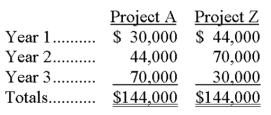
(77) A company is considering two alternative investment opportunities, each of which requires an initial cash outlay of $110,000. The expected net cash flows from the two projects follow:
Required:
(1) Based on a comparison of their net present values, and assuming the same discount rate (greater than zero) is required for both projects, which project is the better investment? (Check one answer.)
________________ Project A
________________ Project Z
________________ The projects are equally desirable
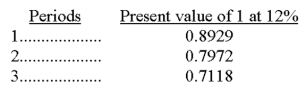
(2) Use the table values below to find the net present value of the cash flows associated with Project A, discounted at 12%:
(Essay)
4.7/5 (74)
(74) The time value of money is considered when calculating the payback period of an investment.
(True/False)
4.7/5 (77)
(77) The _______________________________ is computed by discounting the future net cash flows from the investment at the project's required rate of return and then subtracting the initial amount invested.
(Essay)
4.8/5 (85)
(85) Which one of the following methods considers the time value of money in evaluating alternative capital expenditures?
(Multiple Choice)
4.8/5 (84)
(84) 
Filters
- Essay(0)
- Multiple Choice(0)
- Short Answer(0)
- True False(0)
- Matching(0)