



 Chat with AI
Exam 25: Capital Budgeting and Managerial Decisions

Exam 1: Accounting in Business245 Questions
Exam 2: Analyzing and Recording Transactions201 Questions
Exam 3: Adjusting Accounts and Preparing Financial Statements227 Questions
Exam 4: Completing the Accounting Cycle177 Questions
Exam 5: Accounting for Merchandising Operations189 Questions
Exam 6: Inventories and Cost of Sales194 Questions
Exam 7: Accounting Information Systems166 Questions
Exam 8: Cash and Internal Controls195 Questions
Exam 9: Accounting for Receivables162 Questions
Exam 10: Long-Term Assets208 Questions
Exam 11: Current Liabilities and Payroll Accounting178 Questions
Exam 12: Accounting for Partnerships141 Questions
Exam 13: Accounting for Corporations210 Questions
Exam 14: Long-Term Liabilities158 Questions
Exam 15: Investments and International Operations156 Questions
Exam 16: Statement of Cash Flows173 Questions
Exam 17: Analysis of Financial Statements182 Questions
Exam 18: Managerial Accounting Concepts and Principles199 Questions
Exam 19: Job Order Cost Accounting165 Questions
Exam 20: Process Cost Accounting172 Questions
Exam 21: Cost Allocation and Performance Measurement173 Questions
Exam 22: Cost-Volume-Profit Analysis190 Questions
Exam 23: Master Budgets and Planning166 Questions
Exam 24: Flexible Budgets and Standard Costs178 Questions
Exam 25: Capital Budgeting and Managerial Decisions153 Questions
Select questions type


A minimum acceptable rate of return for an investment decision is called the:
(Multiple Choice)
4.8/5  (91)
(91) If the internal rate of return (IRR) of an investment is below the hurdle rate, the project should be accepted.
(True/False)
4.8/5 (73)
(73) A company is evaluating the purchase of a machine for $900,000 with a six-year useful life and no salvage value. The company uses straight-line depreciation and it assumes that the annual net cash flow from using the machine will be received uniformly throughout each year. In calculating the accounting rate of return, what is the company's average investment?
(Short Answer)
4.9/5 (82)
(82) What is capital budgeting? Why are capital budgeting decisions often difficult and risky?
(Essay)
4.9/5 (70)
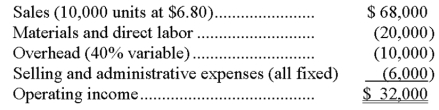
(70) Fleming Company had the following results of operations for the past year:
A foreign company (whose sales will not affect Fleming's regular sales) offers to buy 2,000 units at $5.00 per unit. In addition to variable manufacturing costs, there would be shipping costs of $1,200 in total on these units. Should Fleming take this order? Explain.
(Essay)
4.9/5 (83)
(83) When making capital budgeting decisions, companies usually prefer shorter payback periods. Explain why shorter payback periods are desirable.
(Essay)
4.9/5 (88)
(88) Incremental costs should be considered in a make or buy decision.
(True/False)
4.9/5 (66)
(66) Two investments with exactly the same payback periods are always equally valuable to an investor.
(True/False)
4.8/5 (94)
(94) A company purchases a machine for $1,000,000. The machine has an expected life of 9 years and no salvage value. The company anticipates a yearly net income of $60,000 after taxes of 30% to be received uniformly throughout each year. What is the accounting rate of return?
(Short Answer)
4.9/5 (69)
(69) How does the calculation of break-even time (BET) differ from the calculation of payback period (PBP)?
(Essay)
4.8/5 (82)
(82) Capital budgeting is the process of analyzing alternative long-term investments and deciding which assets to acquire or sell.
(True/False)
4.9/5 (85)
(85) After-tax net income divided by the annual average investment in an investment, is the:
(Multiple Choice)
4.8/5 (90)
(90) An out-of-pocket cost requires a current and/or future outlay of cash.
(True/False)
4.9/5 (87)
(87) Capital budgeting decisions are risky because the outcome is uncertain, large amounts are usually involved, the investment involves a long-term commitment, and the decision could be difficult or impossible to reverse.
(True/False)
4.9/5 (89)
(89) In evaluating capital budgeting alternatives, there are two primary methods that do not consider the time value of money. These methods are _______________ and _________________. There are also two primary methods that consider the time value of money; these are ___________________ and ______________________.
(Essay)
4.9/5 (84)
(84) A machine costs $180,000 and is expected to yield an after-tax net income of $10,800 each year. Management estimates the machine will have a ten-year life, a $20,000 salvage value, and straight-line depreciation is used. Compute the accounting rate of return for the investment.
(Multiple Choice)
4.8/5 (87)
(87) Relevant benefits refer to the additional or incremental revenue generated by selecting a particular course or action over another.
(True/False)
4.8/5 (77)
(77) 
Filters
- Essay(0)
- Multiple Choice(0)
- Short Answer(0)
- True False(0)
- Matching(0)