



 Chat with AI
Exam 8: Life Histories

Exam 1: Introduction: Ecology, Evolution, and the Scientific Method60 Questions
Exam 2: Adaptations to Aquatic Environments60 Questions
Exam 3: Adaptations to Terrestrial Environments60 Questions
Exam 4: Adaptations to Variable Environments59 Questions
Exam 5: Climates and Soils60 Questions
Exam 6: Terrestrial and Aquatic Biomes58 Questions
Exam 7: Evolution and Adaptation60 Questions
Exam 8: Life Histories59 Questions
Exam 9: Reproductive Strategies65 Questions
Exam 10: Social Behaviours62 Questions
Exam 11: Population Distributions59 Questions
Exam 12: Population Growth and Regulation61 Questions
Exam 13: Population Dynamics Over Space and Time60 Questions
Exam 14: Predation and Herbivory56 Questions
Exam 15: Parasitism and Infectious Diseases61 Questions
Exam 16: Competition60 Questions
Exam 18: Community Structure56 Questions
Exam 19: Community Succession108 Questions
Exam 20: Movement of Energy in Ecosystems58 Questions
Exam 21: Movement of Elements in Ecosystems60 Questions
Exam 22: Landscape Ecology, Biogeography, and Global Biodiversity58 Questions
Exam 23: Global Conservation of Biodiversity60 Questions
Select questions type


Which of the following is NOT a potential benefit of increased resource availability?
(Multiple Choice)
4.9/5  (78)
(78) Red foxes mature after their first year of life and may live for 5 to 10 years. Foxes often reproduce many times over their life. The term to describe this aspect of their life history is
(Multiple Choice)
4.8/5 (71)
(71) Explain the main life history trait that differentiates ruderals and stress-tolerant plants.
(Essay)
4.7/5 (75)
(75) Topic: combinations of life history traits in plants
Difficulty: medium
Consider a species with a fast potential growth rate, reproduction at a relatively early age, allocation of a small proportion of net production to seeds, and reliance on vegetative spread. According to Grime's classification of life history traits, this species fits the profile of a
(Multiple Choice)
4.9/5 (82)
(82) Topic: senescence
Difficulty: medium
Across a wide range of bird and mammal species, the rate of aging
(Multiple Choice)
4.7/5 (83)
(83) For seed-producing trees, what conditions might favour production of few relatively large seeds? What conditions might favour production of many relatively small seeds?
(Essay)
4.9/5 (77)
(77) Use this figure to answer questions 21 to 23.
 -Which variable has the smallest proportional difference among the low and high levels of predation risk?
 (Multiple Choice)
4.9/5 (63)
(63) Use this figure to answer questions 21 to 23.
-Which variable best summarizes the response to increased predation mortality for adults and suggests that putting more energy into reproduction provides an improved fitness benefit?
-Which variable best summarizes the response to increased predation mortality for adults and suggests that putting more energy into reproduction provides an improved fitness benefit? (Multiple Choice)
4.7/5 (77)
(77) What environmental factor would likely lead to later maturation with an iteroparous reproductive strategy?
(Multiple Choice)
4.9/5 (87)
(87) How would fecundity and age at maturity be influenced by adult and juvenile survival rates?
(Essay)
4.9/5 (88)
(88) A gradual increase in fecundity and increase in the probability of mortality is known as
(Multiple Choice)
4.9/5 (91)
(91) The number of chicks fledged in a brood may not be independent of the number of eggs produced. How might researchers test these variables independently to determine whether there is a relationship between them?
(Essay)
4.9/5 (82)
(82) When adults have a high probability of survival from one year to the next and offspring survival is relatively poor, the best strategy for an adult to maximize fitness is to
(Multiple Choice)
4.9/5 (91)
(91) 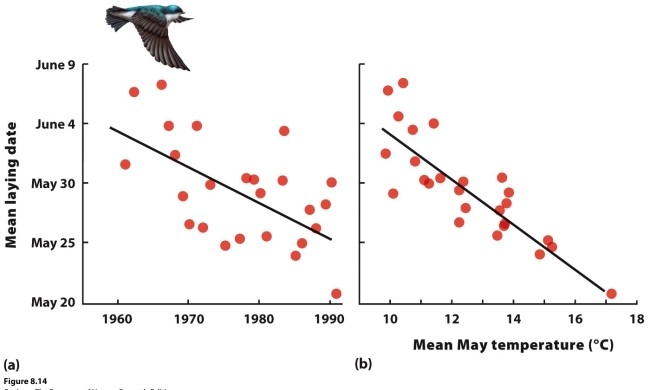 -Explain the relationship between the two plotted variables in Figure 8.14b. How can egg development and laying occur prior to the end of May if there is a relation between the mean date of laying and average temperatures for May?
 (Essay)
4.7/5 (83)
(83) Many life history events are matched to seasonal changes in environmental conditions, such as the onset of winter. Explain why photoperiod is a more reliable seasonal indicator for plants than air temperature.
(Essay)
4.9/5 (75)
(75) Compare the relative influence of determinate and indeterminate growth patterns on natural selection for adult size.
(Essay)
4.9/5 (76)
(76) How does having a large number of offspring affect a parent's fitness for subsequent breeding seasons?
(Multiple Choice)
4.8/5 (81)
(81) 
Filters
- Essay(0)
- Multiple Choice(0)
- Short Answer(0)
- True False(0)
- Matching(0)