



 Chat with AI
Exam 8: Life Histories

Exam 1: Introduction: Ecology, Evolution, and the Scientific Method60 Questions
Exam 2: Adaptations to Aquatic Environments60 Questions
Exam 3: Adaptations to Terrestrial Environments60 Questions
Exam 4: Adaptations to Variable Environments59 Questions
Exam 5: Climates and Soils60 Questions
Exam 6: Terrestrial and Aquatic Biomes58 Questions
Exam 7: Evolution and Adaptation60 Questions
Exam 8: Life Histories59 Questions
Exam 9: Reproductive Strategies65 Questions
Exam 10: Social Behaviours62 Questions
Exam 11: Population Distributions59 Questions
Exam 12: Population Growth and Regulation61 Questions
Exam 13: Population Dynamics Over Space and Time60 Questions
Exam 14: Predation and Herbivory56 Questions
Exam 15: Parasitism and Infectious Diseases61 Questions
Exam 16: Competition60 Questions
Exam 18: Community Structure56 Questions
Exam 19: Community Succession108 Questions
Exam 20: Movement of Energy in Ecosystems58 Questions
Exam 21: Movement of Elements in Ecosystems60 Questions
Exam 22: Landscape Ecology, Biogeography, and Global Biodiversity58 Questions
Exam 23: Global Conservation of Biodiversity60 Questions
Select questions type


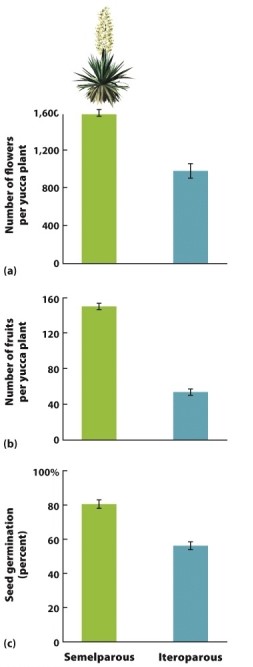 -Yucca plants are mostly iteroparous, but some can be semelparous. Based on the information in Figure 8.9, semelparous yuccas have a higher percentage of seed germination, which suggests high fitness. Why, then, are most yucca varieties iteroparous?
 (Essay)
4.7/5  (89)
(89) What type of reproduction will be favoured if adult plant survival is low because of a disturbance such as fire?
(Multiple Choice)
4.8/5 (77)
(77) Topic: semelparity and iteroparity
Difficulty: medium
A mature female sockeye salmon swims up to 5000 km from her Pacific Ocean feeding ground to the mouth of a coastal river in British Columbia and then another 1000 km upstream to her spawning ground. Once there, she lays thousands of eggs in her single reproductive event and promptly dies. The salmon's reproductive life history is
(Multiple Choice)
4.9/5 (78)
(78) Topic: senescence
Difficulty: medium
In human females the increased prevalence of birth defects in offspring and of infertility after 30 years of age is known as
(Multiple Choice)
4.8/5 (87)
(87) Use this figure to answer questions 27 and 28.
 -Use the information in the figure to explain whether the fitness of the parent increases with more eggs produced and why.
 (Essay)
4.9/5 (75)
(75) We might expect natural selection to favour organisms that produce more offspring. Why is this not the case for species with a high degree of parental care?
(Essay)
4.8/5 (79)
(79) Explain how human fishing for larger individuals from a population of fish can reduce the average maturation time in the population.
(Essay)
4.9/5 (74)
(74) Topic: growth versus age of sexual maturity and life span
Difficulty: medium
For birds, age at maturity
(Multiple Choice)
4.8/5 (83)
(83) Would human removal of large fish from a population influence both the age of maturation in the population and the proportion of energy dedicated to reproduction? Explain your answer.
(Essay)
4.9/5 (86)
(86) Topic: combinations of life history traits in plants
Difficulty: medium
Consider a species with a slow potential growth rate, reproduction at a relatively late age, allocation of a small proportion of net production to seeds, and reliance on vegetative spread. According to Grime's classification of life history traits, this species fits the profile of a:
(Multiple Choice)
4.8/5 (84)
(84) Grime proposed that combinations of life history traits in plants are mainly determined by three factors. Which is NOT one of these factors?
(Multiple Choice)
4.8/5 (60)
(60) Which life history trait is most likely to be fixed for a species?
(Multiple Choice)
4.8/5 (78)
(78) Which plant life history type, fast or slow, would best describe a weed species that is a good invader of new habitats?
(Essay)
4.9/5 (84)
(84) Topic: the effects of resources
Difficulty: easy
Many animals undergo a dramatic metamorphosis from larval to adult form. Poorly nourished animals cannot grow as fast as well-nourished animals and therefore do not reach a given mass as quickly as their well-nourished counterparts. If metamorphosis occurs when a specific minimum body mass is reached, which of the following costs is most likely incurred by a poorly nourished animal?
(Multiple Choice)
4.8/5 (74)
(74) Size limits for fish catches typically refer to the minimum size of individuals that can be harvested and retained. How might size limits affect the spawning strategy of a fish population compared with no size limits, assuming the fish captured are representative of the size distribution of the population?
(Essay)
4.8/5 (87)
(87) Topic: senescence
Difficulty: medium
If maintaining high survival and reproduction would increase an individual's fitness at any age, what is the most likely reason these traits decline with age in humans?
(Multiple Choice)
4.7/5 (81)
(81) Which of the following does NOT apply to determinate growth?
(Multiple Choice)
4.7/5 (71)
(71) 
Filters
- Essay(0)
- Multiple Choice(0)
- Short Answer(0)
- True False(0)
- Matching(0)