



 Chat with AI
Exam 14: Predation and Herbivory

Exam 1: Introduction: Ecology, Evolution, and the Scientific Method60 Questions
Exam 2: Adaptations to Aquatic Environments60 Questions
Exam 3: Adaptations to Terrestrial Environments60 Questions
Exam 4: Adaptations to Variable Environments59 Questions
Exam 5: Climates and Soils60 Questions
Exam 6: Terrestrial and Aquatic Biomes58 Questions
Exam 7: Evolution and Adaptation60 Questions
Exam 8: Life Histories59 Questions
Exam 9: Reproductive Strategies65 Questions
Exam 10: Social Behaviours62 Questions
Exam 11: Population Distributions59 Questions
Exam 12: Population Growth and Regulation61 Questions
Exam 13: Population Dynamics Over Space and Time60 Questions
Exam 14: Predation and Herbivory56 Questions
Exam 15: Parasitism and Infectious Diseases61 Questions
Exam 16: Competition60 Questions
Exam 18: Community Structure56 Questions
Exam 19: Community Succession108 Questions
Exam 20: Movement of Energy in Ecosystems58 Questions
Exam 21: Movement of Elements in Ecosystems60 Questions
Exam 22: Landscape Ecology, Biogeography, and Global Biodiversity58 Questions
Exam 23: Global Conservation of Biodiversity60 Questions
Select questions type


Many organisms that employ chemical defences also display

Free
(Multiple Choice)
4.8/5  (82)
(82) Correct Answer: Verified
B
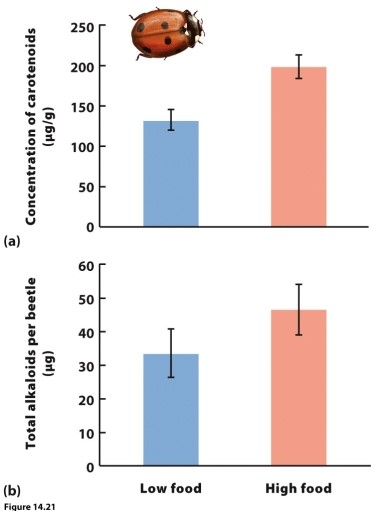 Ladybugs (Coccinella septempunctata) produce bad-tasting alkaloids as a chemical defence against predators. Researchers wanted to determine the costs of this chemical defence. They fed ladybugs either small or large amounts of food and measured alkaloid production and concentrations of carotenoids in the ladybug bodies. Carotenoids are the chemicals responsible for the red colour of the ladybug, which advertises its unpalatability to predators. What do the results of this experiment, shown in the figure, indicate about costs of chemical defences?
Free
(Essay)
5.0/5 (81)
(81) Correct Answer:Verified
VerifiedLadybugs fed large amounts of food produced more alkaloids and had more carotenoids in their bodies. These ladybugs were better able to advertise their unpalatability to predators through aposematism. These results indicated that chemical defences are energetically expensive for ladybugs to maintain.
On Macquarie Island invasive rabbits were causing declines in palatable vegetation, and feral cats were preying on native birds. What was the primary result when a flea carrying a virus that killed the rabbits decreased rabbits' numbers on the island?
Free
(Multiple Choice)
4.7/5 (74)
(74) Correct Answer:Verified
VerifiedA
The bombardier beetle (Stenaptinus insignis) deters predators by releasing boiling hot fluid from its abdomen. This is an example of
(Multiple Choice)
4.9/5 (83)
(83) In the study of brown anole lizards (Anolis sagrei) and orb-weaving spiders (Metepeira datona) on islands in the Bahamas, researchers concluded that
(Multiple Choice)
4.9/5 (89)
(89) Reductions in bay scallops in the Atlantic Ocean were caused by
(Multiple Choice)
4.9/5 (82)
(82) Milkweeds use _____ as a chemical defence against herbivory.
(Multiple Choice)
4.8/5 (85)
(85) How does the removal of top predators affect mesopredator populations?
(Multiple Choice)
4.8/5 (89)
(89) A functional response in predator-prey cycles is the relation between the density of
(Multiple Choice)
4.8/5 (89)
(89) Which of the following chemical defences makes plants difficult for herbivores to digest?
(Multiple Choice)
4.9/5 (81)
(81) Which of the following is NOT a behavioural defence against predation?
(Multiple Choice)
5.0/5 (82)
(82) In Lotka-Volterra models of predator-prey interactions, the growth rate of the prey population is represented by
(Multiple Choice)
4.8/5 (79)
(79) In Lotka-Volterra models of predator-prey interactions, the growth rate of the predator population is represented by
(Multiple Choice)
4.8/5 (71)
(71) The common wasp (Vespula vulgaris), the hover fly (Helophilus pendulus), and the hornet clearwing (Sesia apiformis) all exhibit similar colour patterns, but only the wasp is harmful. What benefit, if any, do the hornet and fly gain from having colouring similar to that of the wasp?
(Essay)
5.0/5 (86)
(86) The resemblance of poison dart frog species of the genus Ranitomeya to one another in Peru is an example of
(Multiple Choice)
4.9/5 (85)
(85) A numerical response is a change in the number of predators due all of the following EXCEPT
(Multiple Choice)
4.9/5 (77)
(77) Huffaker's laboratory experiment of predator and prey species of mites demonstrated that predator and prey cycles
(Multiple Choice)
4.9/5 (77)
(77) 
Filters
- Essay(0)
- Multiple Choice(0)
- Short Answer(0)
- True False(0)
- Matching(0)