



 Chat with AI
Exam 14: Predation and Herbivory

Exam 1: Introduction: Ecology, Evolution, and the Scientific Method60 Questions
Exam 2: Adaptations to Aquatic Environments60 Questions
Exam 3: Adaptations to Terrestrial Environments60 Questions
Exam 4: Adaptations to Variable Environments59 Questions
Exam 5: Climates and Soils60 Questions
Exam 6: Terrestrial and Aquatic Biomes58 Questions
Exam 7: Evolution and Adaptation60 Questions
Exam 8: Life Histories59 Questions
Exam 9: Reproductive Strategies65 Questions
Exam 10: Social Behaviours62 Questions
Exam 11: Population Distributions59 Questions
Exam 12: Population Growth and Regulation61 Questions
Exam 13: Population Dynamics Over Space and Time60 Questions
Exam 14: Predation and Herbivory56 Questions
Exam 15: Parasitism and Infectious Diseases61 Questions
Exam 16: Competition60 Questions
Exam 18: Community Structure56 Questions
Exam 19: Community Succession108 Questions
Exam 20: Movement of Energy in Ecosystems58 Questions
Exam 21: Movement of Elements in Ecosystems60 Questions
Exam 22: Landscape Ecology, Biogeography, and Global Biodiversity58 Questions
Exam 23: Global Conservation of Biodiversity60 Questions
Select questions type


The crucian carp (Carassius carassius) develops a muscular hump on its back that increases its acceleration in response to predators. This is an example of
(Multiple Choice)
4.9/5  (77)
(77) The Indian grey mongoose (Herpestes edwardsii) is a small mammal that is known for its ability to kill venomous king cobras (Ophiophagus hannah). Mongooses have evolved acetylcholine receptors that make them resistant or immune to the cobra's venom. What is likely responsible for this?
(Multiple Choice)
4.9/5 (82)
(82) What is the driving force in the 10-year cycle of lynx and hare abundance?
(Multiple Choice)
5.0/5 (76)
(76) The introduction of the brown tree snake (Boiga irregularis) to Guam decimated the native fauna because
(Multiple Choice)
4.9/5 (79)
(79) Australian authorities removed dingoes and feral dogs because they killed sheep. As a result
(Multiple Choice)
4.8/5 (79)
(79) In Lotka-Volterra models, a population is stable when its rate of change is
(Multiple Choice)
4.9/5 (77)
(77) 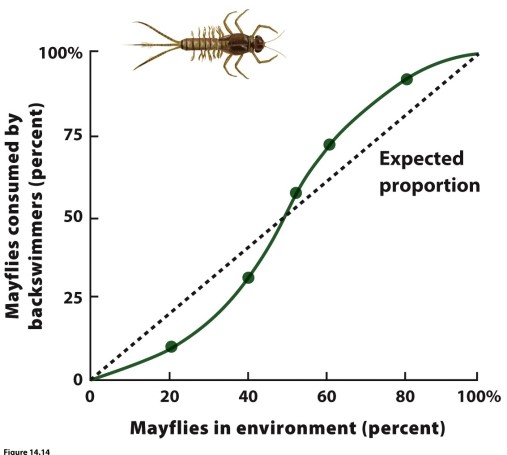 In experiments with the backswimmer (Notonecta glauca), a predatory insect, and two types of prey species, isopods (Asellus aquaticus) and mayflies (Coeon dipterum), predator preference seemed to be affected by the percent of mayflies. What explains the results presented in the figure? What type of functional response is being demonstrated?
 (Essay)
4.8/5 (96)
(96) The viceroy (Limenitis archippus) is an unpalatable North American butterfly that has colouration similar to that of another species of unpalatable butterfly, the monarch (Danaus plexippus). This is an example of
(Multiple Choice)
4.8/5 (78)
(78) How was the invasive plant the Saint-John's-wort controlled in California?
(Multiple Choice)
4.8/5 (78)
(78) 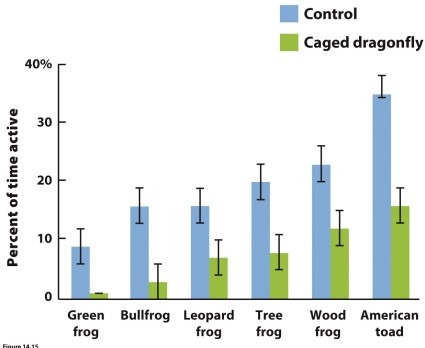 The figure shows results of a study in which scientists observed the responses of tadpoles to a caged predator and an empty control cage in tubs of water. The caged predator emitted a chemical that alerted the tadpoles to its presence but was not able to kill tadpoles. Based on the figure, how did tadpoles respond to the experiment, and what type of defence did they exhibit?
 (Essay)
5.0/5 (77)
(77) In Lotka-Volterra predator-prey models, predator populations decrease when
(Multiple Choice)
4.9/5 (77)
(77) 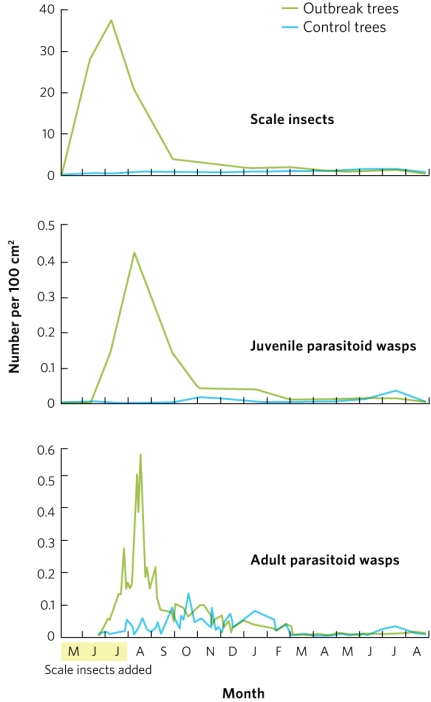 The graphs show the result of experiments involving the crop pest the California red scale insect Aonidiella aurantii and the parasitoid wasp Aphytis melinus. What did the results show about the populations of wasps and scale insects on control and outbreak trees? Is the parasitoid wasp a good biocontrol candidate for reducing scale insects?
 (Essay)
4.9/5 (92)
(92) Reduced growth and development due to reduced feeding and foraging activity is a cost of
(Multiple Choice)
4.8/5 (96)
(96) Lotka-Volterra models of predator-prey interactions show that
(Multiple Choice)
4.7/5 (70)
(70) A type _____ functional response occurs when a predator's rate of prey consumption increases linearly with increasing prey and then satiates.
(Multiple Choice)
4.9/5 (82)
(82) Plants that respond to herbivory by increasing their growth rate (compensatory growth) are using
(Multiple Choice)
4.8/5 (86)
(86) Researchers studying production of nicotine in tobacco plants (Nicotiana sylvestris) treated some of the plants with a hormone that prevents the chemical defences from responding to herbivory. What did they find to be the cost of nicotine production?
(Multiple Choice)
4.9/5 (78)
(78) 
Filters
- Essay(0)
- Multiple Choice(0)
- Short Answer(0)
- True False(0)
- Matching(0)