Essay
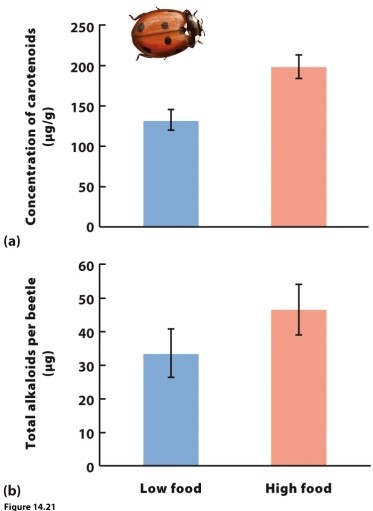
Ladybugs (Coccinella septempunctata) produce bad-tasting alkaloids as a chemical defence against predators. Researchers wanted to determine the costs of this chemical defence. They fed ladybugs either small or large amounts of food and measured alkaloid production and concentrations of carotenoids in the ladybug bodies. Carotenoids are the chemicals responsible for the red colour of the ladybug, which advertises its unpalatability to predators. What do the results of this experiment, shown in the figure, indicate about costs of chemical defences?
Correct Answer:

Verified
Correct Answer:
Verified
Q1: Many organisms that employ chemical defences also
Q4: The bombardier beetle (Stenaptinus insignis) deters predators
Q7: Reductions in bay scallops in the Atlantic
Q8: Milkweeds use _ as a chemical defence
Q10: A functional response in predator-prey cycles is
Q11: Alarm signals in primates are an example
Q14: Which of the following is an example
Q21: On Macquarie Island invasive rabbits were causing
Q57: How does the removal of top predators
Q66: In the study of brown anole lizards