



 Chat with AI
Exam 15: Parasitism and Infectious Diseases

Exam 1: Introduction: Ecology, Evolution, and the Scientific Method60 Questions
Exam 2: Adaptations to Aquatic Environments60 Questions
Exam 3: Adaptations to Terrestrial Environments60 Questions
Exam 4: Adaptations to Variable Environments59 Questions
Exam 5: Climates and Soils60 Questions
Exam 6: Terrestrial and Aquatic Biomes58 Questions
Exam 7: Evolution and Adaptation60 Questions
Exam 8: Life Histories59 Questions
Exam 9: Reproductive Strategies65 Questions
Exam 10: Social Behaviours62 Questions
Exam 11: Population Distributions59 Questions
Exam 12: Population Growth and Regulation61 Questions
Exam 13: Population Dynamics Over Space and Time60 Questions
Exam 14: Predation and Herbivory56 Questions
Exam 15: Parasitism and Infectious Diseases61 Questions
Exam 16: Competition60 Questions
Exam 18: Community Structure56 Questions
Exam 19: Community Succession108 Questions
Exam 20: Movement of Energy in Ecosystems58 Questions
Exam 21: Movement of Elements in Ecosystems60 Questions
Exam 22: Landscape Ecology, Biogeography, and Global Biodiversity58 Questions
Exam 23: Global Conservation of Biodiversity60 Questions
Select questions type


What does the S-I-R model characterize for infectious diseases?
(Multiple Choice)
4.8/5  (62)
(62) Unlike predators, most parasites do not kill their hosts. Why is this beneficial?
(Essay)
5.0/5 (89)
(89) Which of the following is NOT an assumption of the S-I-R model?
(Multiple Choice)
4.8/5 (81)
(81) Which species is a reservoir for Borrelia burgdorferi, the bacterium that causes Lyme disease?
(Multiple Choice)
5.0/5 (79)
(79) Because of its relationship with its host, the ectoparasite has
(Multiple Choice)
4.9/5 (77)
(77) A parasite moving between individuals other than parents and their offspring uses _____ transmission.
(Multiple Choice)
5.0/5 (94)
(94) 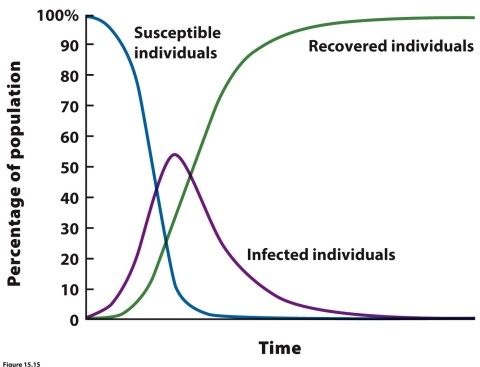 (Figure 15.15) In the figure showing dynamics of an infected population over time, what the curves A, B, and C represent?
 (Essay)
4.9/5 (98)
(98) In S-I-R models of infectious disease transmission, R represents _____ individuals.
(Multiple Choice)
4.9/5 (83)
(83) Which of the following statements is NOT true about the endoparasite life cycle?
(Multiple Choice)
4.9/5 (83)
(83) When parasites require a series of hosts to complete their life cycle, they often evolve adaptations that
(Multiple Choice)
4.9/5 (83)
(83) Organisms that produce antibacterial or antifungal chemicals have developed this ability as the result of
(Multiple Choice)
4.8/5 (86)
(86) Diseases such as HIV and African sleeping sickness can avoid the host's immune system by
(Multiple Choice)
4.8/5 (88)
(88) Which of the following is NOT an example of horizontal transmission through a vector?
(Multiple Choice)
4.8/5 (86)
(86) The amphibian pathogen the chytrid fungus does not fit the S-I-R model because
(Multiple Choice)
5.0/5 (86)
(86) In S-I-R models, which of the following does NOT determine the proportion of S, I, and R individuals in a population?
(Multiple Choice)
4.9/5 (80)
(80) What types of endoparasites replicate by altering their host's proteins and do not contain any nucleic acids?
(Multiple Choice)
4.9/5 (82)
(82) Mice infected with Toxoplasma gondii are often attracted to bobcat urine. This is an example of
(Multiple Choice)
4.9/5 (79)
(79) 
Filters
- Essay(0)
- Multiple Choice(0)
- Short Answer(0)
- True False(0)
- Matching(0)