



 Chat with AI
Exam 15: Parasitism and Infectious Diseases

Exam 1: Introduction: Ecology, Evolution, and the Scientific Method60 Questions
Exam 2: Adaptations to Aquatic Environments60 Questions
Exam 3: Adaptations to Terrestrial Environments60 Questions
Exam 4: Adaptations to Variable Environments59 Questions
Exam 5: Climates and Soils60 Questions
Exam 6: Terrestrial and Aquatic Biomes58 Questions
Exam 7: Evolution and Adaptation60 Questions
Exam 8: Life Histories59 Questions
Exam 9: Reproductive Strategies65 Questions
Exam 10: Social Behaviours62 Questions
Exam 11: Population Distributions59 Questions
Exam 12: Population Growth and Regulation61 Questions
Exam 13: Population Dynamics Over Space and Time60 Questions
Exam 14: Predation and Herbivory56 Questions
Exam 15: Parasitism and Infectious Diseases61 Questions
Exam 16: Competition60 Questions
Exam 18: Community Structure56 Questions
Exam 19: Community Succession108 Questions
Exam 20: Movement of Energy in Ecosystems58 Questions
Exam 21: Movement of Elements in Ecosystems60 Questions
Exam 22: Landscape Ecology, Biogeography, and Global Biodiversity58 Questions
Exam 23: Global Conservation of Biodiversity60 Questions
Select questions type


Reduction in virulence of myxomatosis in rabbits in Australia in the second outbreak was a result of
(Multiple Choice)
4.8/5  (83)
(83) 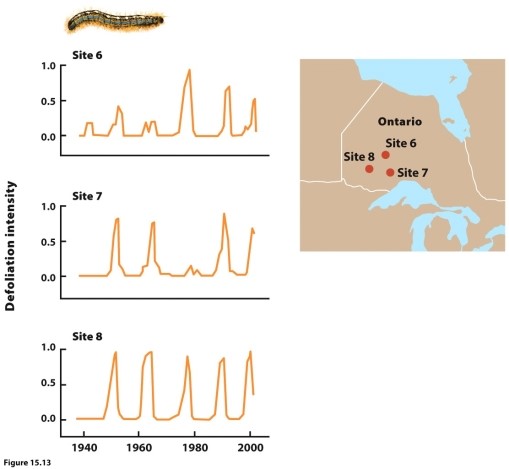 (Figure 15.13) The figure shows population fluctuations in forest tent caterpillars over a 60-year period. The caterpillars were susceptible to a viral infection throughout this time. What causes the 10- to 15-year population fluctuation in the caterpillars?
 (Essay)
5.0/5 (86)
(86) Two populations with sample sizes of 25 and 27 are compared with a t-test. What is the value for the degrees of freedom?
(Multiple Choice)
4.7/5 (95)
(95) In S-I-R models of infectious disease transmission, I represents _____ individuals.
(Multiple Choice)
4.8/5 (85)
(85) Parasites generally have _____ reproductive rates than their hosts and often _____ them.
(Multiple Choice)
5.0/5 (82)
(82) Which of the following characterizes the rate of recovery of infected individuals in an S-I-R model?
(Multiple Choice)
4.8/5 (75)
(75) Endoparasitic roundworms and flatworms that live in the tissues of plants and animals are called
(Multiple Choice)
4.8/5 (83)
(83) When a new disease is discovered, it is called an _____ disease.
(Multiple Choice)
4.8/5 (58)
(58) Describe two ways a parasite can decrease the likelihood that it will run out of potential hosts.
(Essay)
4.8/5 (84)
(84) Why does the parasitic flatworm (Leucochloridium paradoxum) of the amber snail (Succinea putris) alter the behaviour of the snail so that it moves to the top of a plant stem?
(Multiple Choice)
4.7/5 (83)
(83) While you are conducting a study of the optimal growing conditions for commercially grown sunflowers, all of the sunflower plants in the field you are studying die. You discover that an emerging fungal pathogen kills sunflowers by destroying their roots. The fungus uses honeybees, which pollinate your flowers, as a vector to transmit fungal spores among sunflower plants. The next year the farm reseeds, hoping that the fungus has died over the winter. Early in the growing season some plants begin dying again, but then the honeybee population develops colony collapse disorder and all of the honeybees die. To compensate for the loss in pollinators, the farmers introduce large numbers of bumblebees. The number of new sunflower plants that become infected during the remainder of the growing season drops to near zero. Using the variables in the susceptible-infected-resistant (S-I-R) model equation: R0 = (S × I × g) ÷ (I × b), explain what has happened to alter the disease dynamics in the second year of your study and how this has occurred.
(Essay)
4.9/5 (79)
(79) In S-I-R models, which of the following represents the probability of contact between susceptible and infected individuals?
(Multiple Choice)
4.9/5 (92)
(92) In S-I-R models, which of the following models the ratio of new infections to recoveries?
(Multiple Choice)
5.0/5 (82)
(82) The World Health Organization estimates that _____ of human deaths are caused by infectious diseases.
(Multiple Choice)
4.9/5 (80)
(80) Endoparasites (such as tapeworms) seem to lead an ideal life in the interior of the host, protected from natural enemies and the external environment while having a continual supply of nutrients. What are challenges that endoparasites face?
(Essay)
4.9/5 (83)
(83) 
Filters
- Essay(0)
- Multiple Choice(0)
- Short Answer(0)
- True False(0)
- Matching(0)