



 Chat with AI
Exam 19: Community Succession

Exam 1: Introduction: Ecology, Evolution, and the Scientific Method60 Questions
Exam 2: Adaptations to Aquatic Environments60 Questions
Exam 3: Adaptations to Terrestrial Environments60 Questions
Exam 4: Adaptations to Variable Environments59 Questions
Exam 5: Climates and Soils60 Questions
Exam 6: Terrestrial and Aquatic Biomes58 Questions
Exam 7: Evolution and Adaptation60 Questions
Exam 8: Life Histories59 Questions
Exam 9: Reproductive Strategies65 Questions
Exam 10: Social Behaviours62 Questions
Exam 11: Population Distributions59 Questions
Exam 12: Population Growth and Regulation61 Questions
Exam 13: Population Dynamics Over Space and Time60 Questions
Exam 14: Predation and Herbivory56 Questions
Exam 15: Parasitism and Infectious Diseases61 Questions
Exam 16: Competition60 Questions
Exam 18: Community Structure56 Questions
Exam 19: Community Succession108 Questions
Exam 20: Movement of Energy in Ecosystems58 Questions
Exam 21: Movement of Elements in Ecosystems60 Questions
Exam 22: Landscape Ecology, Biogeography, and Global Biodiversity58 Questions
Exam 23: Global Conservation of Biodiversity60 Questions
Select questions type


Plants _____ should be used for initial seeding of abandoned strip mines.
(Multiple Choice)
4.9/5  (81)
(81) Why are there no spruces in the early seral stages of succession at Glacier Bay?
(Multiple Choice)
4.7/5 (90)
(90) Why might direct observation of succession be easier in intertidal communities than in terrestrial communities?
(Multiple Choice)
4.9/5 (74)
(74) Why must oxygen concentrations remain at low levels for pond succession to occur?
(Multiple Choice)
5.0/5 (84)
(84) When seeds of early- and late-succession species were raised under low light conditions similar to those found in the understorey of mature forest, researchers found that species with _____ seeds had _____ seedling survivorship in shade.
(Multiple Choice)
4.9/5 (70)
(70) Which mechanism of succession is independent of the presence or absence of other species?
(Multiple Choice)
4.8/5 (71)
(71) 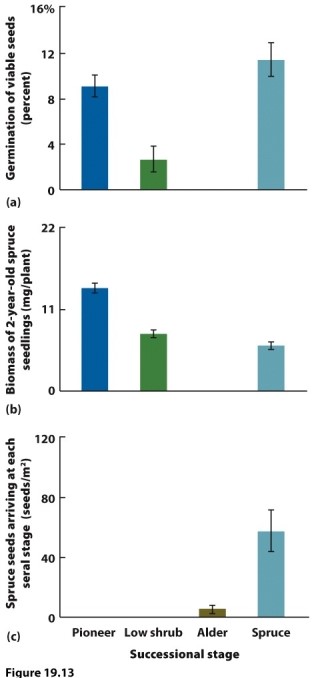 (Figure 19.13) Researchers in Glacier Bay, Alaska, planted Sitka spruce seeds (Picea sitchensis) in four seral stages recovering from deglaciation: pioneer stage (dominated by lichens, mosses and herbs), low-shrub stage (dominated by Dryas drummondii), alder stage (dominated by Alnus sinuate shrubs), and spruce stage (dominated by P. sitchensis). The researchers originally hypothesized that each seral state facilitates species in the subsequent stage. Do the data shown in the figure support their hypothesis? If so, explain. If not, what would explain the results? What type of successions is this area undergoing?
 (Essay)
4.9/5 (71)
(71) Suppose two species of trees are able to colonize an area disturbed by fire. One species typically grows to 5 metres, while the other species tends to stay under 2 metres in height. The two species have seeds of the same shape that are relatively light. Which one is more likely to colonize the disturbed area and why?
(Essay)
4.8/5 (78)
(78) In the Great Basin Desert, many areas are dominated by sagebrush (Artemesia tridentata). Before settlement by Europeans, these areas had a greater diversity of native plants. What might have happened to cause the dominance of sagebrush?
(Essay)
4.8/5 (78)
(78) Why might a forest contain both climax tree species and a few early-succession species?
(Multiple Choice)
4.9/5 (85)
(85) A climax community that is not persistent is called a _____ climax community.
(Multiple Choice)
4.9/5 (82)
(82) Canopy gaps change local forest composition primarily by increased
(Multiple Choice)
4.8/5 (76)
(76) Can you tell what plant seral state you are in by looking at the bird species in a given area?
(Multiple Choice)
5.0/5 (72)
(72) Why don't freezing and drying cycles cause primary succession to happen over and over again in vernal pools?
(Essay)
4.8/5 (76)
(76) 
Filters
- Essay(0)
- Multiple Choice(0)
- Short Answer(0)
- True False(0)
- Matching(0)