



 Chat with AI
Exam 15: Unemployment

Exam 1: Ten Principles of Economics438 Questions
Exam 2: Thinking Like an Economist620 Questions
Exam 3: Interdependence and the Gains From Trade527 Questions
Exam 4: The Market Forces of Supply and Demand700 Questions
Exam 5: Elasticity and Its Application598 Questions
Exam 6: Supply, Demand, and Government Policies648 Questions
Exam 7: Consumers, Producers, and the Efficiency of Markets547 Questions
Exam 8: Application: the Costs of Taxation514 Questions
Exam 9: Application: International Trade496 Questions
Exam 10: Measuring a Nations Income522 Questions
Exam 11: Measuring the Cost of Living545 Questions
Exam 12: Production and Growth507 Questions
Exam 13: Saving, Investment, and the Financial System567 Questions
Exam 14: The Basic Tools of Finance513 Questions
Exam 15: Unemployment699 Questions
Exam 16: The Monetary System517 Questions
Exam 17: Money Growth and Inflation487 Questions
Exam 18: Open-Economy Macroeconomics: Basic Concepts522 Questions
Exam 19: A Macroeconomic Theory of the Open Economy484 Questions
Exam 20: Aggregate Demand and Aggregate Supply563 Questions
Exam 21: The Influence of Monetary and Fiscal Policy on Aggregate Demand511 Questions
Exam 22: The Short-Run Trade-Off Between Inflation and Unemployment516 Questions
Exam 23: Six Debates Over Macroeconomic Policy372 Questions
Select questions type


Over the past several decades, the difference between the labor-force participation rates of men and women in the U.S. has
(Multiple Choice)
4.9/5  (74)
(74) The deviation of unemployment from its natural rate is called
(Multiple Choice)
4.9/5 (92)
(92) In June 2009 the Bureau of Labor Statistics reported an adult population of 234.9 million, a labor force of 154 million and employment of 141.6 million. Based on these numbers the unemployment rate was
(Multiple Choice)
4.8/5 (79)
(79) Who is not included in the labor force by the Bureau of Labor Statistics?
(Multiple Choice)
4.8/5 (78)
(78) Every month when the Bureau of Labor Statistics BLS) announces the unemployment rate, it also announces the number of jobs the economy has gained or lost. Where does the BLS get the data about jobs?
(Multiple Choice)
4.8/5 (72)
(72) In the 1940s and 1950s, about one-third of U.S. workers belonged to unions, but today, only about one-fifth of U.S. workers belong to unions.
(True/False)
4.8/5 (76)
(76) Most U.S. workers have wages well above the legal minimum, so minimum-wage laws do not prevent the wage from adjusting to balance supply and demand.
(True/False)
4.9/5 (84)
(84) Table 28-2
Labor Data for Aridia
 -Refer to Table 28-2. The labor-force participation rate of Aridia in 2010 was
 (Multiple Choice)
4.9/5 (92)
(92) Table 28-9
The table below lists the number of people by labor force classification for the country of Shelbyville.
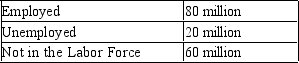 -Refer to Table 28-9. What is the labor force participation rate?
 (Essay)
4.9/5 (65)
(65) A minimum wage that is below the equilibrium wage rate does not raise unemployment.
(True/False)
4.8/5 (93)
(93) Which of the following is not a reason that paying efficiency wages may increase a firm's profit?
(Multiple Choice)
4.9/5 (69)
(69) Within the U.S. population, teenagers ages 16-19) have higher rates of unemployment than adults of prime working age ages 25-54), regardless of race or gender.
(True/False)
4.9/5 (73)
(73) What is the theory of efficiency wages? Provide four reasons that employers might pay efficiency wages.
(Essay)
4.7/5 (76)
(76) People who are unemployed because wages are, for some reason, set above the level that brings labor supply and demand into equilibrium are best classified as
(Multiple Choice)
4.9/5 (62)
(62) 
Filters
- Essay(0)
- Multiple Choice(0)
- Short Answer(0)
- True False(0)
- Matching(0)