



 Chat with AI
Exam 15: Unemployment

Exam 1: Ten Principles of Economics438 Questions
Exam 2: Thinking Like an Economist620 Questions
Exam 3: Interdependence and the Gains From Trade527 Questions
Exam 4: The Market Forces of Supply and Demand700 Questions
Exam 5: Elasticity and Its Application598 Questions
Exam 6: Supply, Demand, and Government Policies648 Questions
Exam 7: Consumers, Producers, and the Efficiency of Markets547 Questions
Exam 8: Application: the Costs of Taxation514 Questions
Exam 9: Application: International Trade496 Questions
Exam 10: Measuring a Nations Income522 Questions
Exam 11: Measuring the Cost of Living545 Questions
Exam 12: Production and Growth507 Questions
Exam 13: Saving, Investment, and the Financial System567 Questions
Exam 14: The Basic Tools of Finance513 Questions
Exam 15: Unemployment699 Questions
Exam 16: The Monetary System517 Questions
Exam 17: Money Growth and Inflation487 Questions
Exam 18: Open-Economy Macroeconomics: Basic Concepts522 Questions
Exam 19: A Macroeconomic Theory of the Open Economy484 Questions
Exam 20: Aggregate Demand and Aggregate Supply563 Questions
Exam 21: The Influence of Monetary and Fiscal Policy on Aggregate Demand511 Questions
Exam 22: The Short-Run Trade-Off Between Inflation and Unemployment516 Questions
Exam 23: Six Debates Over Macroeconomic Policy372 Questions
Select questions type


The Bureau of Labor Statistics' "employed" category includes those who worked as paid employees, worked in their own business, or worked as unpaid workers in a family member's business.
(True/False)
4.9/5  (73)
(73) The natural rate of unemployment i) is the economy's desirable level of unemployment.
Ii) arises from a single problem that has a single solution.
Iii) is the amount of unemployment that does not go away on its own.
(Multiple Choice)
4.9/5 (79)
(79) Minimum-wage laws are one reason there is always some unemployment in the U.S. economy.
(True/False)
4.8/5 (72)
(72) Table 28-4
2010 Labor Data for Adults ages 16 and older) in Meditor
 -Refer to Table 28-4. What is the adult male unemployment rate in Meditor?
 (Multiple Choice)
4.7/5 (85)
(85) Table 28-6
 -Refer to Table 28-6. What is the U-2 measure of labor underutilization?
 (Multiple Choice)
4.7/5 (78)
(78) The Bureau of Labor Statistics reported in 2005 that there were 50.40 million people over age 25 whose highest level of education was some college or an associate degree, 33.86 million of whom were employed and 1.27 million of whom were unemployed. What were the labor-force participation rate and the unemployment rate for this group?
(Multiple Choice)
4.9/5 (96)
(96) The unemployment rate equals the percentage of the adult population that is unemployed.
(True/False)
4.8/5 (70)
(70) When a union bargains successfully with employers, in that industry,
(Multiple Choice)
4.8/5 (77)
(77) Suppose that the adult population is 4 million, the number of unemployed is 0.25 million, and the labor-force participation rate is 75%. What is the unemployment rate?
(Multiple Choice)
4.8/5 (74)
(74) Minimum wage laws help explain the natural rate of unemployment if they create a surplus in any labor market.
(True/False)
4.8/5 (72)
(72) Which of the following is not an explanation for the existence of structural unemployment?
(Multiple Choice)
4.8/5 (87)
(87) The Bureau of Labor Statistics is part of the U.S. Department of
(Multiple Choice)
4.8/5 (76)
(76) Suppose that florists and landscape workers are not unionized. If florists unionize, then the wages of
(Multiple Choice)
4.8/5 (88)
(88) Only paid workers are included in the Bureau of Labor Statistics' "employed" category.
(True/False)
4.8/5 (79)
(79) Figure 28-5 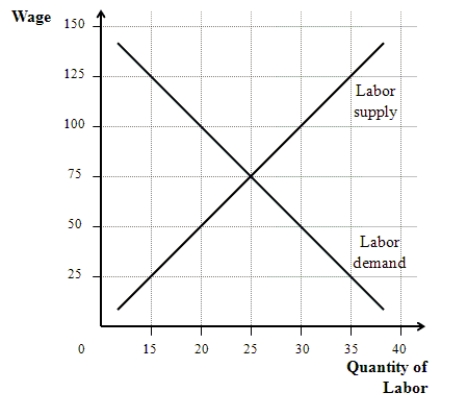 -Refer to Figure 28-5. If the minimum wage is set at $125, then
 (Multiple Choice)
4.8/5 (81)
(81) Adults who are waiting to be recalled to a job from which they had been laid off are counted as "unemployed."
(True/False)
4.9/5 (80)
(80) 
Filters
- Essay(0)
- Multiple Choice(0)
- Short Answer(0)
- True False(0)
- Matching(0)